Vitamin D3: Why It Matters and the Best Supplements to Take
Vitamin D3 explained: why it matters for bones, immunity, and mood, how much to take, and the best D3 supplements to choose from in 2026.


Affiliate disclosure: This article contains affiliate links. As an Amazon Associate we earn from qualifying purchases, at no extra cost to you. Learn more.
◆ The verdict
5 reviewed- 1Our PickSports Research Vitamin D3 5000 IU with Coconut MCT Oil, 360 Liquid SoftgelsCheck price ▸
- 2Best ValueNOW Foods Vitamin D-3 5,000 IU, High Potency, 240 SoftgelsCheck price ▸
- 3Best TestedNature Made Vitamin D3 5000 IU (125 mcg), 360 SoftgelsCheck price ▸
- 4Best Whole-FoodGarden of Life Vitamin D3 5000 IU, Raw Whole Food, 60 Vegetarian CapsulesCheck price ▸
- 5Best VeganSports Research Vitamin D3 + K2 with Coconut Oil, Vegan, 60 SoftgelsCheck price ▸
Vitamin D is sometimes called the "sunshine vitamin," and for good reason. Your skin makes it when sunlight hits it, and your body relies on it for everything from building strong bones to keeping your immune system running smoothly. The catch is that a surprising number of people simply do not get enough. Between indoor jobs, sunscreen, long winters, and diets naturally low in vitamin D, deficiency is common worldwide.
That is where a vitamin D3 supplement comes in. D3 is the form your body produces in response to sunlight, and it tends to be the most practical way to raise your levels when sun and food fall short. But not all supplements are equal, and more is not always better. Doses, forms, added nutrients, and testing vary widely from one bottle to the next.
In this article, we will cover what vitamin D3 does in the body, the signs of deficiency, how much most people need, the difference between D3 and D2, and how to choose a supplement worth your money. Vitamin D is also one of the cornerstones of our complete guide to supplements for healthy aging, since deficiency grows more common with age. We reviewed several well-known D3 products to inform this guide, but the goal is to help you understand the basics. None of this is medical advice or a substitute for your own clinician.
What Vitamin D3 Does in the Body
Vitamin D is best known for its role in bone health, and that reputation is earned. D3 helps your body absorb calcium and phosphorus from food. Without enough of it, you absorb only a fraction of the calcium you consume, which over time can leave bones weaker and more prone to fractures. In children, severe deficiency is linked to rickets, and in adults to a softening of the bones called osteomalacia. For most people, adequate vitamin D helps keep the skeleton strong with age.
Bones are only part of the story. Vitamin D also plays a role in immune function, with receptors appearing on many immune cells. While the evidence on preventing specific infections is still mixed, maintaining healthy levels is widely considered a sensible part of supporting immune health, rather than a guaranteed shield against illness.
There is also growing interest in vitamin D and mood. Some studies have found associations between low levels and low mood or seasonal dips, which makes sense given how levels fall in darker months. The research is far from settled, and vitamin D is not a treatment for depression. Still, keeping your levels in a healthy range is a reasonable, low-risk step that may support how you feel through the winter.
Signs and Risk Factors for Deficiency
Vitamin D deficiency is often quiet. Many people have no obvious symptoms, which is part of what makes it so common. When symptoms do appear, they can be vague: fatigue, muscle weakness, aches in the bones or muscles, and a general sense of running low on energy. Because these overlap with so many other things, deficiency often goes unnoticed until a blood test reveals it.
Certain groups face a higher risk. People who get limited sun exposure, whether from working indoors, living in cloudy climates, or covering their skin, make less vitamin D naturally. Those with darker skin have more melanin, which reduces the skin's ability to produce vitamin D from sunlight, so they may need more sun or supplementation. Older adults are also at greater risk, because aging skin makes vitamin D less efficiently and they may spend less time outdoors.
Geography matters too. People at northern latitudes get weaker sunlight for much of the year, and in winter the sun may be too low to trigger meaningful production at all. Other risk factors include obesity, certain digestive conditions that affect fat absorption, and diets with little fatty fish, egg yolks, or fortified foods. If several of these apply to you, ask your doctor about a blood test rather than guessing.
How Much to Take
General guidance suggests many adults need around 600 IU per day, with older adults often advised to aim for about 800 IU. These are baseline recommendations for the general population, not personalized targets. People who are deficient, or who have specific risk factors, sometimes need more under medical supervision, which is why many over-the-counter supplements come in higher strengths like 1,000, 2,000, or 5,000 IU.
The honest answer to "how much should I take" is that it depends on your starting point, and the only way to know that is a blood test. A simple test measures your blood level of 25-hydroxyvitamin D and tells you whether you are deficient, sufficient, or in between. Testing takes the guesswork out of dosing and helps you avoid both under-treating a deficiency and overshooting into territory you do not need.
This matters because vitamin D is fat-soluble and builds up in the body, so very high doses over time can become harmful (more on that below). The safest approach is a sensible dose, a retest after a few months if you are correcting a deficiency, and clinician guidance for higher amounts.
D3 vs. D2, and the D3 Plus K2 Pairing
Vitamin D supplements come in two main forms: D2 (ergocalciferol) and D3 (cholecalciferol). D3 is the form your skin produces from sunlight, and most evidence suggests it is more effective at raising and maintaining blood levels. For that reason, D3 is generally preferred for everyday use. D2 still has its uses, particularly in some high-dose prescription products, but if you are picking a supplement off the shelf, D3 is usually the better bet.
You will also notice many supplements that combine D3 with vitamin K2, and this pairing has become genuinely popular. The reasoning is that vitamin D helps you absorb more calcium, while K2 is thought to help direct that calcium toward your bones rather than soft tissues like your arteries. The research on this is still developing and not fully conclusive, so think of D3-plus-K2 as a reasonable, well-tolerated option rather than a proven necessity for everyone.
How to Choose a Good D3 Supplement
Once you have a target dose, a few practical factors separate a good supplement from a mediocre one. The first is strength. Match the IU on the label to what you actually need, whether that is a modest maintenance dose or a higher amount to correct a deficiency. There is no benefit to the highest strength on the shelf if a smaller dose meets your needs, and real downside to overdoing it.
Absorption comes next. Because vitamin D is fat-soluble, it is absorbed better alongside fat. Oil-based softgels, often made with olive oil or coconut oil, are popular for this reason, and taking your supplement with a meal that contains fat helps too. Many of the products we looked at use this oil-based approach, which is a sensible default.
Finally, pay attention to quality. Look for products that have been third-party tested, meaning an independent lab has checked that the supplement contains what the label claims, without unwanted contaminants. Reputable brands often manufacture in facilities that follow good manufacturing practices and say so clearly, and a clean ingredient list free of unnecessary colors or fillers is a nice bonus. These signals will not guarantee results, but they stack the odds in your favor and help you avoid a poorly made product.
How Long Does It Take to Raise Vitamin D Levels?
It usually takes time, not days. Because vitamin D builds up gradually, most people need several weeks to a few months of consistent supplementation to meaningfully change their blood levels. If you are correcting a deficiency, your clinician may recommend retesting after about three months to check your response.
Can You Get Enough Vitamin D From Sunlight Alone?
Sometimes, but it is unreliable for many people. Sun exposure can produce plenty of vitamin D in the right conditions, but those depend heavily on your latitude, the season, the time of day, your skin tone, and sunscreen use. In winter at northern latitudes, the sun may be too weak to help much. For these reasons, a supplement is often the more dependable route, especially in the darker months.
Should I Take Vitamin D Every Day?
A consistent daily dose is the most common and convenient approach, and it keeps your levels steady. Some people instead take a larger amount once a week, which can also work. Whichever you choose, taking it with a meal that includes some fat may improve absorption. If you are unsure, your doctor or pharmacist can help.
Is It Possible to Take Too Much Vitamin D3?
Yes. Because vitamin D is fat-soluble and stored in the body, very high doses over time can cause toxicity, leading to dangerously high calcium levels that may affect the kidneys and heart. This is uncommon and almost always tied to mega-dosing rather than normal use, but it is a genuine reason to respect the dose. Stick to a sensible amount, and let testing and a clinician guide anything higher.
The Bottom Line
Vitamin D3 is one of the few supplements that earns its popularity — and one of the cornerstones of our best supplements for healthy aging. It supports bone health, plays a role in immune function, may help with mood, and deficiency is common enough that many people genuinely benefit from topping up. The smart way to use it is not to grab the strongest bottle on the shelf, but to know your levels through a blood test, choose a reasonable dose, and pick a well-made, third-party-tested oil-based softgel. Be cautious with high doses, since more is not better and can cause harm. Treat this as a starting point and talk with your own clinician. This article is for general information only and is not medical advice.

Sports Research Vitamin D3 5000 IU with Coconut MCT Oil, 360 Liquid Softgels
Sports Research delivers 5000 IU (125 mcg) of vitamin D3 (cholecalciferol) in a mini liquid softgel, blended with cold-pressed virgin coconut oil to aid absorption of this fat-soluble vitamin. It is Non-GMO Verified, gluten- and soy-free, third-party tested, and made in a U.S. cGMP facility. The 360-softgel bottle is roughly a one-year supply.

NOW Foods Vitamin D-3 5,000 IU, High Potency, 240 Softgels
NOW Foods provides a highly absorbable liquid-softgel D3 at 5,000 IU (125 mcg) per softgel, with 240 softgels per bottle. It supports immune function and bone mineral density, is Non-GMO and made without gluten or soy, and carries NOW's GMP-quality, third-party-tested assurance. NOW is a long-standing, family-owned supplement maker.

Nature Made Vitamin D3 5000 IU (125 mcg), 360 Softgels
Nature Made Extra Strength D3 supplies 5000 IU (125 mcg) per softgel and is USP Verified — an independent check that the contents match the label. It supports bone, teeth, muscle, and immune health, is gluten-free with no artificial flavors, and the 360-count bottle is a full-year supply. Nature Made is the #1 pharmacist-recommended vitamin brand.
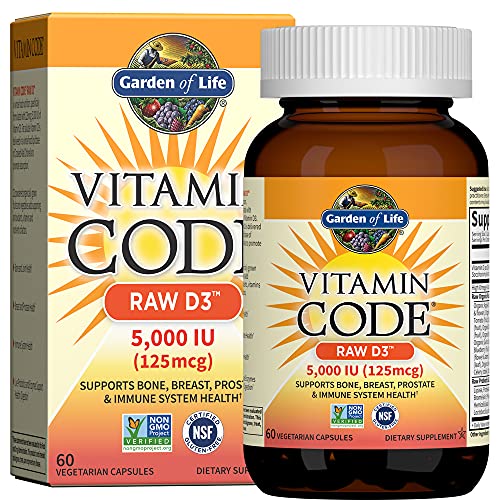
Garden of Life Vitamin D3 5000 IU, Raw Whole Food, 60 Vegetarian Capsules
Garden of Life pairs 5000 IU (125 mcg) of vitamin D3 with raw whole-food fruits and vegetables, plus probiotics and digestive enzymes that make it gentle on the stomach. It is third-party certified Non-GMO, gluten-free, and kosher, and is vegetarian friendly with no high heat or synthetic additives. The bottle holds 60 vegetarian capsules.

Sports Research Vitamin D3 + K2 with Coconut Oil, Vegan, 60 Softgels
Sports Research D3 + K2 combines 5000 IU (125 mcg) of vegan vitamin D3 from lichen with 100 mcg of vitamin K2 as MK-7 from fermented chickpea, in a coconut MCT oil base. It is Vegan Certified and Non-GMO Project Verified, third-party tested, and made in a U.S. cGMP facility. The bottle holds 60 softgels.
Keep reading

Best Collagen Supplements for Skin & Joints
The best collagen supplements for aging skin and joints in 2026: what the research shows, how to choose collagen peptides, and our researched top picks.

Best CoQ10 Supplements for Energy & Heart Health
The best CoQ10 supplements in 2026: ubiquinol vs ubiquinone, who actually benefits (statin users, heart health), how to dose it, and our researched top picks.

Best Omega-3 Fish Oil Supplements for Healthy Aging
The best omega-3 fish oil supplements for healthy aging in 2026: how much EPA and DHA you need, how to judge purity, and our researched top picks.