Dry Eye After 50: Why It Happens and What Actually Helps
Dry eye after 50 has two very different causes, and most people treat the wrong one. What the NEI and AAO evidence says actually helps, and what does not.

Affiliate disclosure: This article contains affiliate links. As an Amazon Associate we earn from qualifying purchases, at no extra cost to you. Learn more.
Dry eye after 50 usually comes down to one of two problems: your eyes are not making enough tear fluid, or the tears you do make evaporate too fast. Which one you have decides what helps. Most people reach for drops. For the more common type, drops are the weakest part of the fix.
According to the National Eye Institute, you are more likely to have dry eye if you are age 50 or older, if you are female, if you wear contact lenses, or if you have an autoimmune condition such as Sjögren syndrome. Two of those four are not choices anyone makes.
We have not examined anyone's eyes and we do not run a clinic. What we did was read the guidance from the National Eye Institute and the American Academy of Ophthalmology, plus the trial data behind the fixes people actually buy, and sort the useful from the oversold. For the wider picture of what changes with age, start with our guide to eye health after 50.
Why dry eye climbs after 50
The age curve is steep and it is well documented. The American Academy of Ophthalmology notes that dry eye prevalence increases with every decade of life over 40.
The clearest single number comes from a survey of more than 37,000 women published in the American Journal of Ophthalmology in 2003 by Debra Schaumberg and colleagues. It found an age-adjusted dry eye prevalence of 7.8 percent among American women aged 50 and older, which works out to roughly 3.2 million women. The same research group estimated over one million American men aged 50 and older were affected. A 2017 review in International Ophthalmology Clinics summarized the Women's Health Study and Physicians' Health Study data this way: dry eye prevalence rises in both women and men every five years after age 50, and is consistently higher in women.
Two things change with age. The tear-producing lacrimal gland accumulates structural damage: that same review describes age-related acinar atrophy and fibrosis in the gland tissue. And the eyelids change too, with what the review calls lid laxity and meibomian gland atrophy.
Hormones are part of the story, but read the claims carefully. Researchers have established that meibomian glands carry androgen receptors and respond to androgen stimulation, which is why shifting hormone levels are a plausible mechanism. That is a mechanism, not a finished explanation, and it is not a reason to take a hormone product for your eyes.
The two kinds of dry eye, and why the difference matters
The National Eye Institute puts it simply: dry eye happens when your glands do not make enough tears, when tears evaporate too quickly, or when the tears you make are not effective.
Clinically that splits into two buckets:
- Aqueous-deficient dry eye. Not enough tear fluid. The Academy notes that tear insufficiency of this kind may point to an underlying autoimmune disorder.
- Evaporative dry eye. Enough fluid, but it does not stay put. This is usually driven by meibomian gland dysfunction, or MGD, which is the clogging or degradation of the tiny oil glands lining the edges of your eyelids.
Here is the part that changes what you buy. The American Academy of Ophthalmology describes MGD as by far the principal cause of evaporative dry eye, a problem that accounts for up to two-thirds of all dry eye cases. Those glands secrete meibum, which the Academy describes as a protective lipid layer that prevents evaporation of the watery tear film. When they clog, the water layer is fine and the lid on top of it is missing.
So if up to two-thirds of dry eye is an oil problem, pouring more water on the eye is treating the wrong layer. It may feel better briefly, but the relief tends to be short-lived.
What is actually causing yours
Screens, and specifically blinking
This is the one most people over 50 underestimate. According to the American Academy of Ophthalmology, the normal blink rate is about 15 times per minute, while people looking at screens blink only five to seven times per minute. A 2021 review in Clinical Ophthalmology cites an office-worker study in which blinking fell from 22 times per minute at rest to 7 times per minute while viewing text on a screen.
Every blink resurfaces the tear film and squeezes the oil glands a little. Blink half as often for six hours and the math is not complicated. The commonly cited fix is the 20-20-20 rule: every 20 minutes, look at something 20 feet away for 20 seconds. It is free, and a 2022 trial in Contact Lens and Anterior Eye that gave 29 symptomatic computer users automated break reminders found their digital eye strain and dry eye symptoms decreased while the reminders were running, though the improvement was not maintained a week after the reminders stopped.
Note what this is not about. Whether blue light glasses work is a separate question we will take up on its own, but the dry eye problem with screens is not the light coming out of them. It is your eyelids not moving.
Dry air, wind, and contact lenses
The National Eye Institute's lifestyle list is short and boring and mostly correct: avoid smoke and wind, use a humidifier, limit screen time, wear sunglasses outdoors. The Academy adds a low-tech winter version, which is to put a pan of water near a heater or radiator. Contact lens wear is on the NEI's own risk-factor list.
The medication list
This is the cause people most often miss, because the drug is doing its job somewhere else in the body. The American Academy of Ophthalmology states that anticholinergics, antidepressants, and oral allergy and decongestant medications designed to dry up mucous membranes can all dry the surface of the eye. It also notes that preservatives in glaucoma medications can destabilize the tear film.
A 2012 review in the Journal of Ophthalmology by Fraunfelder, Sciubba and Mathers, "The Role of Medications in Causing Dry Eye," catalogued the drug classes involved. The corrected tables from that work include beta blockers, alpha blockers, anticholinergic agents, first-generation antihistamines, thiazide-related diuretics, anticonvulsants, and several other classes. Published ophthalmology research also flags isotretinoin, the acne drug, which studies report reduces the secretory output of the meibomian glands.
Do not stop or change any of these on your own. Most of them are treating something more dangerous than dry eyes. The useful move is to bring the full list to whoever prescribes them and ask whether an alternative exists, which is exactly what the National Eye Institute suggests a doctor may consider.
What helps, roughly ranked by the evidence behind it
1. Artificial tears, used honestly
The American Academy of Ophthalmology is direct about this: you can use artificial tears as often as you need to, and you can buy them without a prescription. The National Eye Institute lists moisturizing gels and ointments alongside them. Mayo Clinic notes that these are thicker than drops and can temporarily blur vision, which is why ointments are often applied just before bedtime.
This is the right first step for almost everyone. It is also symptomatic relief, not a repair. If the cause is MGD, drops are a comfort measure you will keep needing.
2. Warm compresses and lid hygiene, if your problem is MGD
For the more common kind of dry eye, this is the intervention that addresses the actual mechanism, and it costs the price of a washcloth. The Academy's instruction for the related condition blepharitis is a warm, wet washcloth over closed eyes for at least one minute, which it says helps keep nearby oil glands from clogging, followed by gently scrubbing the base of the lashes with diluted baby shampoo on a cloth or pad.
Published reviews of non-pharmaceutical MGD treatment report that the effective temperature range for eyelid warming is about 40 to 45°C (104 to 113°F), held for a minimum of four minutes once or twice daily, with medium-to-intense lid massage afterward to express the softened oil. Most people underdo both the temperature and the time, which is probably why so many report that "warm compresses did nothing."
The honest footnote: a Cochrane review covering 13 trials and 1,155 participants compared the in-office LipiFlow thermal device against basic warm compresses in five of those trials and found no evidence of a difference in meibomian gland expression, meibum quality, or tear breakup time. The expensive machine did not beat the washcloth on those measures. Spend the money on consistency instead.
3. Fixing your environment
Humidifier in dry months, screen breaks, no vents blowing at your face, wraparound sunglasses in wind. None of this is exciting and all of it is on the National Eye Institute's list. It is also the only category here with no downside and no cost beyond a humidifier.
4. Omega-3 supplements: the evidence says no
This one deserves a clear verdict because it is still recommended constantly. The DREAM trial (Dry Eye Assessment and Management), published in the New England Journal of Medicine, randomized 535 people with dry eye disease to 3,000 mg per day of omega-3 fatty acids or placebo for 12 months. Participants taking omega-3 did not have significantly better outcomes than those on placebo, on the primary symptom score or on the objective measures of corneal and conjunctival staining, tear break-up time, and the Schirmer test.
A DREAM extension study followed a small group for a second year, with 22 people continuing omega-3 and 21 switching to placebo, and again found no statistically significant difference in dry eye symptoms or signs between the groups. The American Academy of Ophthalmology's own review of MGD treatment now states that dietary omega-3 supplementation, previously recommended as a first-line therapy, may not be beneficial for MGD.
Fish oil has other uses, and our look at the best omega-3 fish oil supplements covers where the evidence is stronger. Dry eye relief is not one of those places. The same skepticism applies to eye supplements generally, which we went through in detail in do eye vitamins work: the formula with real trial evidence behind it was studied for macular degeneration, not for dry eye.
5. Prescription and in-office options
If drops and compresses are not enough, this is an eye doctor conversation, not a shopping one. The National Eye Institute lists prescription cyclosporine and lifitegrast eye drops as options, and tear duct plugs, small silicone or gel inserts that block tear drainage so your own tears stay on the eye longer. The Academy describes punctal plugs as removable later as needed, and lists topical steroids or cyclosporine for moderate-to-severe cases. We are not going to dose any of these. That is what the appointment is for.
Preservatives: the part most people get wrong
Nearly every multi-dose eye drop bottle contains a preservative to keep it sterile after opening. The most common is benzalkonium chloride, usually printed as BAK on the inactive ingredients list. A 2021 review in the ophthalmology journal Eye reported that BAK is used in roughly 70 percent of ophthalmic formulations and is well known to cause cytotoxic damage to conjunctival and corneal epithelial cells.
The nuance matters more than the alarm. That review describes BAK toxicity as time- and concentration-dependent, with adverse effects most problematic under chronic exposure such as lifelong glaucoma therapy, though changes can appear after exposure as brief as seven days.
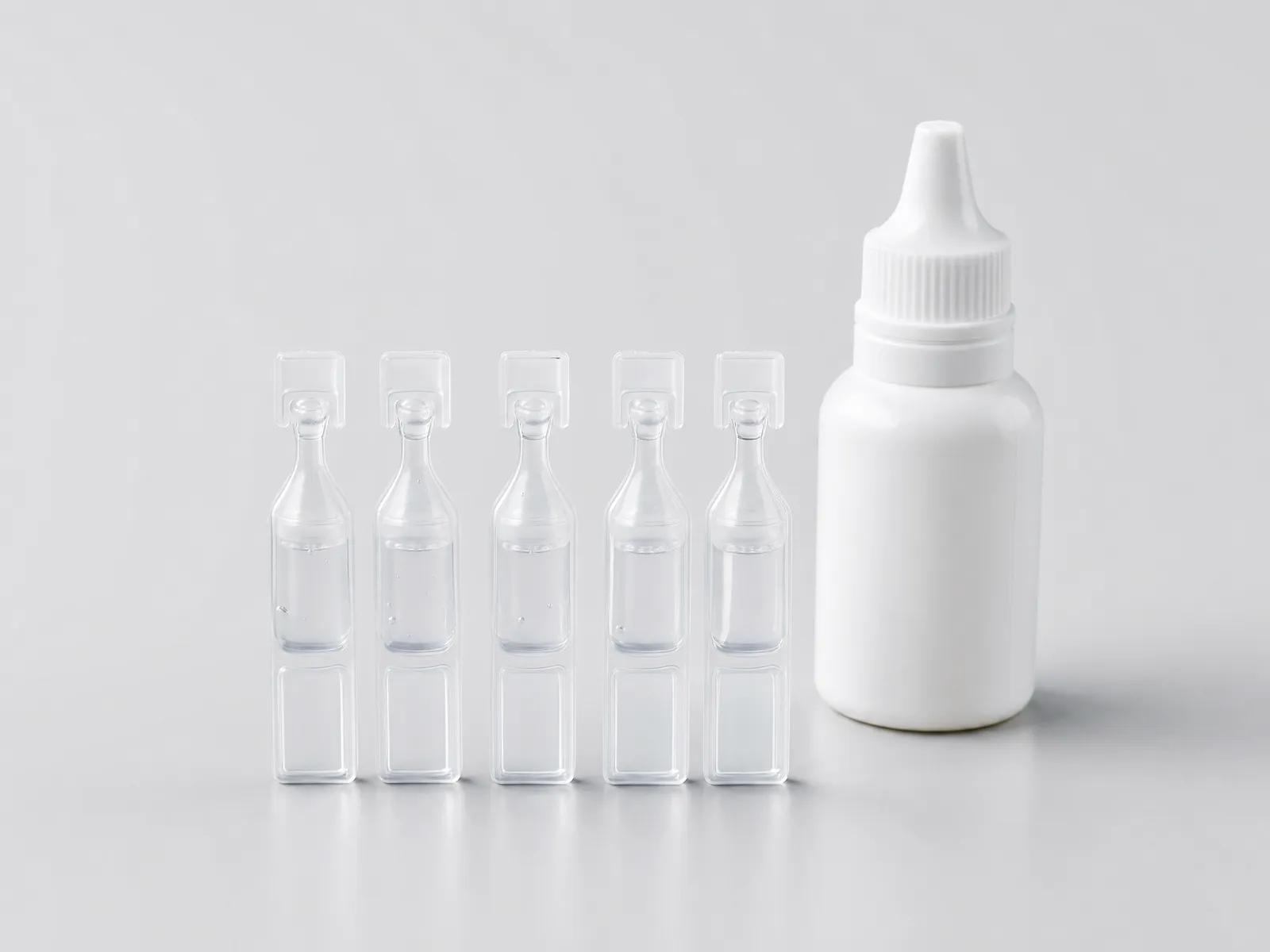
So the practical rule is about frequency, not fear. The American Academy of Ophthalmology's patient guidance is specific: if you use artificial tears more than six times a day, or you are allergic to preservatives, you should use preservative-free tears. The Academy's clinician-facing quick guide sets the bar lower still, at more than four times daily. Preservative-free drops usually come in single-use vials, which cost more per dose and are the correct purchase if you are dosing all day.
If you are at the point of standing in the aisle comparing bottles, we broke down what is actually in them in our roundup of the best dry eye drops, including which formulas target the oil layer rather than the water one.
When it is not just dry eye
Two conditions routinely wear the dry eye costume.
Blepharitis. The American Academy of Ophthalmology defines it as inflammation of the eyelids, with lids that look red or swollen or feel like they are burning or sore, often with flakes or oily crusts at the base of the lashes. The Academy states there is no cure but that the symptoms can be controlled. If your lid margins look crusty in the morning, this belongs in the conversation.
Sjögren syndrome. The Academy's quick guide to dry eye reports that one in ten patients with clinically significant dry eye will have Sjögren's, an autoimmune condition it notes puts the patient at risk for systemic problems. Dry eyes plus a persistently dry mouth is a pattern worth naming out loud at your next appointment rather than treating with drops.
And some symptoms are not a dry eye question at all. The Academy is clear that sudden vision loss is an emergency even when it does not hurt, and that any new floaters or flashes should be examined, because they can signal a torn or detached retina. Severe eye pain, or light sensitivity with a red eye, belongs in the same category.
Before you change anything
This article is general information, not medical advice. Mary Burson is a health writer, not a physician and not an eye care professional, and nothing here is a diagnosis. Your medications, your autoimmune history, and the actual state of your lid glands all change the answer, so talk with an eye doctor or physician about your own situation before starting or stopping anything, including over-the-counter drops.
Get seen promptly, rather than self-treating, if you have sudden vision changes, eye pain, light sensitivity with redness, or new floaters or flashes of light. Those are exam symptoms, not drop symptoms.
The bottom line
Dry eye after 50 is common, and the single most useful thing you can do is find out which kind you have. If up to two-thirds of cases are driven by oil glands that have stopped working properly, then the default response of buying a bigger bottle of drops is aimed at the wrong layer of the tear film. Warm compresses done at a real temperature for a real four minutes, a humidifier, deliberate blinking at the screen, and an honest audit of your medication list are more likely to help than another shelf of supplements. Skip the omega-3 capsules for this purpose: the largest randomized trial on the question found no benefit over placebo.
Age also changes plenty besides tear production, and dry eye is only one item on a longer list of vision changes after 50. For how the rest of it fits together, see our complete guide to eye health after 50.
Keep reading

Eye Health After 50: What Changes, What Helps, and What Actually Works
Eye health after 50: what really changes, which supplements and drops have evidence behind them, how often to get examined, and the symptoms to act on today.
How Often Should You Get an Eye Exam After 50?
How often should you get an eye exam after 50? The AAO and AOA intervals side by side, the risk factors that shorten them, the red flags that override them, and what Medicare actually pays for.
The Best Dry Eye Drops in 2026: Preservative-Free Picks Compared
The best dry eye drops in 2026. Why preservative-free is the honest default, how to match a drop to your type of dry eye, and six picks with their real downsides.