The Best Dry Eye Drops in 2026: Preservative-Free Picks Compared
The best dry eye drops in 2026. Why preservative-free is the honest default, how to match a drop to your type of dry eye, and six picks with their real downsides.

Affiliate disclosure: This article contains affiliate links. As an Amazon Associate we earn from qualifying purchases, at no extra cost to you. Learn more.
◆ The verdict
6 reviewed- 1Our PickREFRESH PLUS Lubricant Eye Drops Preservative-Free Artificial Tears, 0.01 fl oz (0.4 mL), 50 Single-Use ContainersCheck price ▸
- 2Runner-UpSystane Ultra Preservative Free Lubricant Eye Drops for Dry Eye, 60 CountCheck price ▸
- 3Best Preservative-Free BottleREFRESH TEARS PF Preservative-Free Artificial Tears Lubricant Eye Drops, 0.33 fl oz (10 mL)Check price ▸
- 4Best for Evaporative Dry EyeRefresh OPTIVE MEGA-3 PF Lubricant Eye Drops Preservative-Free Artificial Tears, 0.33 fl oz (10mL)Check price ▸
- 5Best for Overnight ReliefTheraTears Liquid Gel Nighttime, Preservative Free, Dry Eye Drops, 30 CtCheck price ▸
- 6Best Budget BottleTheraTears Dry Eye Lubricating Drops, Value Size, 1 Fl OzCheck price ▸
The best dry eye drops for most people over 50 are preservative-free artificial tears, and the format matters more than the brand on the box. The American Academy of Ophthalmology says preservative-free drops are often best for people who use artificial tears more than four times a day. Better Life Span is reader-supported: if you buy through links on this page we may earn a commission, at no extra cost to you.
That is the whole decision in one sentence, but it hides a second question that matters just as much: which kind of dry eye do you have? A drop that tops up the watery part of your tears and a drop that replaces the oily part are not interchangeable. The mechanism lives in our article on dry eye after 50. This one is the shopping trip. For the wider picture of what shifts in your eyes in midlife, start with eye health after 50.
Our method: published labels, not lab tests
We did not test these drops. Nobody at Better Life Span put a vial in their eye and timed the relief, and any roundup claiming it did that across six products is telling you a story.
What we did do is compare the published preservative status, the delivery format (single-use vial versus multidose bottle), the stated volume, the active ingredients where the maker publishes them, and the cost per dose, then check those against what eye-care bodies and published trials actually say.
That last step is uncomfortable. A 2016 Cochrane review by Pucker and colleagues pooled 43 randomized trials covering 3,497 people with dry eye and concluded there was uncertainty over whether different over-the-counter artificial tears provide similar relief when compared with each other or with placebo; the trials were too inconsistent in design and reporting to settle it. The American Academy of Ophthalmology says the same thing in one line: no single brand works best for all types of dry eye.
So read the picks below as "this one fits this situation and this budget," not "this one is scientifically superior." Mostly, they are not.
The four decisions that actually pick your drop
- How often will you dose? This drives everything else. The American Academy of Ophthalmology says many eye doctors recommend not using drops with preservatives more than four times a day, and Mayo Clinic sets the same ceiling, adding that using preserved drops more often can cause eye irritation. If you are at five, six or eight doses a day, preservative-free stops being a premium upgrade and becomes the sensible default.
- Is the problem volume or oil? The National Eye Institute describes two basic failures: your glands do not make enough tears to keep your eyes wet, or your tears dry up too fast. The first is aqueous-deficient dry eye. The second is usually evaporative, driven by the oil glands in your lid margins. The 2023 systematic review of artificial tears by Semp and colleagues in Clinical Optometry found that drops containing phospholipids are more effective in people with evaporative dry eye. If your eyes feel worst late in the day, in wind, or under air conditioning, an oil-containing drop is the more logical first try.
- Daytime or overnight? Thin drops for the day, thicker gels at night. The American Academy of Ophthalmology notes that thicker gels and ointments may blur vision temporarily, so most people prefer to use them just before bedtime; Mayo Clinic gives the same advice about ointments. If mornings are your worst hour, a nighttime gel is a more targeted purchase than another daytime bottle.
- Vial or bottle? Single-use vials are the strictest form of preservative-free and they travel well, but they are fiddly, and arthritic hands do not love twisting the tops off. A preservative-free multidose bottle is the middle path: the container itself is engineered to hold sterility instead of a chemical doing it. Refresh, for example, describes its soft-squeeze bottle as using a double lockout system that keeps drops sterile. That is the manufacturer's description of its own design, not an independent test result.
Preservatives, in plain English
A preservative is a chemical that stops bacteria growing in the bottle once you have opened it. The most common one is benzalkonium chloride, usually printed as BAK.
A 2021 review in the journal Eye reported that benzalkonium chloride is used in roughly 70 percent of ophthalmic formulations and is well known to cause cytotoxic damage to conjunctival and corneal surface cells, producing the signs and symptoms of ocular surface disease. The same review notes these effects are most problematic with chronic exposure, as in lifelong glaucoma therapy, but can show up after exposure as brief as seven days.
Here is the honest reading of that. Occasional use of a preserved drop is not the problem. Frequent, long-term use is. A preserved bottle twice a day through a dry winter sits comfortably inside the four-times-a-day guidance. The same bottle at eight doses a day for years is the exposure pattern the toxicity research is concerned with.
That is why our picks skew preservative-free, and the reason is tolerance rather than potency. Semp and colleagues recommend preservative-free formulations for all types of dry eye, and say this matters even more for severe dry eye or sensitive individuals.
One label warning is worth repeating. The American Academy of Ophthalmology points out that drops marketed as red-eye relievers are actually decongestants, and while they make eyes look less red they can make dry eye symptoms worse over time. Those are not artificial tears, and they are not a substitute for them.
Our picks, and who each one is for
Prices below were captured on 28 September 2026 and will move. Every one of them has a genuine drawback, and we have put it in writing.
Refresh Plus Preservative-Free, 50 Vials
About $15.29 for 50 vials as of September 2026. Divide the price by the vial count and one dosing occasion costs roughly $0.31, since a single 0.4 mL vial covers both eyes. That is the cheapest per-vial preservative-free option among the single-use vials here, which is the right kind of cheap: it lands where it helps the high-frequency dosers who need preservative-free most.
Refresh markets this as the number one doctor recommended preservative-free artificial tear, and supports that with its own data on file (AbbVie, REF-113774) rather than a published trial. Treat it as advertising.
The real downside: you throw away most of each 0.4 mL vial after one use, because the label tells you to. Check the current price.
Systane Ultra Preservative-Free, 60 Vials
About $26.99 for 60 vials as of September 2026, or roughly $0.45 a vial. It is the only pick here whose maker publishes the active ingredients in the listing: Systane says the formula uses polyethylene glycol 400 and propylene glycol to replenish the aqueous layer of the tear film, and its directions are 1 to 2 drops as needed through the day.
That ingredient disclosure is worth something, because Semp and colleagues found polyethylene glycol formulations outperformed carboxymethylcellulose and hydroxypropyl methylcellulose alternatives in their review.
The real downside: at $0.45 against $0.31, it is about 47 percent more per vial than the Refresh box for a broadly similar job.
Refresh Tears PF Multidose Bottle
About $12.94 for a 10 mL preservative-free bottle as of September 2026, which is roughly $1.29 per millilitre. This is the pick for anyone who wants preservative-free dosing without the twist-off vial ritual, and Refresh says the drops are safe to use as often as needed.
If you have hand tremor, arthritic fingers, or simply know you will stop opening vials by week three, this is the format that survives contact with real life.
The real downside: a bottle you keep for weeks is a bottle with a discard-by window. Follow the carton, not your optimism.
Refresh Optive Mega-3 PF
About $19.39 for a 10 mL preservative-free bottle as of September 2026, or roughly $1.94 per millilitre, the most expensive drop here by volume. Refresh says it is enhanced with antioxidants and plant-based flaxseed oil, which the company itself lists as inactive ingredients, and claims one drop provides 10-plus hours of relief with results that may vary, again citing internal data on file (AbbVie, REF-136415) rather than a published study.
It earns the evaporative pick on category logic. The Academy's own EyeNet review of evaporative dry eye (Goel and colleagues, September 2019) says initial treatment should involve replacing the natural oils of the tear film with lipid-containing over-the-counter lubricant eye drops.
The real downside, stated plainly: the published evidence Semp's review points to concerns phospholipid-containing drops, and flaxseed oil listed as an inactive ingredient is not that. We found no trial showing this specific formula matches that result. Check the current price.
TheraTears Liquid Gel Nighttime PF, 30 Vials
About $11.78 for 30 preservative-free vials as of September 2026, roughly $0.39 a vial. TheraTears says the gel holds four times the active lubricating ingredient of TheraTears original and includes what it calls OxyLytes, five electrolytes the brand says are found in natural tears. TheraTears also says the formula was created by an ophthalmologist after 18 years of research. Those are the company's claims about its own product, not findings we verified independently.
Buy it if you wake with gritty, stuck-together lids. Both the American Academy of Ophthalmology and Mayo Clinic note that thicker products blur vision temporarily and are best used at bedtime, which is exactly the slot this one is sold for.
The real downside: it cannot do daytime duty, so it is a second purchase alongside a thin drop, not a replacement for one. Check the current price.
TheraTears Dry Eye Lubricating Drops, 1 fl oz
About $12.56 as of September 2026. A 1 fl oz bottle is about 29.6 mL, so that is roughly $0.42 per millilitre, comfortably the lowest volume cost in this roundup. For comparison, the Refresh Tears PF bottle works out to about $1.29 per millilitre at the same date.
The real downside is a real one. Unlike the other five, this listing makes no preservative-free claim. TheraTears explicitly labels its nighttime vials preservative-free and does not do so here, which is a meaningful silence. If you expect to dose more than four times a day, read the carton before you buy, because the four-times-a-day ceiling for preserved drops would apply. Check the current price.
A note on FSA and HSA money
Both Refresh and TheraTears state that their drops may be FSA and HSA eligible depending on your plan. That quietly changes what a year of drops actually costs you. We walk through how those accounts work for over-the-counter eye and health products in our guide to Medicare, FSA and HSA coverage.
The limits of artificial tears
Drops relieve symptoms. They do not repair the reason your tear film is failing. That distinction is the most useful thing on this page.
If your problem is meibomian gland dysfunction, meaning the oil glands along your lid margins are blocked, the Academy's EyeNet review describes the most conservative approach as warm compresses, lid scrubs and gentle massage done at home. A drop may top up the oil layer temporarily. It cannot unblock a gland.
If your problem is inflammation, that is prescription territory. The National Eye Institute lists cyclosporine (Restasis) and lifitegrast (Xiidra) among the medicines an eye doctor may prescribe, and punctal plugs, small plugs placed in the tear ducts to keep tears on the eye, as another option. None of that is available in a drugstore aisle.
So here is the line we want you to keep: needing drops six or eight times a day is a reason to book an eye appointment, not a reason to buy a bigger bottle. Mayo Clinic's own guidance is that if you have not found relief with over-the-counter products, you should make an appointment with an ophthalmologist or optometrist. High dosing frequency is itself a symptom.
Supplements, omega-3 and the DREAM trial
Readers ask whether a supplement belongs in a dry eye routine. For omega-3, the honest answer is no, at least not on the strength of the best trial we have.
The DREAM trial enrolled 535 people with moderate to severe dry eye across 27 centres and was published in the New England Journal of Medicine in April 2018. One group took 3,000 mg of marine omega-3 daily (2,000 mg of EPA plus 1,000 mg of DHA); the other took 5,000 mg of olive oil as placebo. The National Eye Institute's summary is blunt: the omega-3 supplements were no better than placebo at relieving the symptoms or signs of dry eye. Symptom scores fell by an average of about 13 points on the Ocular Surface Disease Index in both groups, with no statistically significant difference between them.
There are other reasons people take fish oil, and we cover them in our guide to omega-3 fish oil supplements. Dry eye is not one of them.
Eye supplements more broadly are a separate question with a separate evidence base, and we sort out what is and is not supported in best eye vitamins for aging eyes. Screen-related dryness also gets blamed on blue light, but blue light glasses are a different topic with different evidence, and they are not something we would put in a dry eye plan.
Contaminated drops and recalls: two minutes well spent
This is the part most roundups skip, and it is the part that can actually hurt you.
In February 2023 the FDA warned consumers and health care practitioners not to purchase, and to immediately stop using, EzriCare Artificial Tears and Delsam Pharma's Artificial Tears because of potential bacterial contamination. Working with the CDC, the agency connected the products to an outbreak of an extensively drug-resistant strain of Pseudomonas aeruginosa. As of 31 January 2023 the CDC had identified 55 patients in 12 states, with outcomes that included hospitalization, one death involving a bloodstream infection, and permanent vision loss.
It happened again, less dramatically, this year. UC Davis Health, summarizing the FDA action, reported that a voluntary recall initiated on 3 March 2026, and classified by the FDA on 31 March 2026, covered more than 3 million bottles of over-the-counter eye drops sold under store brands including Walgreens, CVS, Rite Aid and Kroger, cited for a lack of assurance of sterility.
Two things are true at the same time. Infections from contaminated eye drops remain uncommon. And when they happen the consequences are severe enough to justify checking a recall list occasionally. Nothing in our research suggests any of the six products above is affected. The advice from the eye doctors UC Davis quoted is simple: drops that are not on the recall list should be safe to use, and drops that are on it should go in the bin.
Using drops the way the label intends
- Never let the dropper tip touch your eye, your fingers, your face or any surface. MedlinePlus, the NIH consumer drug reference, warns that if the tip touches another surface, bacteria may get into the drops.
- Wash your hands first. Same source, same reason.
- One vial, one use. MedlinePlus says the liquid from a single-use vial should be used immediately after opening, for one or both eyes, and the vial discarded even if it is not empty. Throwing away a mostly full vial feels wasteful. Do it anyway. The absence of a preservative is exactly why that rule exists.
- Wait about five minutes between different drops. The American Academy of Ophthalmology's answer on this is that five minutes is traditional and a minute or so less is not critical. The point is to stop the second drop washing the first one out.
- Gel goes last, and at night. Thicker products blur vision temporarily, per both the Academy and Mayo Clinic, so they belong after your thin drops and close to bedtime.
- Press the inner corner afterwards. The Academy advises gently closing your eyes after each drop and pressing the inner corner near your nose for a minute or two, which keeps the drop on the eye instead of letting it drain away.
- Expect to try more than one product. Mayo Clinic says no single brand works best for every form of dry eye and that you may need to try several before you find one that suits you.
A word about medical advice
Mary Burson is a health writer, not a doctor and not an eye care professional. This article is general information, not medical advice, and it cannot account for your prescriptions, your surgical history or your diagnosis. Talk to an ophthalmologist or optometrist about your own eyes before you change anything.
Some symptoms should not be met with a drop at all. Sudden changes in vision, eye pain, light sensitivity with redness, or new floaters and flashes need to be seen promptly rather than self-treated. The American Academy of Ophthalmology treats a sudden change in vision and the sudden onset of flashes and floaters as reasons for prompt evaluation, because some of the causes can damage sight quickly.
The bottom line
Buy on format first. If you dose more than four times a day, buy preservative-free and stop agonising over which brand, because the Cochrane evidence does not support agonising. If your dryness is the evaporative kind, put an oil-containing drop in the rotation. If mornings are the worst part, add a nighttime gel and keep your daytime drop. If your hands struggle with vials, a preservative-free bottle is a legitimate answer rather than a compromise.
And if you are reaching for drops more than a handful of times a day, the most valuable thing on this page is not a product link. It is the suggestion that you book an eye exam and find out what is actually wrong. For the rest of what changes in your eyes after midlife, and what is genuinely worth doing about it, read our complete guide to eye health after 50.

REFRESH PLUS Lubricant Eye Drops Preservative-Free Artificial Tears, 0.01 fl oz (0.4 mL), 50 Single-Use Containers
Fifty single-use vials of preservative-free lubricant eye drops, each holding 0.01 fl oz (0.4 mL). Refresh describes it as an original-strength lubricating formula for mild dryness, burning and irritation, and says it is safe to use as often as needed. Refresh also markets it as usable after LASIK or other eye surgery if your eye doctor approves. At about $15.29 as of September 2026, the 50-vial box works out to roughly $0.31 a vial.
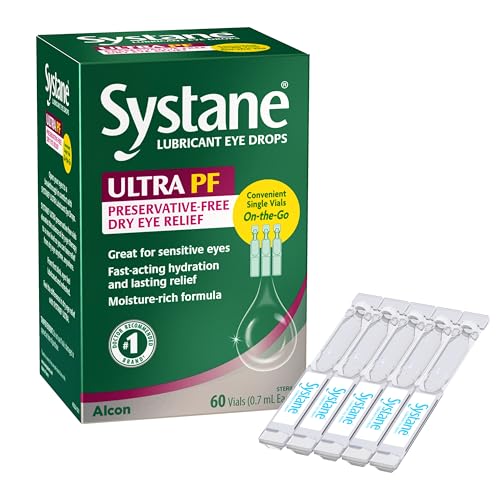
Systane Ultra Preservative Free Lubricant Eye Drops for Dry Eye, 60 Count
Sixty single-use preservative-free vials. Systane is the only maker here that publishes its active ingredients in the listing: polyethylene glycol 400 and propylene glycol, which the company says replenish the watery (aqueous) layer of the tear film. Systane's stated directions are 1 to 2 drops as needed through the day. At about $26.99 as of September 2026, that is roughly $0.45 a vial.

REFRESH TEARS PF Preservative-Free Artificial Tears Lubricant Eye Drops, 0.33 fl oz (10 mL)
A 0.33 fl oz (10 mL) preservative-free bottle rather than a box of vials. Refresh says the soft-squeeze multidose bottle uses a double lockout system to keep the drops sterile, and that the drops are safe to use as often as needed. About $12.94 as of September 2026, or roughly $1.29 per millilitre.

Refresh OPTIVE MEGA-3 PF Lubricant Eye Drops Preservative-Free Artificial Tears, 0.33 fl oz (10mL)
A 0.33 fl oz (10 mL) preservative-free multidose bottle. Refresh says it is enhanced with antioxidants and plant-based flaxseed oil, which the company lists as inactive ingredients, and calls it a triple-action formula that lubricates, hydrates and protects tears from evaporating. Refresh also claims one drop provides 10-plus hours of relief, with results that may vary, citing its own data on file (AbbVie REF-136415). About $19.39 as of September 2026.

TheraTears Liquid Gel Nighttime, Preservative Free, Dry Eye Drops, 30 Ct
Thirty preservative-free single-use vials of a thicker liquid gel intended for overnight use. TheraTears says it contains four times the active lubricating ingredient of TheraTears original, plus what the brand calls OxyLytes, five electrolytes it says are found in natural tears. About $11.78 as of September 2026, or roughly $0.39 a vial.

TheraTears Dry Eye Lubricating Drops, Value Size, 1 Fl Oz
A 1 fl oz value-size bottle, by far the largest volume here. TheraTears says the formula was created by an ophthalmologist after 18 years of research and contains its OxyLytes electrolytes. About $12.56 as of September 2026, which works out to roughly $0.42 per millilitre, the lowest volume cost in this roundup.
Keep reading
Dry Eye After 50: Why It Happens and What Actually Helps
Dry eye after 50 has two very different causes, and most people treat the wrong one. What the NEI and AAO evidence says actually helps, and what does not.
How Often Should You Get an Eye Exam After 50?
How often should you get an eye exam after 50? The AAO and AOA intervals side by side, the risk factors that shorten them, the red flags that override them, and what Medicare actually pays for.
AREDS2 vs AREDS3: What Changed in the New Eye Vitamin Formula
AREDS2 vs AREDS3: one is a National Eye Institute trial formula, the other is a product name. What the AREDS 3 formula adds, what the evidence does and does not show.