How Much Protein Do You Actually Need After 50?
How much protein do you need after 50? The RDA is 0.8 g per kg for all adults. Two expert groups say 1.0 to 1.2 for over-65s. Why both are right.

Affiliate disclosure: This article contains affiliate links. As an Amazon Associate we earn from qualifying purchases, at no extra cost to you. Learn more.
If you want the number first: the Recommended Dietary Allowance for protein is 0.8 grams per kilogram of body weight per day, and that figure applies to adults of every age. Two major expert groups recommend at least 1.0 to 1.2 grams per kilogram per day for people over 65. Both numbers are legitimate. They are answers to two different questions.
That is the part almost nobody explains, and it is why the topic feels like a shouting match. One number tells you how little protein prevents a deficiency. The other tells you how much appears to maintain muscle and function in an older body. Knowing which is which is worth more than any single gram target.
Most people arrive at this question while trying to do something else, usually losing weight after 50, where protein is the one nutrient that changes what you keep while the scale moves. We are a research desk, not a clinic, and we did not examine anyone. Where the evidence is small, short, or contested, we say so in the same sentence.
The two numbers behind protein requirements for older adults
The RDA of 0.8 g/kg/day was derived from nitrogen-balance studies, with an Estimated Average Requirement of 0.66 g/kg/day. Nitrogen balance asks a narrow question: at what intake does the body stop losing more nitrogen than it takes in? That is a deficiency threshold, not a description of the intake that best preserves strength, mobility, or lean mass at 68.
Researchers in this field say so openly. Stuart Phillips' 2017 review in Frontiers in Nutrition records that the RDA is set at 0.80 g/kg/day "based on nitrogen balance", that the RDA is by definition "an estimate of the minimum daily average dietary intake level", and that current protein requirements "may not be sufficient for older persons" — with possible benefits of higher intakes, including preservation of lean body mass and function, that he says are worth further investigation.
So the higher ranges you keep reading are not a correction of the RDA. They answer a different question, and they were published by different bodies.
Who actually published the higher number
Two documents do most of the work here.
- The PROT-AGE Study Group position paper, published in the Journal of the American Medical Directors Association in 2013, recommends an average daily intake of at least 1.0 to 1.2 grams of protein per kilogram of body weight per day for people over 65 to help maintain and regain lean mass and function, and 1.2 g/kg/day or more for those who exercise and are otherwise active.
- The ESPEN Expert Group (the European Society for Clinical Nutrition and Metabolism), writing in Clinical Nutrition in 2014, recommends at least 1.0 to 1.2 g/kg/day for healthy older people, and 1.2 to 1.5 g/kg/day for those who are malnourished or at risk because of acute or chronic illness.
Both are expert-group consensus recommendations. Neither is the RDA, and no government raised the RDA to match them.
The federal picture did change in January 2026, and it is easy to misread. The 2025-2030 Dietary Guidelines for Americans, published that month, list a protein serving goal of "1.2-1.6 grams of protein per kilogram of body weight per day, adjusting as needed based on your individual caloric requirements" — well above the RDA, and written for adults generally rather than for older adults specifically. The RDA itself did not move. The Dietary Guidelines do not set Dietary Reference Intakes, and the adult RDA remains 0.8 g/kg. The higher range is also contested: in FactCheck.org's review of the change, Harvard's Frank Hu criticized applying the goal to the general population rather than to the groups the evidence covers, while McMaster's Stuart Phillips said older adults are among the groups who "appear to achieve better outcomes at intakes closer to 1.2-1.6 g/kg/day". So there are now three numbers in circulation, and they answer three different questions: a deficiency floor, a geriatric-care range, and a population-level federal goal.
The arithmetic, worked once, as illustration
Body weight in kilograms is the usual basis, so convert first. Divide pounds by 2.2.
For someone weighing 70 kg, which is about 154 pounds, the RDA of 0.8 g/kg works out to roughly 56 grams a day, the PROT-AGE and ESPEN floor of 1.0 g/kg to about 70 grams, and their upper healthy-adult figure of 1.2 g/kg to about 84 grams. The spread between the deficiency threshold and the top of the expert range is around 28 grams a day for this person: one substantial meal's worth.
Two honest caveats. This is arithmetic, not a prescription for you. And straight multiplication becomes a poor guide at very high body weight, because fat mass does not carry the same protein demand as lean tissue. Clinical guidance often sidesteps that by using ideal rather than actual body weight, as the kidney guidelines below do.
If you would rather not convert by hand, our protein calculator runs the same ranges against your own weight and labels which authority each number came from.
Why the target rises with age at all: anabolic resistance
The reason the expert groups land above the RDA is a phenomenon called anabolic resistance: older muscle responds less to the same dose of protein than younger muscle does.
A narrative review by Aragon, Tipton, and Schoenfeld in Nutrition Reviews, titled "Age-related muscle anabolic resistance: inevitable or preventable?", describes aging as dulling the muscle protein synthesis response to a given protein dose. The candidate mechanisms it lays out are weaker anabolic signaling inside the muscle, poorer insulin-driven delivery of amino acids to the tissue, and more of the amino acids being retained by the gut and liver before they reach muscle. The same review argues that inactivity and obesity make the problem worse, largely through insulin resistance and inflammation.
Note what that implies: anabolic resistance is partly a consequence of how much you move, which is why the review's title asks whether it is preventable rather than inevitable. Whether your energy needs fall on the same schedule is a separate question, and we have taken up whether metabolism slows down with age on its own terms.
How much protein per meal, and how good is that evidence
Most people eat almost no protein at breakfast and a large amount at dinner. The per-meal argument says that pattern wastes some of the daily total.
Donald Layman's 2024 review in Frontiers in Nutrition reports that clinical studies have found adults over 60 require meals containing at least 2.8 grams of leucine, roughly 30 grams of protein, to stimulate muscle protein synthesis, and that this meal-level threshold is not observed in adults under 30, whose response rises in near-linear proportion to the protein in a meal. That is the origin of the familiar "25 to 30 grams per meal" advice.
The supporting trial evidence is real but thin. Mamerow and colleagues, publishing in the Journal of Nutrition, used a seven-day crossover feeding design to compare an even protein pattern (about 31.5, 29.9, and 32.7 grams across the three meals) against a skewed one (10.7, 16.0, and 63.4 grams). The 24-hour muscle protein synthesis rate was 25 percent higher on the even pattern, at 0.075 against 0.056 percent per hour. The study enrolled eight healthy adults whose average age was in the thirties, so it is not an older-adult result.
Here is the honest summary. Layman's own review calls the long-term benefit of per-meal distribution for muscle mass in aging adults speculative. The leucine threshold underneath the rule is only partly supported, too: a 2021 systematic review in the same journal, by Zaromskyte and colleagues, judged only 16 of 29 eligible studies sufficient to support the leucine-trigger hypothesis, found the disconnect between blood leucine and muscle protein synthesis mostly in young adults, and concluded the idea holds best in older adults and for isolated proteins rather than whole foods. The evidence for hitting your daily total is stronger than the evidence for how you split it up. Spread it out if that is easy; do not let a per-meal rule stop you from eating enough.
Protein without resistance training is mostly just calories
The supplement aisle will not say this for you.
The best-known synthesis is Morton and colleagues' meta-analysis in the British Journal of Sports Medicine in 2018, which pooled 49 studies and 1,863 participants. Protein supplementation produced a small but statistically significant gain of 0.30 kilograms of fat-free mass, and the critical qualifier is in the question those trials asked: every one was a resistance-training trial. The protein was an addition to lifting, not a substitute for it. The same analysis found the effect was smaller in older participants, and that supplementation beyond a total intake of about 1.62 g/kg/day produced no further gains in fat-free mass.
Two things follow. Protein above roughly 1.6 g/kg/day has no demonstrated muscle benefit in that body of evidence, and protein without a training stimulus is, metabolically speaking, food. It has value for satiety and for not losing ground. It builds nothing on its own.
A pair of resistance bands and two sessions a week is the cheapest version of the training half. Which set matters less than whether it sits within reach of where you already sit.
Protein while you are losing weight
Weight loss is where protein intake stops being academic, because some of what comes off is muscle.
Kim and colleagues, writing in Nutrition Reviews in 2016, pooled 20 randomized controlled trials of adults over 50 losing weight through energy restriction, comparing higher protein intakes (at least 25 percent of energy, or at least 1.0 g/kg/day) with lower ones. Older adults on the higher-protein diets retained more lean mass and lost more fat mass.
Function appears to follow composition. Porter Starr and Bales randomized 67 obese, functionally limited adults aged 60 and over to a standard weight-loss diet or one providing more than 30 grams of protein at each meal, publishing the six-month pilot trial in the Journals of Gerontology in 2016. Both groups lost meaningful weight, 7.5 kilograms in the control arm and 8.7 in the protein arm. The difference the authors highlighted was physical function, which improved by 2.4 units versus 0.9 in the control group.
None of that is a reason to set yourself an aggressive deficit, and we are not giving you a calorie target. It is a reason that if you are eating less, the protein share of what remains is the variable worth protecting. We will cover how to keep muscle while losing weight separately. If the deficit itself has stopped working, we have written about why the weight stopped coming off.
What 25 to 30 grams of protein actually looks like
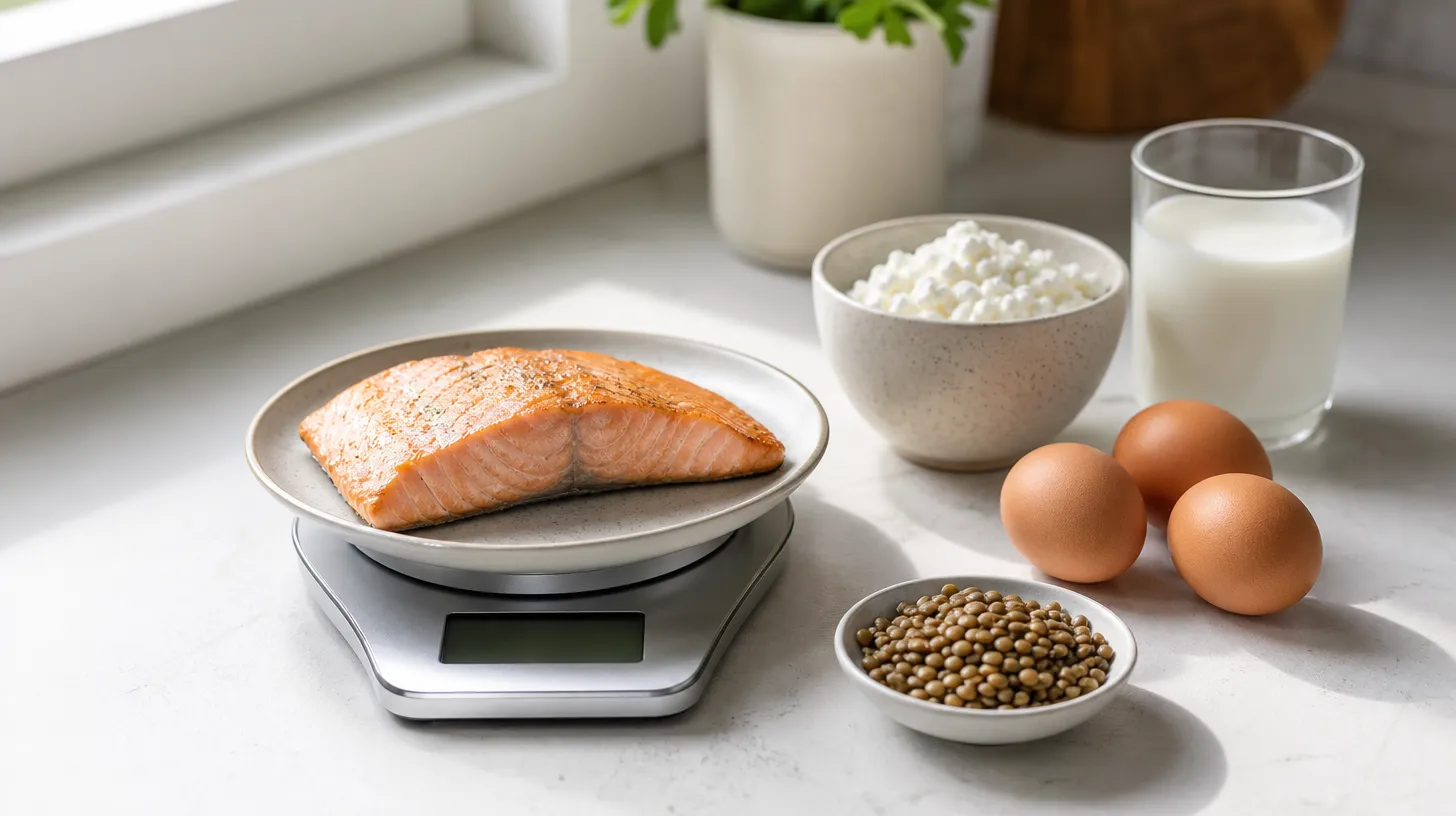
Food first. Except where noted, these are Harvard Health's own per-serving figures.
- Lean chicken, 3.5 ounces — 31 grams. A single palm-sized portion clears the per-meal threshold on its own.
- Salmon, 3.5 ounces — 24 grams. Harvard puts 3 ounces of tuna, salmon, haddock or trout at about 21 grams.
- Plain yogurt, 6 ounces — 17 grams, which is roughly three-quarters of a cup.
- Cottage cheese, half a cup — about 12 grams, per the USDA's FoodData Central entry for 1 percent lowfat cottage cheese.
- One egg — about 6 grams. Two eggs is a little over 12, so eggs alone rarely make a 25-gram breakfast.
- Cooked beans, one cup — about 18 grams, lentils included.
- Tofu, one-quarter cup — 7 grams, and Harvard puts a half-cup of chickpeas at 7 grams as well.
- Nuts, one-quarter cup — about 7 grams. Nuts are a garnish here, not a source.
Two patterns jump out. A breakfast of yogurt plus two eggs lands near 30 grams; a bagel with cream cheese does not come close. And plant sources have to be portioned generously to do the same work, which is a matter of volume rather than virtue. Harvard's Nutrition Source also cautions that raising overall protein without distinguishing between sources may carry unintended long-term implications.
Powder is convenience, not strategy
Powder solves one problem well: getting 25 grams into a morning when you were not going to cook. If that is your problem, we have reviewed the best protein powders for people over 50. It is not a superior category of protein, only a convenient one.
One distinction here is worth more than any brand comparison. Collagen is not interchangeable with whey, casein, soy, or pea protein. Oikawa and colleagues, publishing in the American Journal of Clinical Nutrition in 2020, randomized 22 healthy older women with a mean age of 69 to 30 grams of either whey or collagen protein twice daily for six days, and found whey produced greater increases in both acute and longer-term muscle protein synthesis. Collagen is an incomplete protein: clinician-authored reviews such as Barbell Medicine's note that it contains no tryptophan, one of the nine essential amino acids, and is low in leucine.
That does not make collagen useless, and we have assessed the best collagen supplements on their own merits. It means the grams on a collagen label should not be counted toward a muscle-maintenance target.
If your kidney function is reduced, these targets are not yours
This is not a footnote. It is the one place where the wrong number carries real risk.
Protein targets in chronic kidney disease move in the opposite direction, and they are individualized by stage. The KDOQI 2020 clinical practice guideline for nutrition in CKD recommends restricting protein to about 0.55 to 0.60 g/kg/day of ideal body weight in metabolically stable adults with CKD stages 3 to 5 who are not on dialysis, a somewhat higher 0.6 to 0.8 g/kg/day for those with diabetes, and 1.0 to 1.2 g/kg/day for people on dialysis.
Even specialists argue over those figures. The International Society of Renal Nutrition and Metabolism, endorsing the guideline, suggested clinicians might consider a streamlined 0.6 to 0.8 g/kg/day regardless of cause, while a 2020 Cochrane review found low protein intake may make little difference to progression to kidney failure in non-diabetic adults.
The practical point stands regardless of how that debate resolves. If you have reduced kidney function, the ranges in this article do not apply to you, and the right target is a conversation for your clinician rather than a number from a calculator. Estimated GFR appears on routine bloodwork, so you may already have the result without having been told to look at it.
Most people over 50 are not close, and the gap is usually breakfast
The gap between the recommendation and reality is large. A UK study of older adults found fewer than 15 percent met the ESPEN recommendation of 1.2 g/kg/day. An NHANES analysis of protein intake in an aging American population reported that intakes fell with age, with up to 46 percent of the oldest adults not meeting even the 0.8 g/kg/day RDA.
Those are not people making exotic nutritional mistakes. They are people eating toast.
- Anchor breakfast first — one swap there moves the daily total more than anything you do at dinner.
- Count what you already eat before adding anything — a week of honest tallying tells you whether you are 10 grams short or 40.
- Pair any increase with two short resistance sessions a week — on the trial evidence above, that is the half that converts protein into function.
What we would do
If you are over 50 and healthy, the defensible version is short. Convert your weight to kilograms, multiply by 1.0 and by 1.2 to see the range PROT-AGE and ESPEN describe, and compare it with what you eat now. Fix breakfast first. Lift something twice a week, because the trial evidence attaches protein's muscle benefit to training. There is little reason to chase intakes much past about 1.6 g/kg/day, which is where Morton's meta-analysis stopped finding further gains in fat-free mass. And if your kidney function is reduced, ignore all of that and ask your clinician for your number.
The broader program this fits into is our guide to weight loss after 50. Protein is not the whole of it. It is the one input that changes what you are left with when the weight comes off.
Keep reading
Weight Loss After 50: What Actually Works
Weight loss after 50: what the research says about metabolism, protein, muscle, belly fat, menopause and GLP-1 drugs, and the moves worth making first.

Does Your Metabolism Really Slow Down After 50?
Does metabolism slow down with age? Not when you think. The largest measurement study found adjusted energy burn is flat from 20 to 60, then declines slowly.

How to Lose Belly Fat After 50
How to lose belly fat after 50, by the evidence. Why visceral fat is the most exercise-responsive fat you have, what to measure, and what to skip.