How to Choose an OTC Hearing Aid: A Step-by-Step Guide
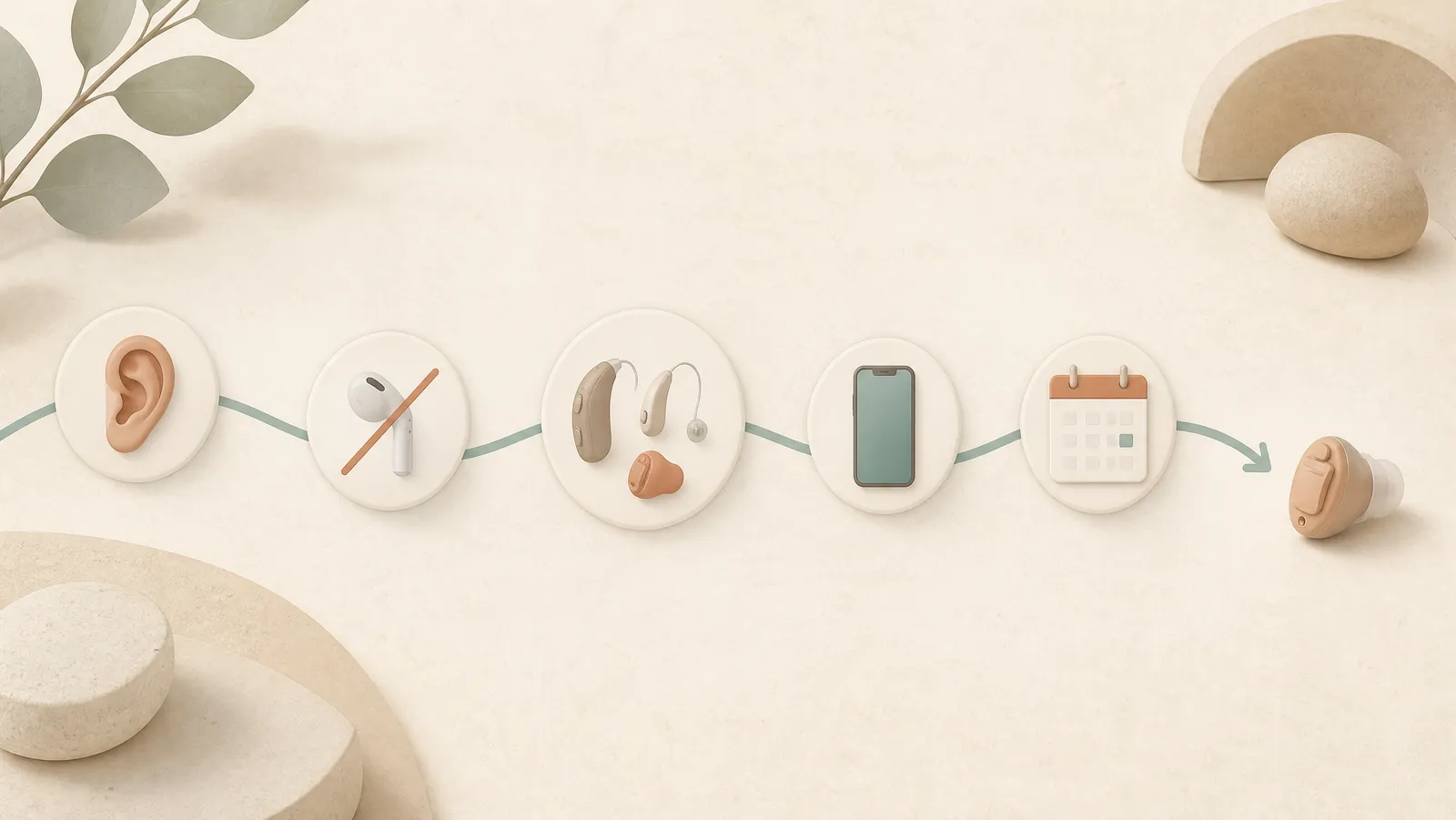
How to choose OTC hearing aids in five steps: confirm the category fits, pick a style you will wear, decide on an app, and check the return window first.

Affiliate disclosure: This article contains affiliate links. As an Amazon Associate we earn from qualifying purchases, at no extra cost to you. Learn more.
Choosing an over-the-counter hearing aid is five decisions made in a specific order: whether the category fits your hearing at all, whether the device is legally a hearing aid, which shape you will actually wear, whether you want an app, and what happens if the thing does not work. Most people decide price and app first. That order is backwards.
Here is the short answer to how to choose OTC hearing aids: the two things that predict whether a device stays in your ear are physical fit and a return window long enough to discover the fit. Neither is on the spec sheet. This guide is the method, not a ranking — if you want ranked picks, start with our roundup of the best over-the-counter hearing aids.
The short version
- Step 1 — Confirm you are in the category. OTC is for adults 18 and older with perceived mild to moderate hearing loss, and there is a short list of symptoms that should send you to a clinician instead.
- Step 2 — Confirm the product is a hearing aid. A regulated OTC hearing aid publishes things an amplifier does not.
- Step 3 — Pick the form factor you will wear all day. For most people, comfort and handling matter more than discreetness once the novelty wears off.
- Step 4 — Decide whether you want an app. "Self-fitting" is a regulatory category with a clearance behind it. "Has an app" is not the same thing.
- Step 5 — Buy the return policy before you buy the price. Fit and benefit only reveal themselves over weeks.
Step 1: Make sure OTC is the right category for you
The FDA built this category for a specific person. According to the agency, OTC hearing aids "are intended only for perceived mild to moderate hearing loss, and NOT for the treatment of severe or profound hearing loss," and buyers must be at least 18. They are sold "without the supervision, involvement, or prescription of a licensed health care professional" — no exam, no audiogram, no gatekeeper.
The word doing the heaviest lifting is perceived. Nobody checks whether your self-assessment is right, which is the category's convenience and its main failure mode. The Cleveland Clinic makes the point plainly: people overestimate and underestimate their own loss, and it cites a study in which nearly 20% of individuals could not correctly self-identify the extent of their hearing loss. Consumers who self-identify, it warns, "may miss underlying medical conditions."
Before anything else, work down the FDA's red-flag list. The agency says to see a doctor, preferably an ENT, if any of these apply:
- Ear shape or injury — a birth defect, an unusual shape, or an ear deformed in an accident.
- Drainage — blood, pus or fluid coming out of the ear in the past 6 months.
- Pain or discomfort in the ear.
- Heavy wax, or something possibly in the ear.
- Real dizziness — spinning or swaying, called vertigo.
- Sudden change — hearing that changed suddenly in the past 6 months.
- Fluctuating hearing — it gets worse, then gets better again.
- Asymmetry — noticeably worse hearing in one ear.
- One-sided ringing — ringing or buzzing in only one ear.
The American Academy of Audiology says people with conditions such as ear drainage, sudden hearing loss, dizziness or ear pain should not buy an OTC hearing aid without first seeing an audiologist or an ENT physician. None of that is a diagnosis. It is a triage list, and it belongs at the top of your process, not in the fine print of a box you have already opened.
Step 2: Rule out the things that are not hearing aids
Plenty of what sells as a hearing aid is a personal sound amplification product with a hearing-aid haircut. The distinction is legal, not cosmetic, and it is worth understanding how OTC hearing aids differ from sound amplifiers before you compare anything on price.
Three checks separate them, and all three are free:
- The package says both "OTC" and "hearing aid." Under 21 CFR 800.30, the outside package of an OTC hearing aid also has to carry a warning against use by anyone under 18, the red-flag conditions, notice of professional services, manufacturer contact information, and a notice of the return policy.
- The user instructional brochure is downloadable for free. The rule requires manufacturers to "make an electronic version available for download without site or customer registration and without requiring purchase." If you cannot find one, that is information.
- That brochure publishes two numbers. 21 CFR 800.30 requires "the maximum output limit value (Output Sound Pressure Level 90 (OSPL90))" and "the full-on gain value, which is the gain with a 50 decibel (dB) Sound Pressure Level (SPL) pure-tone input and volume set to full on." Amplifiers advertise a marketing number instead.
One phrase should end your interest in a listing. The FDA warns that "statements such as 'FDA Registered' and 'FDA Certified' medical devices, and the use of an FDA logo on an OTC hearing aid package labeling may be misleading." Registration is a form a facility files — not approval, not clearance, not a test of anything.
Step 3: Pick a form factor you will actually wear
Style vocabulary is where Amazon listings get loosest, so start from how audiologists define them. The UCSF EARS program describes the range this way:
- BTE, behind-the-ear — the case sits behind the ear with tubing to a dome or mould. Suits "mild through profound hearing loss," and handling is "often easiest."
- RIC, receiver-in-canal — a small behind-the-ear body with the speaker down in the canal. Suits "mild to severe hearing loss."
- ITE, in-the-ear — sits in the bowl of the outer ear and is "custom molded to your ear shape." Easier to insert and remove than tiny canal styles.
- ITC, CIC and IIC, the canal styles — progressively smaller and deeper, suited to "mild to moderate hearing loss," with the hardest handling and "small batteries/charging constraints."
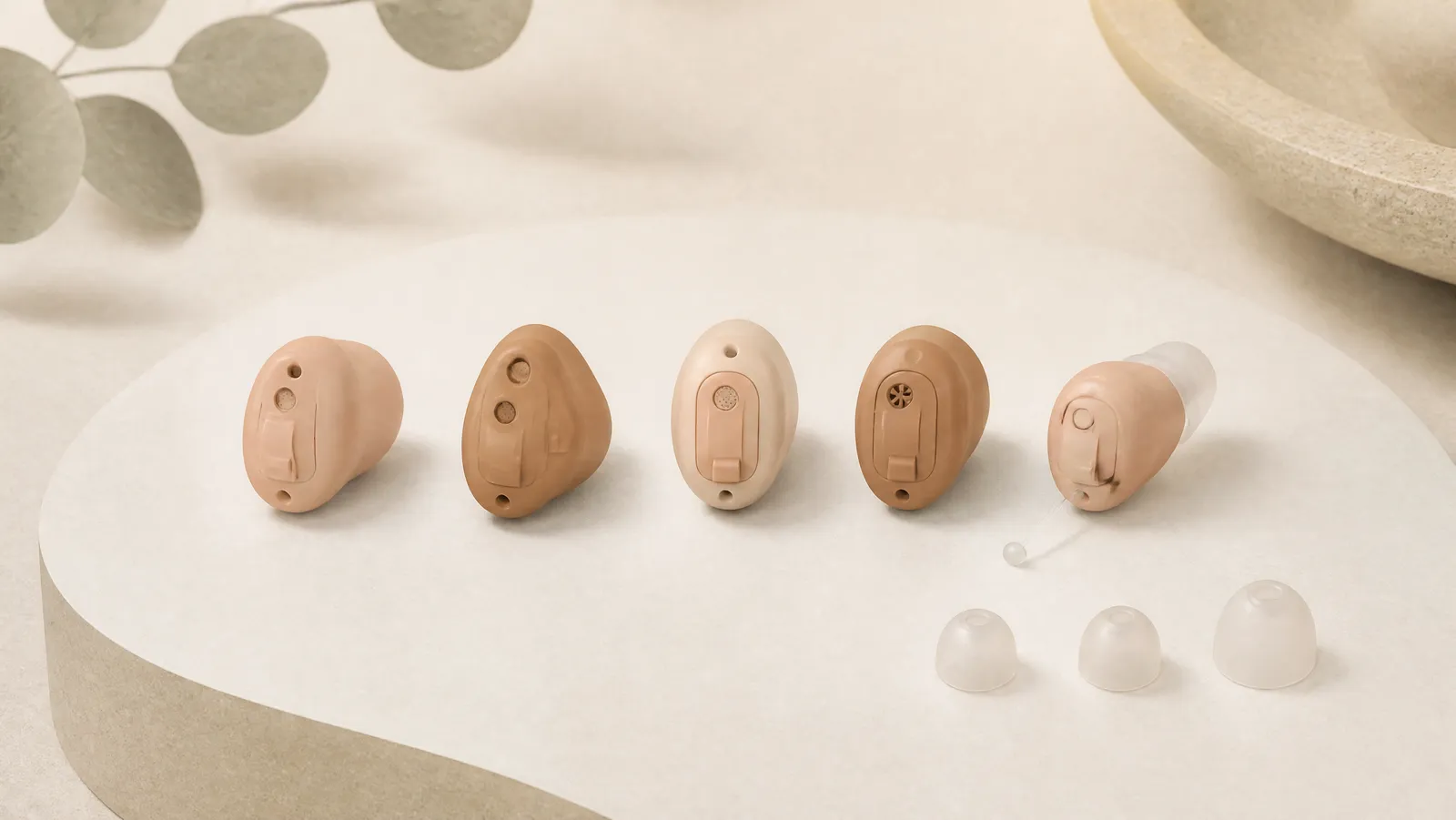
Two consequences follow. First, the smaller and deeper the style, the more it depends on matching your individual canal — and a true custom shell is moulded from an impression taken by a clinician, which a boxed retail product cannot do. What OTC sells as invisible is a stock-shell in-canal device sized by swappable eartips: a different thing, with different limits. That trade-off is the subject of our guide to invisible OTC hearing aids.
Second, discreetness is the feature people over-weight and dexterity is the one they under-weight. If you have arthritis, tremor or reduced fingertip sensation, the largest style you are willing to be seen in is usually the right answer. Glasses arms and mask loops also compete for the space behind the ear.
For small ear canals, the answer is eartip range rather than any single spec. Audiology practices that fit these devices describe dome sizes running from roughly extra-small to large, about 6 to 13 mm, and the failure modes in both directions: too small will not seal, too large irritates or hurts. Check how many eartip sizes ship in the box and whether replacements are sold separately. Then hold this line: a device that hurts after an hour is the wrong device, whatever it cost.
Step 4: Decide whether you want an app
This step has the most marketing fog and the clearest underlying rule.
Self-fitting is a regulatory classification. A self-fitting air-conduction hearing aid (21 CFR 874.3325) is defined as one that "incorporates technology, including software, that allows users to program their hearing aids," integrating user input with a self-fitting strategy. It is a class II device that requires 510(k) clearance, and its special controls state that "clinical data must evaluate the effectiveness of the self-fitting strategy" and that "usability testing must demonstrate that users can correctly use the device as intended under anticipated conditions of use." Preset and non-self-fitting OTC hearing aids are 510(k)-exempt — they carry no clearance, and that is normal rather than suspicious.
So the useful buying signal is not the presence of an app. It is whether the manufacturer claims the device is self-fitting, because that claim comes with a submission and evidence behind it. A Bluetooth app that only changes volume and preset modes does not make a device self-fitting.
Is the fitting app worth it? The evidence is better than we expected and narrower than the marketing suggests. In a randomized trial published in JAMA Otolaryngology–Head and Neck Surgery in 2023, De Sousa and colleagues gave 68 adults with self-reported mild to moderate hearing loss the same commercially available device, either self-fitted with remote support or fitted by an audiologist. The self-fitted group held an early advantage on two self-report measures at 2 weeks but not on speech recognition in noise, and by 6 weeks there were no meaningful differences on any outcome. A follow-up of 44 of those participants at roughly 8 months, published in the same journal in 2024, again found no clinically meaningful difference.
Read that carefully: it is evidence that self-fitting can match professional fitting for this population and this device, not that any app can. If you are not comfortable with a phone, you are not disqualified. The AAO-HNS summary of the final rule notes the FDA "is not requiring OTC hearing aids to be self-fitting devices," but does require them to be controllable and customisable by the user — and 21 CFR 800.30 requires every OTC hearing aid to have a user-adjustable volume control.
Step 5: Buy the return policy, not the price
Fit is only discoverable by wearing the device, in your own kitchen and your own restaurant, for weeks. That makes the return window the most important spec on the page, and it is almost never presented as one.
The rule helps you halfway. The outside of the package must carry a notice of the manufacturer's return policy, per 21 CFR 800.30 and the AAO-HNS summary of the final rule, but disclosure is not generosity: nothing sets a minimum length. The FDA's consumer guidance tells buyers to understand the terms of any applicable return or warranty period before purchasing. And where trial periods are mandated by state rules, the American Academy of Audiology ties that to the dispenser's audiology licence — not the same situation as a box shipped to your door.
Before you compare prices, get these four answers in writing:
- The length of the window, and when the clock starts — order date, delivery date, or first use.
- Restocking fees — a flat fee per aid, a percentage, or none.
- Who pays return shipping, and whether a return authorisation number is required.
- What voids it — opened eartips, a used charging case, missing packaging, or a required phone consultation.
A shorter warranty with a longer, cleaner return window is usually the better purchase, because the return window protects you against the failure mode that actually happens: it fits badly, or it does not help enough. Budget honestly, too — and if you have a tax-advantaged account, check whether OTC hearing aids are FSA or HSA eligible before spending post-tax money.
The specs worth checking, and the ones that are noise
Worth your attention:
- Eartip range in the box — sizes and shapes, and whether replacements are easy to buy.
- Battery type, as a trade-off and not a winner. Rechargeable means no fiddly cells to buy; disposables mean no downtime waiting on a charge, and some people with dexterity limits find a battery swap easier than seating an aid in a charging cradle. Pick the failure mode you can live with.
- Published OSPL90 and full-on gain figures, because their presence tells you the manufacturer is operating inside the rule.
- A downloadable brochure, a stated return policy, and real contact information.
- Physical controls, if you would rather not reach for a phone in a restaurant.
Mostly noise:
- "FDA registered" or an FDA-style logo. The FDA has said such claims may be misleading.
- A headline amplification number. The regulation caps output — 111 dB SPL, or 117 dB SPL where input-controlled compression is activated — but the AAO-HNS summary notes the FDA declined to set a separate gain limit, reasoning one "could decrease device effectiveness and user satisfaction." A big advertised gain figure is not a quality grade.
- Channel and band counts. Channel counts are not standardised across manufacturers, so a higher number is not by itself evidence that a device will work better for you.
- "Invisible" as a headline claim. See step 3.
The first month, realistically
Expect an adjustment, and expect it to be uneven. The UCSF EARS program frames the process in phases: week 1 is "normal weird", weeks 2 to 4 are targeted tuning, months 1 to 3 are stable habits and harder environments. New users commonly report the occlusion effect — the "talking in a barrel" sound of your own voice, which the programme says becomes less prominent by weeks 2 to 4 — and a world that feels "too present", with refrigerators, keys and footsteps suddenly loud. Early listening fatigue is common.
Two honest caveats. UCSF cautions that evidence for a distinct, predictable acclimatisation effect on speech recognition is mixed, and that there is "no single proven hourly schedule for everyone." We would not promise anyone that six weeks of persistence produces a specific gain. And adjustment applies to sound, not pain. Persistence fixes strangeness; it does not fix a device that hurts, whistles constantly or falls out. Those are fit problems, and the return window is the tool for them.
Our take
If we were talking a relative through this, we would spend the whole conversation on steps 1, 3 and 5. Rule yourself in or out of the category honestly, using the FDA's red-flag list. Pick the largest, easiest-to-handle style you are willing to wear in public. Then buy from the seller with the longest clean return window you can find, and treat the first six weeks as the real product test.
A baseline hearing test is not required and is still worth getting: the American Academy of Audiology recommends consulting an audiologist to confirm candidacy, and it gives you a number to compare against in five years. For the method translated into specific devices, see our complete OTC hearing aid guide.
Do I need a hearing test before buying OTC hearing aids?
No. According to the FDA, OTC hearing aids are available without the supervision, involvement or prescription of a licensed health care professional, so no exam is required. The American Academy of Audiology still recommends seeing an audiologist to confirm you are a candidate, and the Cleveland Clinic notes that people frequently misjudge the extent of their own loss and can miss an underlying medical condition.
Which OTC hearing aid style is best for small ear canals?
No single style solves it — eartip range does. Look for a device shipping several eartip sizes, since audiology practices describe domes running from roughly extra-small to large in the 6 to 13 mm range, with too-small tips failing to seal and too-large tips causing irritation. Behind-the-ear and receiver-in-canal styles also put less hardware inside the canal.
How long does it take to get used to hearing aids?
Most of the adjustment falls in the first one to three months. The UCSF EARS program frames week 1 as "normal weird", weeks 2 to 4 as targeted tuning and months 1 to 3 as stable habits, while cautioning that evidence for a predictable acclimatisation effect on speech recognition is mixed. Strangeness fades; pain and whistling are fit problems, not adjustment.
Does FDA-registered mean an OTC hearing aid is FDA-approved?
No. The FDA has said that statements such as "FDA Registered" and "FDA Certified", and the use of an FDA logo on OTC hearing aid labeling, may be misleading. Preset and other non-self-fitting OTC hearing aids are 510(k)-exempt, while self-fitting OTC hearing aids under 21 CFR 874.3325 do require FDA clearance.
Keep reading

Are OTC Hearing Aids FSA, HSA, or Medicare Eligible?
Are OTC hearing aids FSA eligible? Yes, and HSA too. Original Medicare is a flat no, Medicare Advantage usually helps. Here is how to pay for them in 2026.
The Most Discreet OTC Hearing Aids of 2026
Invisible OTC hearing aids do not really exist, but some are genuinely discreet. Five in-canal picks for 2026, and what going smaller actually costs you.
OTC Hearing Aids and Severe Hearing Loss: Where the Limit Is
OTC hearing aids for severe hearing loss are outside the FDA category, which covers perceived mild to moderate loss. Here is where the line sits, and why.