OTC Hearing Aids and Severe Hearing Loss: Where the Limit Is
OTC hearing aids for severe hearing loss are outside the FDA category, which covers perceived mild to moderate loss. Here is where the line sits, and why.

Affiliate disclosure: This article contains affiliate links. As an Amazon Associate we earn from qualifying purchases, at no extra cost to you. Learn more.
There are no OTC hearing aids for severe hearing loss. The category is authorized for adults with perceived mild to moderate loss, and the FDA states plainly that OTC hearing aids are "intended only for perceived mild to moderate hearing loss, and NOT for the treatment of severe or profound hearing loss." A retail device will not reach a severe loss, whatever the listing says.
That is an unsatisfying answer when you are looking at a $299 box and a $5,000 quote. So here is the rest: what "severe" means as a number, why the physics runs out before the marketing does, and what the other path costs. If you turn out to be inside the mild-to-moderate range after all, our roundup of over-the-counter hearing aids is the right next stop.
The short answer
- The category excludes severe loss. Not a judgment about any brand — it is the stated intended use of the OTC class.
- "Moderately severe" is already outside it. That band sits between moderate and severe, so a device advertised for it is advertising past its own category.
- A big gain number proves nothing. There is no legal gain cap on OTC hearing aids, so "up to 40 dB" is a marketing figure, not a certification.
- No one can tell your degree of loss from symptoms. A hearing test is how anyone finds out; OTC buying skips it by design.
- The prescription path is expensive, but not the only path. Veterans' benefits, Medicaid in some states, and state vocational rehabilitation are worth checking.
Severe hearing loss, defined in decibels
Degrees of hearing loss are set in decibels hearing level, or dB HL — the quietest sound you can detect at each pitch on an audiogram, measured against a normal-hearing reference. A higher number means a worse loss. Two classifications get quoted most, and they do not agree, so it matters whose numbers you are reading.
The World Health Organization grades (2021 revision). In its World Report on Hearing, WHO grades loss by the hearing threshold in the better ear in even 15 dB steps: mild is 20 to under 35 dB, moderate 35 to under 50, moderately severe 50 to under 65, severe 65 to under 80, profound 80 to under 95, and complete or total loss at 95 dB and above. The same table describes each grade in practice. In a quiet room, WHO puts moderately severe as "difficulty hearing conversational speech" while raised voices still come through, and severe as "does not hear most conversational speech; may have difficulty hearing and understanding raised voices."
The Clark (1981) bands used across US audiology. The version published for the public by the Communication Health Support Association, powered by the American Speech-Language-Hearing Association, runs: normal -10 to 15 dB HL, slight 16 to 25, mild 26 to 40, moderate 41 to 55, moderately severe 56 to 70, severe 71 to 90, and profound 91 and above. That page adds a caveat: "not all professionals agree on the cutoff for 'normal' hearing."
Neither set is universal: a 66 dB average is "severe" by WHO and "moderately severe" by Clark. But both agree on the shape. Somewhere in the 50s and 60s dB HL, unaided conversation in a quiet room stops being reliable — well past where a retail device operates.
Moderately severe is a real band, and marketing loves to blur it
Both classifications contain a separate step called moderately severe. It is not a softer way of saying moderate: in the WHO grades it starts at 50 dB, in Clark's at 56 dB.
The FDA's category covers perceived mild to moderate loss and nothing beyond. A product page promising help with "moderate to severe" or "moderately severe" hearing loss is describing a use the OTC class was never authorized for, even if the device is legally sold over the counter.
A related trap: "FDA Registered" is not FDA approval. The FDA says on its own OTC hearing aid page that statements such as "FDA Registered" and "FDA Certified" on labeling "may be misleading." Under the FDA's device classifications, preset OTC hearing aids are exempt from premarket review; only self-fitting OTC hearing aids go through an actual FDA 510(k) clearance.
The line the OTC category draws, legally and physically
The FDA's final rule creating the OTC category took effect October 17, 2022. It covers air-conduction hearing aids for adults 18 and older with perceived mild to moderate hearing loss, sold without a licensed professional involved. The word "perceived" does a lot of work: no audiogram is required to buy one.
The rule then constrains the hardware in two ways. The output limit "will be 111 decibels of sound pressure level (dB SPL), with 117 dB SPL allowable for devices while input-controlled compression is activated." And the innermost part of the device "must be reasonably expected to remain at least 10 millimeters (mm) from the tympanic membrane (eardrum)." Neither caps how much amplification a device may advertise.
The "40 dB gain" claim on a listing is not the constraint
Gain is how much a device adds to an incoming sound. Output is how loud the result can actually get at your eardrum. Sellers advertise gain because it is a big number and they are allowed to: in the final rule, the FDA wrote that "we did not propose, and are not finalizing, a separate gain limit." No one set a number there. That is not the same as anyone reviewing the device for severe loss.
Four things decide what a device can really do:
- The output ceiling. 111 dB SPL, or 117 dB SPL with input-controlled compression, is the top of the range whatever the gain spec says.
- Feedback. A high-gain fitting with a loose silicone dome whistles. Measuring stable gain across instant-fit couplings for Hearing Review in 2009, Gray and Meredith found a universal instant earmold delivered roughly 10 dB more stable gain at 4 kHz than a vented dome, and concluded that feedback "is still an issue and is particularly relevant for hearing aid users with greater than mild-to-moderate levels of hearing loss."
- The seal. NIDCD describes behind-the-ear aids as a case worn behind the ear "connected to a plastic earmold that fits inside the outer ear," a design used for mild through profound loss. The custom earmold keeps high amplification pointed at the eardrum instead of leaking back into the microphone.
- Fitting accuracy. Amplification aimed at the wrong frequencies is wasted at any power level, and an OTC device is tuned from an app or a factory preset rather than measured in your ear canal.
None of that is fixed by a bigger number on a spec sheet. We go further into what OTC devices do and do not deliver in our piece on whether OTC hearing aids actually work.
Trying an OTC device anyway: the realistic outcome
For most people the likelier outcome is not injury but disappointment, at a cost of a few hundred dollars: speech that is louder but still unintelligible, whistling when you push the volume, a device in a drawer by week three. Many conclude from that experience that hearing aids do not work for them, when what failed was the match.
The bigger risk is time. OTC buying is self-assessment by design, and self-assessment measures your experience, not your thresholds. In a 2015 study in the Brazilian Journal of Otorhinolaryngology of 71 adults aged 60 to 82, the Hearing Handicap Inventory for the Elderly reached 90 to 100 percent sensitivity against audiometric criteria but only 43.5 to 58.5 percent specificity. Questionnaires flag that something is wrong; they agree poorly about how much. Nothing in an online checkout catches the gap.
Some causes are also urgent. For sudden sensorineural hearing loss — unexplained, rapid loss all at once or over a few days — NIDCD says you "should consider sudden deafness symptoms a medical emergency and visit a doctor immediately," warning that delay "can decrease treatment effectiveness."
The signs it is time to see an audiologist instead
The FDA publishes a red-flag list because OTC buyers skip the exam. Per the FDA, see a doctor — preferably an ear, nose and throat physician — before using a hearing aid if you have any of these:
- Ear deformity, from birth or injury.
- Blood, pus or fluid coming from the ear in the past six months.
- Ear pain or discomfort.
- Excessive earwax, or the sense that something is in your ear.
- Severe dizziness, spinning or swaying.
- A sudden change in hearing within the past six months, or hearing that gets worse and then better.
- Worse hearing in one ear, or ringing or buzzing in one ear only.
The FDA adds two practical signals to see a hearing health care professional instead: "you can't hear speech even if the room is quiet," and "you don't hear loud sounds well." Neither is a diagnosis. Both mean the question has moved past what a box can answer.
The prescription path, and what it costs
A clinic sells measurement and service, not just louder hardware: an audiogram of each ear, programming to a validated prescriptive target, verification of what reaches your eardrum, custom earmolds where the power demands a seal, and follow-up when the setting is wrong. We lay that out in OTC hearing aids compared with prescription hearing aids.
On price, treat any single figure with suspicion. HearingTracker's 2025 survey of more than 1,100 purchasers, covering 879 US pair purchases with reported pricing, found an average of $3,432 per pair for prescription aids against $502 for OTC — and about $4,727 per pair for people buying from a traditional clinic without insurance. Medicare.gov states that "Original Medicare doesn't cover hearing aids or exams for fitting hearing aids," though Part B does cover diagnostic hearing and balance exams your provider orders, at 20 percent of the approved amount after the deductible.
Past a certain point, hearing aids stop being the question. NIDCD describes a cochlear implant as "a small, complex electronic device that can help to provide a sense of sound to a person who is profoundly deaf or severely hard-of-hearing," and reports roughly 118,100 devices implanted in US adults as of December 2019. That is candidacy, not shopping: adults are evaluated by an audiology and surgical team. As summarized by Reddy and colleagues in Audiology and Neurotology in 2022, US FDA candidacy criteria have centered on aided sentence recognition below 40 percent in the ear to be implanted and below 60 percent in the other, tested with properly fitted hearing aids.
If cost is the obstacle
Often the reason someone shops OTC with a severe loss is that a $4,000 pair is out of reach. Check these first.
- Veterans' benefits. VA prosthetics services state that for eligible veterans, "the hearing aids, repairs, and future batteries will all be at no charge to you, as long as you maintain VA eligibility for care." Enrollment and a clinical evaluation come first.
- Medicaid. The Hearing Loss Association of America notes that adult coverage varies by state, while hearing care and hearing aids for children are covered in every state.
- State vocational rehabilitation. HLAA describes these agencies as assisting adults with disabilities, including hearing loss, in matters related to employment and job seeking.
- Nonprofits. NIDCD notes that some nonprofit organizations provide financial assistance, or offer used or refurbished hearing aids.
- The exam first, the device later. A Part B diagnostic exam is usually covered even when devices are not, and the audiogram is a number you own that follows you to any future purchase.
Our take
We would tell a relative what we are telling you: if a quiet one-on-one conversation is already hard work, do not spend $300 on a device the FDA has said is not for that. Spend the smaller money on a hearing test.
If the audiogram lands in the mild-to-moderate range, you have gained a map — take it to how to choose OTC hearing aids and to our OTC hearing aid buyer's guide, and buy with your own numbers in hand. If it lands further down, you have started the process toward a device that can reach your loss. The route that wastes both money and years is buying past the category line, then treating the failure as proof that hearing aids do not help.
Can OTC hearing aids help severe hearing loss?
No. The FDA states that OTC hearing aids are "intended only for perceived mild to moderate hearing loss, and NOT for the treatment of severe or profound hearing loss." Devices for severe loss are fitted by a professional after a hearing test — usually power behind-the-ear aids with custom earmolds.
What is the difference between moderate and moderately severe hearing loss?
They are adjacent bands on the same scale, and moderately severe is worse. Under the WHO 2021 grades, moderate is 35 to under 50 dB HL and moderately severe is 50 to under 65 dB HL. Under the Clark bands, moderate is 41 to 55 dB HL and moderately severe is 56 to 70 dB HL.
Do I need a hearing test before buying hearing aids?
Not legally. The FDA's OTC rule covers perceived mild to moderate loss, so no audiogram is required to buy. Practically, a test is the only way to know your thresholds, and Medicare Part B covers a diagnostic hearing exam your provider orders at 20 percent of the approved amount after the deductible.
Does a higher dB gain number mean a hearing aid handles worse hearing loss?
No. In the 2022 final rule, the FDA wrote that it "did not propose, and are not finalizing, a separate gain limit" for OTC hearing aids, so an advertised gain figure reflects no review of suitability. Real-world performance is limited by the output ceiling of 111 dB SPL (117 with input-controlled compression), plus feedback, the ear seal, and fitting accuracy.
Keep reading
Are OTC Hearing Aids FSA, HSA, or Medicare Eligible?
Are OTC hearing aids FSA eligible? Yes, and HSA too. Original Medicare is a flat no, Medicare Advantage usually helps. Here is how to pay for them in 2026.
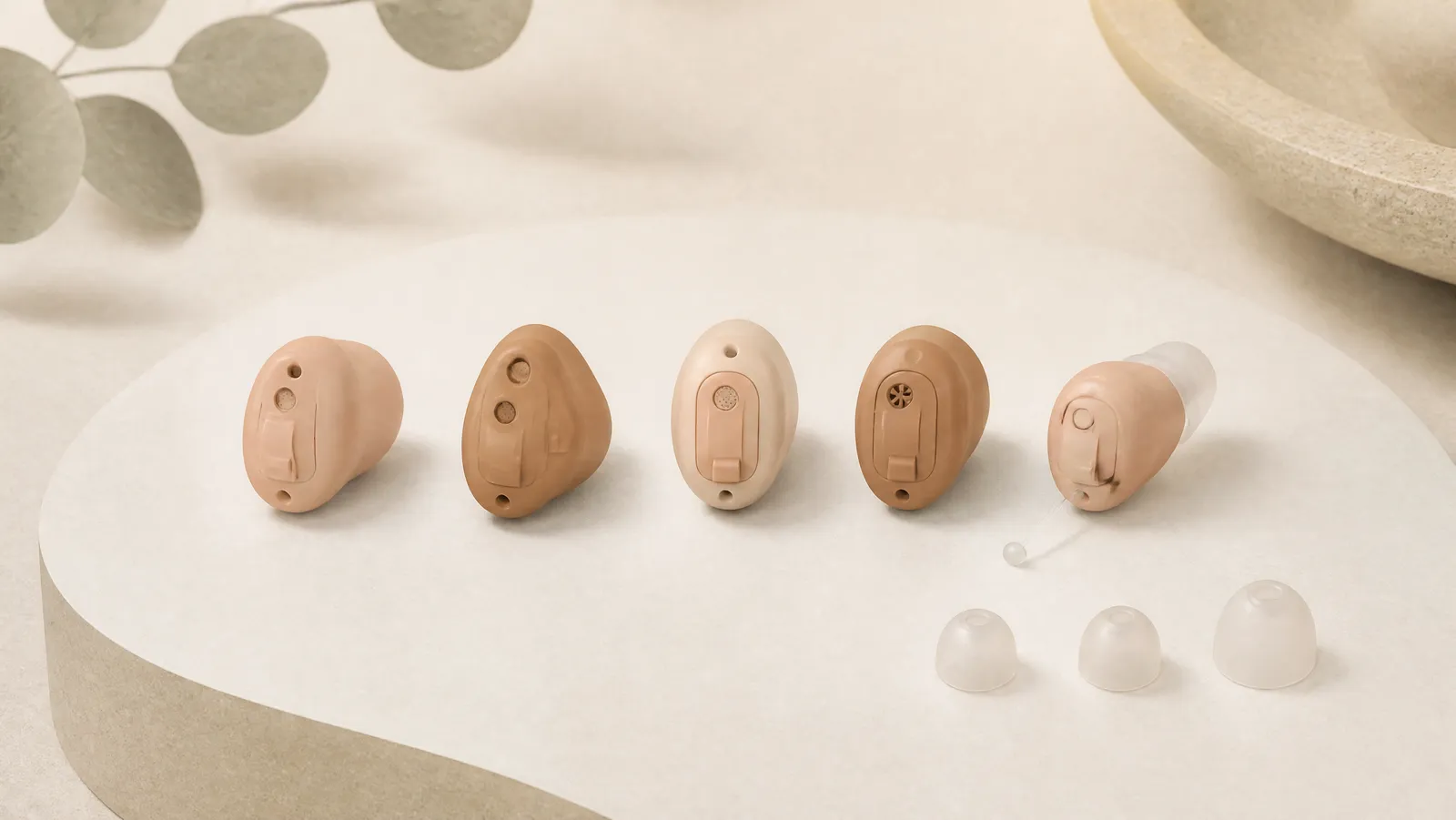
The Most Discreet OTC Hearing Aids of 2026
Invisible OTC hearing aids do not really exist, but some are genuinely discreet. Five in-canal picks for 2026, and what going smaller actually costs you.
The Best OTC Hearing Aids with Bluetooth in 2026
The best OTC hearing aids with Bluetooth in 2026: which ones truly stream calls and music, which use Bluetooth only for a phone app, and how to tell.