Vision Changes After 50: Presbyopia, Night Vision, Floaters and More
Which vision changes after 50 are ordinary aging and which ones need an appointment. Presbyopia, night glare, floaters, dry eye and the real red flags, sourced.


Affiliate disclosure: This article contains affiliate links. As an Amazon Associate we earn from qualifying purchases, at no extra cost to you. Learn more.
Most vision changes after 50 are mechanical rather than medical. The lens inside the eye stiffens, the pupil gets smaller, the gel filling the eye shifts and clumps, and the tear film turns unreliable. Those changes are ordinary. A short list of other changes is not ordinary, and those mean an appointment rather than a stronger pair of readers.
The hard part is telling the two apart. Someone who can no longer read a menu and someone who sees a gray curtain slide across one eye are having very different weeks, and both type the same thing into a search box. This article sorts the common changes by what is physically happening and when it is a same-day call. It is a companion to our broader explainer on how eye health changes after 50.
One caveat first. We are a research desk, not a clinic, and we did not examine anyone. Everything below is drawn from published guidance from the National Eye Institute, the American Academy of Ophthalmology and the American Optometric Association, plus peer-reviewed research, with the source named each time.
Presbyopia: the change almost nobody escapes
If your arms have started feeling too short, that is presbyopia, and it is the single most predictable of the eye changes after 40. The American Optometric Association puts the onset plainly: "Beginning in the early to mid-40s, many adults may start to have problems seeing clearly at close distances," and the reason is that "the lens inside the eye becomes less flexible."
The mechanism in plain terms: to focus up close, a muscle inside the eye squeezes and the lens thickens. A clinical reference on presbyopia published in StatPearls through the NIH National Library of Medicine attributes the primary change to lost lens flexibility caused by protein aggregation and cross-linking, which reduces the lens's ability to bend and thicken when that muscle contracts. The same reference notes presbyopia typically begins in the early to mid-40s and keeps progressing into the sixth decade of life.
Three things follow, and they explain most of what people find confusing about near vision after 50:
- Near focus goes first because near focus is the job that requires the most shape change from the lens.
- It gets slowly worse for about two decades and then tends to level off, which is why your reading prescription keeps creeping up through your 50s.
- It is not a disease. It is a structural change in a part of the eye that has been accumulating protein since you were born.
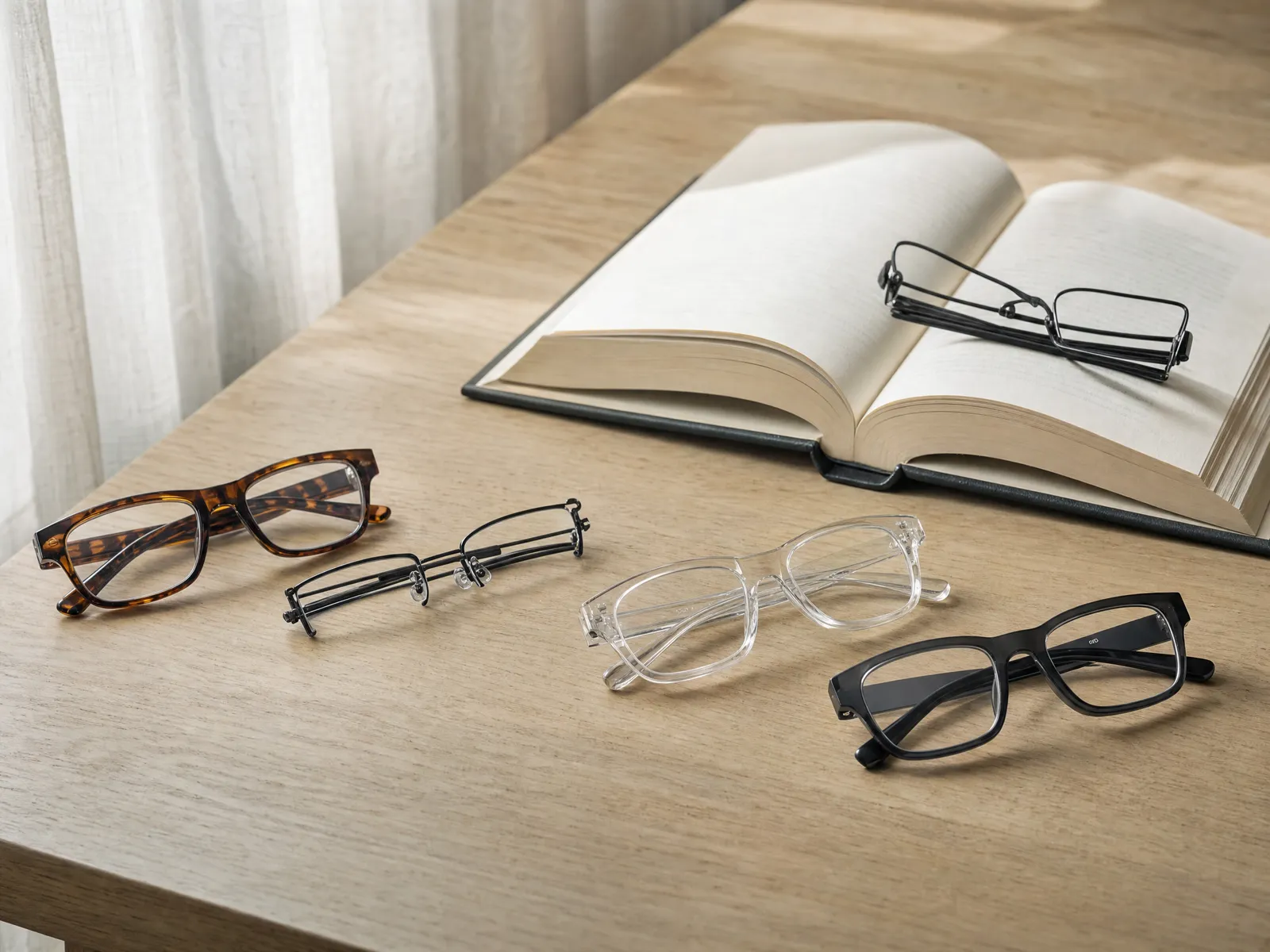
This is the change most people solve with glasses rather than medicine. If you are shopping for your first or fourth pair, we compared published specifications across the current crop in our roundup of the best reading glasses.
You need more light than you used to
This is the second near-universal change, and the internet serves it badly, repeating unsourced multipliers about how much more light an older eye needs. Here is what we could actually verify.
Your pupil gets smaller with age, even in the dark. A 2024 study by Lazar and colleagues in Royal Society Open Science measured pupil size in everyday viewing conditions across 83 people aged 18 to 87. In darkness, pupil diameter shrank by roughly 0.41 mm per decade of age. In bright light the age effect was far smaller, about 0.08 mm per decade. A smaller pupil in dim conditions means less light reaching the retina, which the authors note is a reason to account for age in lighting design.
The penalty shows up in performance too. In a review of aging and vision published in Vision Research, Cynthia Owsley reported that young and older adults have the same sensitivity to a coarse pattern in daylight, but under very low light conditions older adults need on average three times the contrast of younger adults to pick out the same target.
So the honest version is not "you need exactly X times more light." It is: your daylight vision holds up far better than your dim-light vision, and the gap widens with age. The American Optometric Association lists needing more light to see as well as you used to among the expected changes in this age band. The useful response is cheap: put a bright, well-aimed task lamp where you actually read, cook and do close work, rather than relying on one ceiling fixture and squinting harder.
Night driving gets harder, and sometimes it means something
Three separate age changes stack up after dark. The pupil is smaller, so less light gets in. Contrast sensitivity in low light drops, per the Owsley review. And dark adaptation slows: that same review reports that the time it takes 70-year-olds to recover full low-light sensitivity after a bright light is more than 10 minutes longer than it takes people in their 20s.
That last number explains the specific misery of night driving. Oncoming headlights bleach your retina, and the recovery that used to be quick now is not. The American Optometric Association describes exactly this for the 41-to-60 group: added glare from headlights at night and from sun bouncing off windshields and pavement.
Worsening night glare is also one of the first things people notice with a developing cataract. The National Eye Institute lists among cataract symptoms that you cannot see well at night, that lamps, sunlight or headlights seem too bright, and that you see a halo around lights. If your night driving has gotten clearly worse over a year or two, get examined rather than buying tinted night-driving lenses. Read up on the early signs of cataracts, then let an eye doctor look.
Floaters and flashes: the section that matters most
Floaters are the change that scares people most, and usually they are nothing. The American Academy of Ophthalmology describes floaters as tiny clumps of gel or cells inside the vitreous, the jelly filling the eye, and says what you see are the shadows those clumps cast on your retina. With age, the AAO explains, the vitreous thickens or shrinks and clumps or strands form in it. Flashes happen when the vitreous rubs or pulls on the retina.
When the vitreous pulls away from the back of the eye entirely, that is a posterior vitreous detachment. It is common with age, it often announces itself with a burst of floaters, and it usually settles into an annoyance rather than an emergency. The AAO notes that floaters tend to fade and become less noticeable over time.
But the vitreous pulling on the retina can also tear it, and a torn retina can detach. That is why there is a red-flag list, and why it is short enough to memorize. According to the American Academy of Ophthalmology, call an ophthalmologist right away if:
- you notice a lot of new floaters
- you have a lot of flashes
- a shadow appears in your peripheral (side) vision
- a gray curtain covers part of your vision
The AAO says these can be symptoms of a torn or detached retina, which is a serious condition that needs to be treated. Treat that list as a same-day call, not a wait-and-see. A clinical reference on posterior vitreous detachment in StatPearls, hosted by the NIH National Library of Medicine, adds that follow-up after a PVD is individualized but generally falls within two to six weeks of symptom onset, and sooner for a sudden increase in floaters, new or worsening flashes, a dark veil or shadow anywhere in the field of vision, or any abrupt drop in clarity.
The working rule: floaters you have had for years are background noise. A sudden change in their number, repeated flashes, or anything resembling a shadow or curtain is a phone call today.
Smeary, fluctuating vision is often a tear problem
Not everything blurry is the lens. If your vision goes soft and then clears when you blink, or is fine in the morning and smeary by evening, the tear film is a likely suspect. The American Academy of Ophthalmology's 2018 Preferred Practice Pattern on dry eye says the condition is usually not sight-threatening but is "characterized by fluctuating vision" and irritation that is generally worse by the end of the day, and that dry eye "is also a cause of reduced visual function" — with vision-related quality of life hit hardest through impaired reading. The optical explanation in the published research is that the tear film, not the cornea, is the eye's most anterior refractive surface, so when it breaks up unevenly between blinks the image degrades even if the eye chart still reads fine.
It is not rare. The American Academy of Ophthalmology's EyeNet, reporting Schaumberg and colleagues' prevalence work, puts it at roughly 3.23 million women and 1.68 million men aged 50 and older in the United States with moderate to severe dry eye — close to five million people.
Dry eye is worth ruling out because it is often more fixable than the structural changes above, and it gets misread as "my prescription must be wrong again." We go through the options, including the ones that mostly do not work, in our piece on dry eye after 50.
Colors look slightly different
This one is subtle, and most people never name it. The American Optometric Association says the normally clear lens inside the eye may start to discolor, which makes it harder to see and distinguish between certain color shades. The National Eye Institute lists faded colors as a cataract symptom and describes the clear lens slowly changing to a yellowish or brownish color, adding a brownish tint to vision.
In daily life that shows up as navy and black laundry becoming hard to tell apart, whites looking warmer than other people say they are, and blues getting muted. A slow, even drift fits ordinary lens aging. A shift that one eye sees and the other does not is worth raising at an exam.
Can you supplement your way out of this?
Mostly, no, and the evidence here is unusually clear. The National Eye Institute ran the Age-Related Eye Disease Study and its follow-up, AREDS2, to test whether nutritional supplements could prevent or slow cataract and age-related macular degeneration. Per the NEI, the AREDS and AREDS2 formulations cut the risk of progression from intermediate to advanced AMD by about 25 percent, but they do not prevent AMD from developing and they had no effect on cataract. That is a real but narrow benefit for people who already have a specific diagnosis. It is not a reason for everyone over 50 to take an eye vitamin, and it does nothing for presbyopia, floaters or night glare.
What is not normal aging
Everything above is the ordinary machinery of an older eye. This list is different. These are changes that mean an appointment rather than a stronger pair of readers.
- A sudden change in vision, especially in one eye. The AAO says sudden loss of vision should be checked right away, and that sudden blurriness can signal cataract, macular degeneration, retinal or systemic disease.
- Straight lines looking bent or wavy. The National Eye Institute names this as a warning sign of late AMD and says to see your eye doctor right away. If this is you, read up on macular degeneration risk factors after you have made the call.
- Losing part of your field of vision, including side vision. The American Optometric Association lists loss of peripheral vision among the symptoms to report.
- A new shadow or curtain, per the retina red-flag list above.
- Double vision. The AAO notes that double vision can warn of systemic brain conditions or nerve injury.
- Eye pain, or a painful red eye. The AAO groups a painful red eye with urgent and emergency eye conditions.
- Vision that keeps fluctuating. The American Optometric Association flags fluctuating vision, meaning frequent changes in how clearly you see, as a possible sign of diabetes or high blood pressure.
None of these is self-diagnosable from an article, including this one. They are triggers to get looked at, not conclusions.
What to actually do about eye problems after 50
Five things, roughly in order of return on effort.
Keep the exam interval. The American Optometric Association recommends a comprehensive eye exam at least every two years for adults aged 40 to 64 with no risk factors, and at least annually for those at risk. The American Academy of Ophthalmology's guidance for people without risk factors runs every one to three years from 55 to 64 and every one to two years from 65 on. The National Eye Institute puts it more bluntly: a dilated eye exam is the single best thing you can do for your eye health, because it is the only way to find many eye diseases early, before they cause vision loss. If you are unsure where you land, we broke down how often to get an eye exam by age and risk.
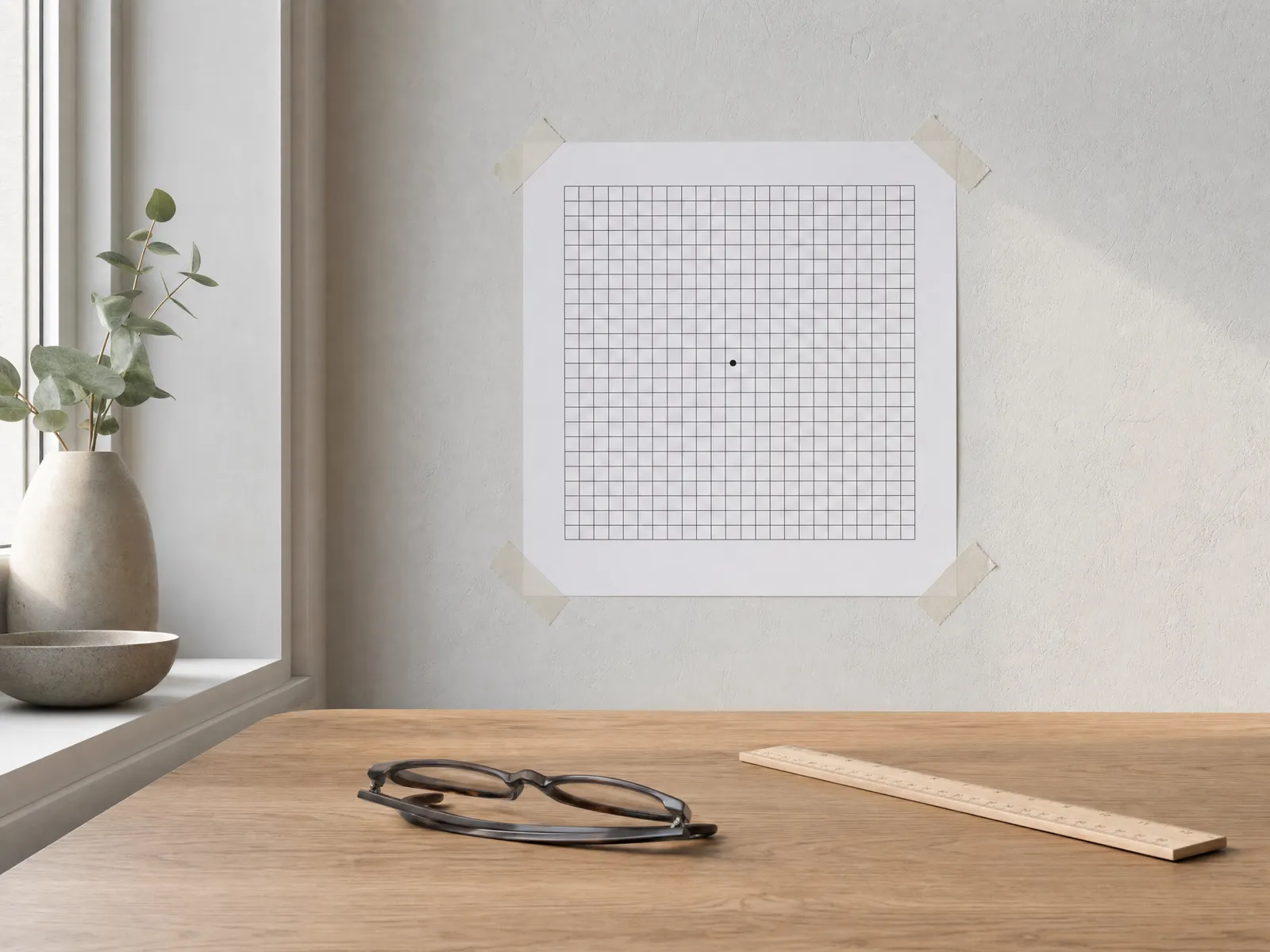
Check yourself between exams. One eye quietly compensates for the other, so problems hide. The AAO's Amsler grid instructions: wear your reading glasses, hold the grid 12 to 15 inches away in good light, cover one eye, look at the center dot, and notice whether any lines look wavy, dark, blurry or blank, then repeat with the other eye, using the same place, lighting and distance each time. Contact your ophthalmologist right away, the AAO says, if any area looks darker, wavy, blank or blurry. We cover that and a few other simple checks in our guide to how to test your vision at home.
Fix the lighting. Given the pupil and contrast data above, better task lighting is the cheapest intervention on this page.
Do not smoke. The National Eye Institute states that quitting lowers your risk for eye diseases including macular degeneration and cataracts.
Manage blood pressure and blood sugar. The NEI notes that diabetes and high blood pressure can increase your risk for some eye diseases, like glaucoma, and that for people with diabetes, controlling blood pressure and cholesterol helps lower the risk of vision loss. The CDC adds that over time high blood sugar damages the blood vessels in your eyes, and can also affect the shape of your lenses and make your vision blurry.
A necessary disclaimer
This article is general information, not medical advice. Better Life Span is a research and review site, not a medical practice, and nothing here can diagnose you. Talk to an eye doctor or your physician about your own eyes, risk factors and symptoms.
Do not wait on sudden vision loss, eye pain, a sudden burst of new floaters or flashing lights, or a shadow or curtain across your field of vision. Those are urgent. The American Academy of Ophthalmology is explicit that they can signal a torn or detached retina. They need to be seen, not self-treated.
The bottom line
Does eyesight deteriorate with age? Yes, mostly in boring, predictable ways. The lens stiffens, so near focus goes. The pupil narrows and contrast sensitivity drops, so you need more light and night driving gets worse. The vitreous shrinks, so floaters appear. The tear film falters, so vision smears. Most of that is managed with light, lenses and a kept appointment.
What matters is the short list that breaks the pattern: sudden change, wavy lines, lost field, a curtain, pain, double vision. Those get a call. For the full picture of how the eye ages and what is worth spending money on, start with our complete guide to eye health after 50.
Keep reading
How to Test Your Vision at Home (and What a Home Test Cannot Tell You)
How to test your vision at home in about ten minutes: the Amsler grid protocol, a distance chart done properly, near-vision checks, and the diseases no home test can see.

Eye Health After 50: What Changes, What Helps, and What Actually Works
Eye health after 50: what really changes, which supplements and drops have evidence behind them, how often to get examined, and the symptoms to act on today.
The Best Reading Glasses for Presbyopia in 2026
The best reading glasses for presbyopia in 2026. Why several cheap pairs beat one costly pair, how to pick your strength, and our five picks.