How to Test Your Vision at Home (and What a Home Test Cannot Tell You)
How to test your vision at home in about ten minutes: the Amsler grid protocol, a distance chart done properly, near-vision checks, and the diseases no home test can see.

Affiliate disclosure: This article contains affiliate links. As an Amazon Associate we earn from qualifying purchases, at no extra cost to you. Learn more.
You can check three things at home in about ten minutes: whether straight lines still look straight, how sharp your distance vision is, and how your eyes handle close work and glare. All three are free. None of them is a diagnosis, and none of them can see the eye diseases that take sight quietly, without symptoms.
That last part is the whole point of this guide. A home eye test is a change detector, not a verdict. Its only job is to notice that something is different this month from last month, and to send you to someone with a slit lamp. If you want the bigger picture of how eye health changes after 50, start there. This piece is the bench work.
Here is how to test your vision at home properly, and the long list of things it cannot touch.
What a home vision test is actually for
Every serious at-home protocol tells you to cover one eye. That single instruction carries most of the value, because two open eyes are a cover-up: your brain blends the images and patches the weaker eye with the better one, so a problem on one side can sit there for years without announcing itself.
Slow change is the other blind spot. The National Eye Institute says glaucoma's vision loss usually starts in side vision and happens so slowly that "many people can't tell that their vision is changing at first."
The same logic runs through our guide to testing your hearing at home: screening sorts you into "probably fine" and "worth a look." It does not name the problem.
Test 1: the Amsler grid, for straight lines
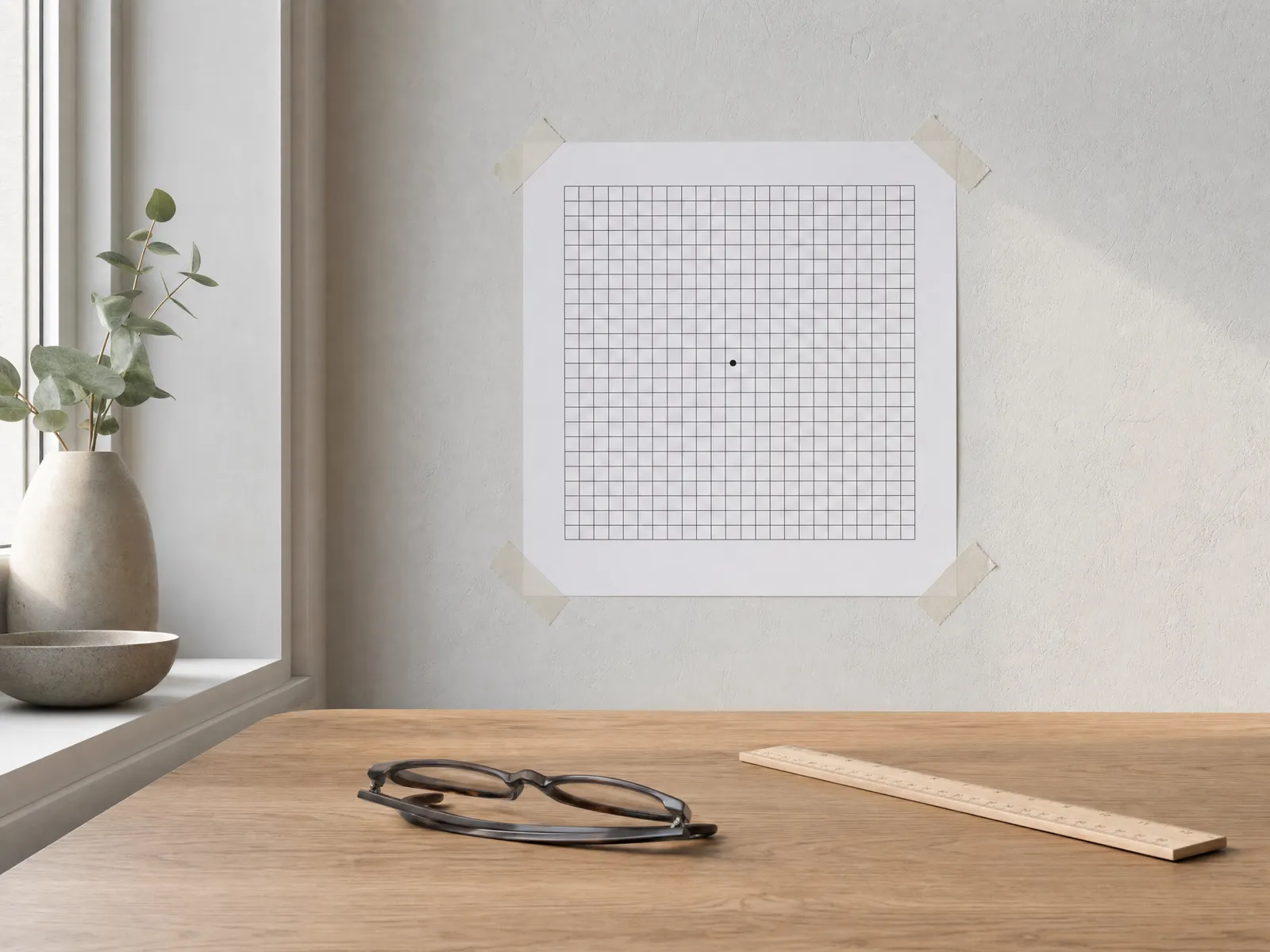
The Amsler grid is a square of fine graph-paper lines with a single dot in the middle. Print one from a reputable eye-health organisation — the American Academy of Ophthalmology publishes the grid and its step-by-step instructions free — and keep it somewhere you will actually see it.
The Academy's protocol, followed exactly:
- Wear the glasses you normally use to read.
- Hold it 12 to 15 inches from your face, in good light. That is bent-arm reading distance. Measure it once so you can repeat it.
- Cover one eye. Use a cupped palm, not fingers pressed on the eyelid.
- Look directly at the centre dot and keep your eye focused on it. Do not let your gaze wander — the whole test happens in your side vision while you stare at the dot.
- Notice whether any lines or areas look blurry, wavy, dark or blank.
- Repeat with the other eye.
The Academy is unambiguous about a positive finding: "If you notice any areas of the grid that appear darker, wavy, blank or blurry, contact your ophthalmologist right away." It also recommends the test once a day, every day, for people who already have age-related macular degeneration.
The National Eye Institute describes the symptoms of late AMD, wet or dry, as "Straight lines start to look wavy or crooked," with a blurry area near the centre of vision. (Intermediate dry AMD, per the NEI, may cause no symptoms at all, or only mild central blurriness and trouble seeing in low light.) That is the signal the grid is built to catch.
If you find distortion, the next thought is almost always supplements. Before spending anything, read whether do eye vitamins really work — the honest answer depends on which stage of AMD you have, and it is separate from your macular degeneration risk factors, which belong with an eye doctor rather than a bottle.
What the Amsler grid actually catches, and what it misses
A 2023 systematic review and meta-analysis in JAMA Ophthalmology pooled 10 studies covering 1,890 eyes and found the Amsler grid detected neovascular ("wet") AMD with a pooled sensitivity of 67% against healthy eyes, and 71% when the comparison group was eyes with non-neovascular AMD. Specificity was 99% against healthy eyes but only 63% against non-neovascular AMD.
Translate that: a clear distortion on the grid is a meaningful finding, not noise. But roughly a third of eyes with wet AMD passed the test anyway. The authors put it plainly: "Although the Amsler grid is easy and inexpensive to use for detection of metamorphopsia, its sensitivity may be at levels typically not recommended for monitoring," and patients "should be encouraged to undergo ophthalmic examination regularly, regardless of any results of Amsler grid self-assessment."
Two more caveats from the same paper. The grid tests in those studies were supervised, which "may not reflect the performance of the Amsler grid test self-assessment for home monitoring." And no randomised trial shows that home Amsler monitoring changes real-world outcomes.
So do the grid: it is free, takes 30 seconds, and a positive result is worth acting on. Just never read a clean grid as an all-clear.
Test 2: a distance chart, for sharpness
Printable distance charts are easy to find online for free. Doing one properly takes five minutes.
- Tape the chart to a plain wall at roughly eye level, with even light on the paper and no lamp glare or window reflection.
- Measure the distance the chart specifies with a tape measure, not paces. Many home-printable charts are scaled for 10 feet rather than the clinic's 20.
- Wear whatever you normally wear for distance — glasses or contacts, as you would to drive.
- Cover one eye, read down to the smallest line where you get more than half the characters right, then swap.
- Write down the line number for each eye, not a guess at a 20/x score.
That last rule matters. A 2022 study in JAMA Ophthalmology, summarised by Review of Optometry, randomised 218 participants across three at-home acuity tests and found all three "comparable within one line to in-office visual acuity measurements," with the printed chart performing best at a mean difference of -0.07 logMAR, ahead of a phone app at -0.12 and a website at -0.13.
Encouraging — but that is a chart printed and used correctly, under study conditions. Your printer's "fit to page" setting, an unmeasured distance, or a chart scaled for 10 feet read from 8, all quietly destroy the 20/x label while leaving the test looking official. Record "smallest line read: 6 right, 8 left" and compare it to your own last result. That comparison is trustworthy. The number is not.
Test 3: near vision, glare and washed-out colour
The checks that catch what actually happens to eyes in your fifties and sixties are less dramatic than a chart on a wall.
Near vision. The National Eye Institute describes presbyopia as a refractive error that makes close focus hard, and says "everyone gets presbyopia as they get older — usually after age 45." Its listed symptoms are trouble seeing things up close, needing to hold reading material farther away, eye strain and headache. The home version: read the same small-print paragraph — a medicine label works — in the same light each month, and note how far out you hold it. Creeping arm length is the measurement.
Glare and colour. The NEI's list of cataract symptoms is a ready-made monthly checklist: vision is cloudy or blurry, "colors look faded," you cannot see well at night, "lamps, sunlight, or headlights seem too bright," you see haloes around lights, you see double, or you are changing your glasses prescription often. Any of those trending the wrong way belongs at your next exam.
The blink check. If print blurs, clears for a few seconds when you blink, then creeps back, suspect the tear film rather than your focusing. Blurry vision is on the NEI's list of dry eye symptoms, alongside a scratchy feeling, stinging, redness and light sensitivity — so that pattern is dry eye after 50 territory, not a new prescription. We found no study validating the blink check as a screening tool, so treat it as a hint worth reporting, not a finding.
How often to test, and how to write it down
Consistency beats precision here, because the only comparison that means anything is against yourself.
- Set the conditions once and never change them. Same room, same lamp, same measured distance, same glasses, roughly the same time of day. Different conditions make it a different test.
- Pick a fixed slot. The Academy recommends the grid daily for people with AMD. If you are testing as general maintenance, a monthly routine you keep beats a daily one you abandon in March.
- Write it down the same way every time. Date, each eye separately, smallest line read, grid result, and anything odd. An index card or a phone note is plenty.
- Take the record to your exam. "My left eye has dropped two lines since June" is far more useful to an eye doctor than "I think it's a bit worse."
This is the same discipline that makes any home reading useful — see our list of what health numbers to track after 50. Vision changes after 50 are normal. The point of a log is telling the normal drift apart from the sudden step.
What a home vision test cannot see at all
Eye pressure and glaucoma. There is no home equivalent of tonometry, and the NEI says the only way to check for glaucoma is a comprehensive dilated eye exam. It is blunt about why that matters: "At first, glaucoma doesn't usually have any symptoms. That's why half of people with glaucoma don't even know they have it." Because it eats peripheral vision first, and slowly, you can pass every home test in this article while it progresses.
Diabetic retinopathy. "The early stages of diabetic retinopathy usually don't have any symptoms," per the NEI, which recommends a comprehensive dilated eye exam at least once a year for anyone with diabetes.
Early AMD. The NEI states flatly that "early dry AMD doesn't cause any symptoms." The Amsler grid is a wet-AMD alarm, not an early-AMD detector.
The peripheral retina. Tears and thinning at the edge of the retina are found by looking, through a dilated pupil. The NEI calls a dilated exam "the only way to check for eye diseases early on, when they're easier to treat — and before they cause vision loss."
A comprehensive exam, by the Academy's description, covers medical history, visual acuity, a refraction, pupil response, side vision, eye movement, tonometry to measure "the pressure within your eye," a slit-lamp look at the eyelids, cornea, iris and lens, and an examination of the retina and optic nerve after dilating drops. The Academy says it "shouldn't take more than 45 to 90 minutes."
Your own eye exam schedule after 50 is a conversation with your eye doctor, but the published anchors are these: the Academy suggests a complete exam every 5 to 10 years under 40, and for people 65 and older, "make sure you have your eyes checked every year or two." The NEI points people over 60, and those with a family history of glaucoma, toward an exam every 1 to 2 years.
Red flags: stop testing and call someone
These are not things to log and watch.
- A lot of new floaters, flashes of light, or a dark shadow or "curtain" across part of your field of vision. The NEI lists all three as symptoms of retinal detachment, states that "retinal detachment is a medical emergency," and advises going "to your eye doctor or the emergency room right away."
- Intense eye pain with a red eye, blurry vision or nausea. The NEI lists these among the sudden symptoms of angle-closure glaucoma and says: "If you have any of these symptoms, go to your doctor or an emergency room now."
- Sudden loss of vision in one eye, whether or not it comes back.
- New distortion on the Amsler grid, which the Academy says warrants contacting your ophthalmologist right away.
- New double vision. The NEI lists double vision as a possible cataract symptom, so it is not automatically an emergency — but do not sit on it. Call the same day and let a professional decide.
Before you take any of this as advice
Mary Burson is a health writer, not a physician and not an eye care professional. Everything here is general information drawn from published sources. It is not medical advice, a diagnosis, or a substitute for an exam, so talk to an eye doctor or your physician about your own situation. Sudden vision changes, eye pain, light sensitivity with redness, and new floaters or flashes need to be seen promptly rather than self-treated.
The honest bottom line
Three tests, ten minutes, no cost: the grid for distortion, a measured chart for sharpness, and a monthly honest answer about near vision, glare and colour. One eye at a time, same conditions, written down.
Then hold the results loosely. The grid still missed about a third of wet AMD cases in the 2023 JAMA Ophthalmology meta-analysis, and the two conditions most likely to cost you sight quietly — glaucoma and early diabetic retinopathy — give a home test no symptoms to find. A home test earns its place by telling you to make the appointment sooner. It never earns the right to cancel one.
For the wider context on how vision, dryness and eye disease shift in your fifties and beyond, see Better Life Span's guide to eye health after 50.
Keep reading

Vision Changes After 50: Presbyopia, Night Vision, Floaters and More
Which vision changes after 50 are ordinary aging and which ones need an appointment. Presbyopia, night glare, floaters, dry eye and the real red flags, sourced.
How to Test Your Hearing at Home Before Buying Hearing Aids
How to test your hearing at home in about 20 minutes: a validated speech-in-noise test, the self-check questions, and the results that mean see a clinician.
Early Signs of Cataracts and What the Timeline Actually Looks Like
The early signs of cataracts, what cataract vision looks like, and the real timeline from the first clouding to surgery, sourced to the NEI, AAO and AOA.