The Best Reading Glasses for Presbyopia in 2026
The best reading glasses for presbyopia in 2026. Why several cheap pairs beat one costly pair, how to pick your strength, and our five picks.

Affiliate disclosure: This article contains affiliate links. As an Amazon Associate we earn from qualifying purchases, at no extra cost to you. Learn more.
◆ The verdict
5 reviewed- 1Our PickSIGVAN 5 Pack Spring Hinge Reading Glasses Rectangular Fashion Quality Readers for Men and WomenCheck price ▸
- 2Best for Screen WorkAQWANO Computer Reading Glasses Blue Light Blocking, Quality Clear Readers for Women Men Fashion Anti Glare UV Ray Filter LightweightCheck price ▸
- 3Best Compact PairOWTXIS Folding Reading Glasses, Black+Blue+BrownCheck price ▸
- 4Best for Reading OutdoorsZESAKER Reading Sunglasses for Women Men Full Lens Outdoor Readers Sunglasses UV Protection Sun Readers EyeglassesCheck price ▸
- 5Most Pairs for the MoneyGaoye Reading Glasses for Women, 6 pack Fashion Readers for Women Men Spring Hinge Eye Glasses, Blue Light Reading GlassesCheck price ▸
The best reading glasses for most people with presbyopia are plain over-the-counter readers, bought several pairs at a time and left wherever you actually read. The brand on the temple barely matters. Strength and fit are the whole decision. Better Life Span is reader-supported: if you buy through a link on this page we may earn a commission, at no cost to you.
That is an odd way to open a shopping guide, so here is the reasoning. The American Academy of Ophthalmology says reading glasses can be bought without a prescription, but that the specific power you need should be determined by an eye exam. Ophthalmologist Michelle Andreoli, a clinical spokesperson for the Academy, told AARP that reading glasses from a drugstore are in fact perfectly safe and will not damage your eyesight. Put those two together and the advice writes itself: spend almost nothing on the glasses, spend your attention on the number printed on the lens. For the wider context, start with our guide to how eye health changes after 50.
Presbyopia, and why the print moved away from you
Presbyopia is why you are here, and it is not a disease. The American Academy of Ophthalmology describes it as the eyes gradually losing the ability to see things clearly up close, and gives the mechanism plainly: after age 40 the lens inside the eye becomes more rigid and cannot change shape as easily. The Academy calls it a normal part of aging, and says you may start to notice it shortly after 40.
Three things follow. It is universal, so nobody is failing at anything. It is mechanical, and no supplement, eye exercise or screen habit has been shown to reverse a stiffening lens. And it keeps moving, which is why the strength that works at 48 is not the strength that works at 58. Andreoli told AARP that reading-glass strength typically needs adjusting about every two years between the ages of 45 and 65.
If the rest of the midlife changes are what you are trying to make sense of, our piece on vision changes after 50 covers them. This article is the shopping trip.
Our method: published specs, not wear tests
We did not wear-test these glasses. Nobody at Better Life Span wore five multi-packs for a month and ranked them, and a roundup that claims it did is telling you a story.
What we did was compare what each maker publishes and what each maker claims: pack counts, frame and lens materials, published frame measurements where they exist, lens type, and the marketing language on the listing. Then we weighted against the claims the evidence does not support. Three of the five packs below advertise blue-light filtering. Not one of them is here because of it, and one lost ground for how hard it leans on it.
Prices were captured on 5 October 2026 and will move.
Our picks, and who each one is for
SIGVAN 5-Pack Spring Hinge Readers, our pick for most people
About $13.99 as of October 2026 for five pairs, or roughly $2.80 a pair. That price is the whole argument. At $2.80 you are not buying one good pair of glasses, you are buying coverage: kitchen, nightstand, car, desk, bag.
SIGVAN also does something unusual for this category, which is publish the frame dimensions. A 52mm lens width, a 135mm frame width, a 25mm lens height, a 19mm bridge and 135mm temples. If you already own a pair that fits, those numbers are usually etched inside the temple arm, and you can compare before you buy instead of after. The pack is plastic frames and plastic lenses on spring hinges, and the maker describes the fit as suited to narrow to medium head sizes.
The real downside sits in that last phrase. "Narrow to medium" is SIGVAN's own description of its own product, not a standard, and a wide face will find these grip. Check the current price.
AQWANO Computer Readers, best for the desk
About $23.95 as of October 2026 for four pairs, four microfiber pouches, four cleaning cloths and a glasses box. The packaging is the actual reason this pick is here. A pouch is a lens that does not get scratched by your keys. A case is a pair that survives a desk drawer.
AQWANO states that the lens blocks 97% of what it calls harmful blue light, filters UV and reduces visual fatigue. That is the manufacturer's claim about its own product, and we are not passing it on as fact for reasons the blue-light section below covers. The maker also states a 90-day money-back period.
We recommend this one for the four pairs, the pouches and the plain clear frame at a workstation, not for the coating. The real downside is cost: at roughly $6 a pair as of October 2026 it is the most expensive pick here, and part of that premium buys a feature with weak evidence behind it. Check the current price.
OWTXIS Folding Readers, best to carry
About $17.99 as of October 2026 for three pairs in black, blue and brown. These are metal-framed with telescoping temples that collapse for storage, a flexible spring hinge and polycarbonate lenses. OWTXIS positions the collapsible, keychain-style design for pockets, purses and glove boxes, which is the right job for it.
Restaurant menus, pill bottles and price tags are where presbyopia is most irritating, and none of them is at your desk. A reader you have with you beats a better reader at home.
OWTXIS also advertises an anti-blue-light coating. Set that aside and buy these for the folding frame. The real downside is mechanical: telescoping temples and a collapsing hinge are more moving parts than a one-piece frame, and more parts means more to fail. Check the current price.
ZESAKER Full-Lens Sun Readers, best for reading outdoors
About $12.99 as of October 2026, the cheapest pick here. These are tinted readers with magnification across the entire lens, and ZESAKER is explicit that they are not bifocal sun readers. The frames are polycarbonate with flexible spring hinges, and the maker states an anti-reflective coating, scratch-resistant lenses and UV400 lenses offering 99% UVA/UVB protection. They are sold in single strengths.
Say the full-lens part out loud before you buy, because it changes how you use them. Magnification across the whole lens means everything you look at through them is magnified, not just the page in your lap. These are glasses for sitting still on a porch or a beach chair. They are not for walking around in, and they are not for driving.
The real downside is that single-purpose limit: one pair, one job, and you will still need a clear pair indoors. Check the current price.
Gaoye 6-Pack Readers, most pairs for the money
About $18.99 as of October 2026 for six pairs, or roughly $3.17 a pair. Six is enough to genuinely cover a house. The frames are polycarbonate with spring-hinge temples in assorted pattern prints, and the maker advertises UV400 protection and a blue-light-blocking lens.
Gaoye's marketing copy also claims the lenses relieve eye strain and migraines. We are not repeating that as fact. It is a seller's claim, it is the kind of claim the trial evidence on blue-light lenses does not support, and a reading glass with a tinted coating is not a headache treatment.
The real downside, beyond the marketing: pattern-print frames are a matter of taste, and six pairs in a style you dislike is worse value than three you will actually wear. Check the current price.
Picking the right strength, which is the only hard part
Reading-glass strength is measured in diopters, written with a plus sign. Consumer guides such as CareCredit's explainer describe the usual retail range as +1.00 to +3.00 in steps of 0.25, with higher numbers giving more magnification.
There is also an age-to-strength chart that circulates everywhere. The version CareCredit publishes runs about +1.00 from 40 to 44, +1.25 to +1.50 from 45 to 49, +1.75 to +2.00 from 50 to 57, and +2.25 or more from 58. Treat it as a starting bin and nothing more. It is a retail convention rather than a clinical standard, and CareCredit itself says an age-based chart should only be used as a general guide because individual vision needs vary. Any version of that chart printed inside a product listing is a seller's claim, not a medical one.
Three better ways to land on a number:
- Use the distance you have already drifted to. Holding a menu at arm's length is the classic first sign of presbyopia. The printed diopter charts those consumer guides describe are designed to be held about 14 inches from your face, because that is the reading distance readers are built around. If you find yourself pushing a page or a phone well past that distance to get it sharp, your current pair may be too weak.
- When two powers feel equally good, take the weaker one. Optometrist William Reynolds, speaking to AARP on behalf of the American Optometric Association, gave the most useful rule we found: in most cases, when two reading-glass powers seem equally suitable, choose the glasses with the lower power.
- Sanity-check it at home before you buy five of anything. A printed near-vision card, read at a fixed distance, in good light, one eye at a time, tells you more than squinting at a drugstore spinner rack. We walk through how to do that properly, and what the result does and does not mean, in our guide to test your vision at home.
And the ceiling on all of it: the Academy's position is that the specific power of reading glasses you need should be determined by an eye exam, and Andreoli's advice to AARP readers was a yearly one. Home checks narrow the field. They do not replace the exam.
Fit and frame size: the numbers nobody reads
Fit is where cheap readers actually fail, and it is the one thing a product photograph will not tell you.
Three published measurements do most of the work:
- Lens width (52mm on the SIGVAN pack) sets how much of your field the lens covers before you are looking over the top of it.
- Bridge width (19mm there) decides whether the glasses sit on your nose or slide down it.
- Temple length (135mm) decides whether they reach your ears without pinching behind them.
If you own a pair that fits, those numbers are usually printed on the inside of the temple arm. Matching them is the closest thing to trying before buying that mail order allows. Note that phrases like "narrow to medium head size" are the maker's own shorthand; there is no industry-wide sizing system for readers. That is another quiet argument for a multi-pack from one maker: if the fit works, it works five times.
One thing in this category genuinely is standardized. Under FDA regulation 21 CFR 801.410, eyeglasses and sunglasses sold in the United States must be fitted with impact-resistant lenses, and the FDA's guidance describes the drop-ball test used to verify it, in which a 5/8-inch steel ball is dropped onto the lens from a height of 50 inches. The FDA is also clear that impact resistant does not mean shatterproof. What it does mean is that a $14 five-pack is not skipping a safety requirement that a $140 pair meets.
The blue-light question
Three of our five picks advertise blue-light filtering. We did not choose any of them for it, and neither should you.
A 2023 Cochrane systematic review of 17 randomized controlled trials from six countries found that there may be no short-term advantage to using blue-light filtering spectacle lenses to reduce the visual fatigue that comes with computer use, and found no evidence that they protect the retina from damage. Cochrane was careful about how far that goes: its reviewers said their certainty in the findings is limited by the quality of the available evidence, and that it is currently unclear whether these lenses affect vision quality or sleep. The Macular Society, writing up the same review, noted that these lenses typically filter out only about 10 to 25 percent of blue light, and that daylight contains roughly a thousand times more blue light than artificial sources such as screens.
So treat a blue-light coating as a free extra on a pair you were buying anyway. Do not pay a premium for it, and do not buy a pack because the listing promises relief from eye strain or migraines. We go through the trial evidence in detail in our piece on whether do blue light glasses work.
If your eyes genuinely ache after a long screen session, dryness is the more likely culprit than wavelength. The American Academy of Ophthalmology says humans normally blink about 15 times a minute, but only about five to seven times a minute while using computers and other digital screen devices, which leaves the surface of the eye under-lubricated. The American Optometric Association's guidance on computer vision syndrome recommends the 20-20-20 rule: every 20 minutes, look at something about 20 feet away for about 20 seconds. If that sounds like your evenings, read dry eye after 50 before you buy another coating.
The limits of over-the-counter readers
Over-the-counter readers put the same power in both lenses. That single fact defines where they stop working.
Optometrist William Reynolds told AARP that over-the-counter options are not suitable for people with astigmatism, or for those who need a different strength in each eye. The American Academy of Ophthalmology makes the same point from the other side: OTC readers are designed to correct age-related loss of near vision, and correcting nearsightedness properly needs an eye exam and a personalized prescription from an ophthalmologist or other eye care professional, because those prescriptions are often unbalanced between the eyes and frequently come with astigmatism.
A few patterns belong in front of an eye doctor rather than in a shopping cart:
- One eye is noticeably worse than the other, or you close one eye to read.
- Headaches, aching eyes or double vision that appear with the readers on.
- A strength that keeps climbing much faster than the roughly two-year rhythm Andreoli described.
- Blur that is there at distance too, not only up close.
None of that is a diagnosis and none of it means something is wrong. It means a stronger pair off the rack is the wrong tool for whatever is happening. A dilated eye exam also belongs on the short list of checks worth keeping on a schedule in midlife, alongside the other health numbers worth tracking after 50.
A word about medical advice
Mary Burson is a health writer, not a doctor and not an eye care professional. This article is general information, not medical advice. It cannot account for your prescription, your eye history or what your own ophthalmologist or optometrist has told you, and nothing here is a reason to change their advice.
Some symptoms are not a reading-glasses problem at all and should not be self-treated. Sudden loss of vision, eye pain, a burst of new floaters, flashes of light, or a shadow or curtain moving across your field of vision need to be seen urgently. The American Academy of Ophthalmology lists flashing lights, new floaters and a shadow in your side vision among the warning signs of a detached retina, and calls a detached retina a serious problem. Call an eye doctor the same day rather than waiting for a routine appointment.
The bottom line
Reading glasses are a commodity, and the expensive mistakes in this category are predictable: buying one costly pair you then leave in the wrong room, and buying a coating instead of a correct strength.
Pick your number carefully, buy a multi-pack, scatter them, and keep the eye exam on the calendar. For most people that is the SIGVAN five-pack at about $14 as of October 2026. Add the ZESAKER sun readers if you read outdoors, and the OWTXIS folding pack if you want a pair that lives in a pocket.
Then keep the whole thing in proportion. Presbyopia is the most predictable thing your eyes will ever do; the changes worth watching for are the other ones, and those are in our complete guide to eye health after 50.

SIGVAN 5 Pack Spring Hinge Reading Glasses Rectangular Fashion Quality Readers for Men and Women
Five pairs of rectangular readers in one pack, with plastic frames and plastic lenses on spring-hinge temples. SIGVAN publishes the full set of frame measurements, which most sellers in this category do not: a 52mm lens width, a 135mm frame width, a 25mm lens height, a 19mm bridge and 135mm temples. The maker describes the fit as suited to narrow to medium head sizes and the plastic as abrasion-resistant, and offers after-sale support on the pack. About $13.99 as of October 2026, which works out to roughly $2.80 a pair.
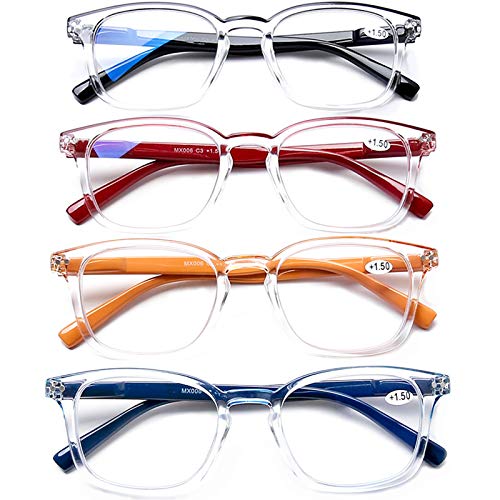
AQWANO Computer Reading Glasses Blue Light Blocking, Quality Clear Readers for Women Men Fashion Anti Glare UV Ray Filter Lightweight
The package holds four pairs of clear-framed readers with spring-hinge temples, plus four microfiber pouches, four cleaning cloths and a glasses box. AQWANO states that the lens blocks 97% of what it calls harmful blue light and filters UV; that is the manufacturer's claim about its own product, not an independent finding. The maker also states a 90-day money-back period. About $23.95 as of October 2026, or roughly $6 a pair.

OWTXIS Folding Reading Glasses, Black+Blue+Brown
Three pairs in black, blue and brown, built on metal frames with telescoping temples that collapse down for storage. The lenses are polycarbonate and the hinge is a flexible spring type. OWTXIS advertises an anti-blue-light coating and positions the collapsible, keychain-style design for pockets, purses and glove boxes. About $17.99 as of October 2026.

ZESAKER Reading Sunglasses for Women Men Full Lens Outdoor Readers Sunglasses UV Protection Sun Readers Eyeglasses
Tinted square readers with magnification across the entire lens; ZESAKER specifies that these are not bifocal sun readers. The frames are polycarbonate with flexible spring hinges, and the maker states an anti-reflective coating, scratch-resistant lenses and UV400 lenses offering 99% UVA/UVB protection. They are sold in single strengths. About $12.99 as of October 2026.
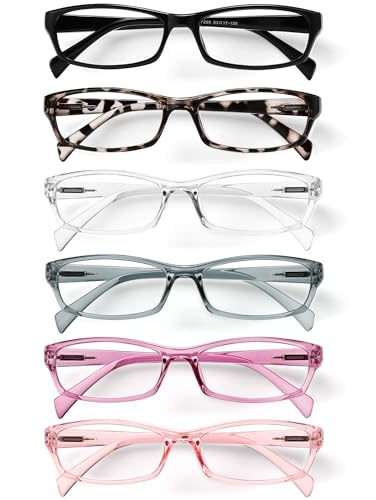
Gaoye Reading Glasses for Women, 6 pack Fashion Readers for Women Men Spring Hinge Eye Glasses, Blue Light Reading Glasses
Six pairs per pack in assorted pattern-print frames, made from polycarbonate with spring-hinge temples on a lightweight frame. Gaoye advertises UV400 protection and a blue-light-blocking lens. About $18.99 as of October 2026, which works out to roughly $3.17 a pair.
Keep reading
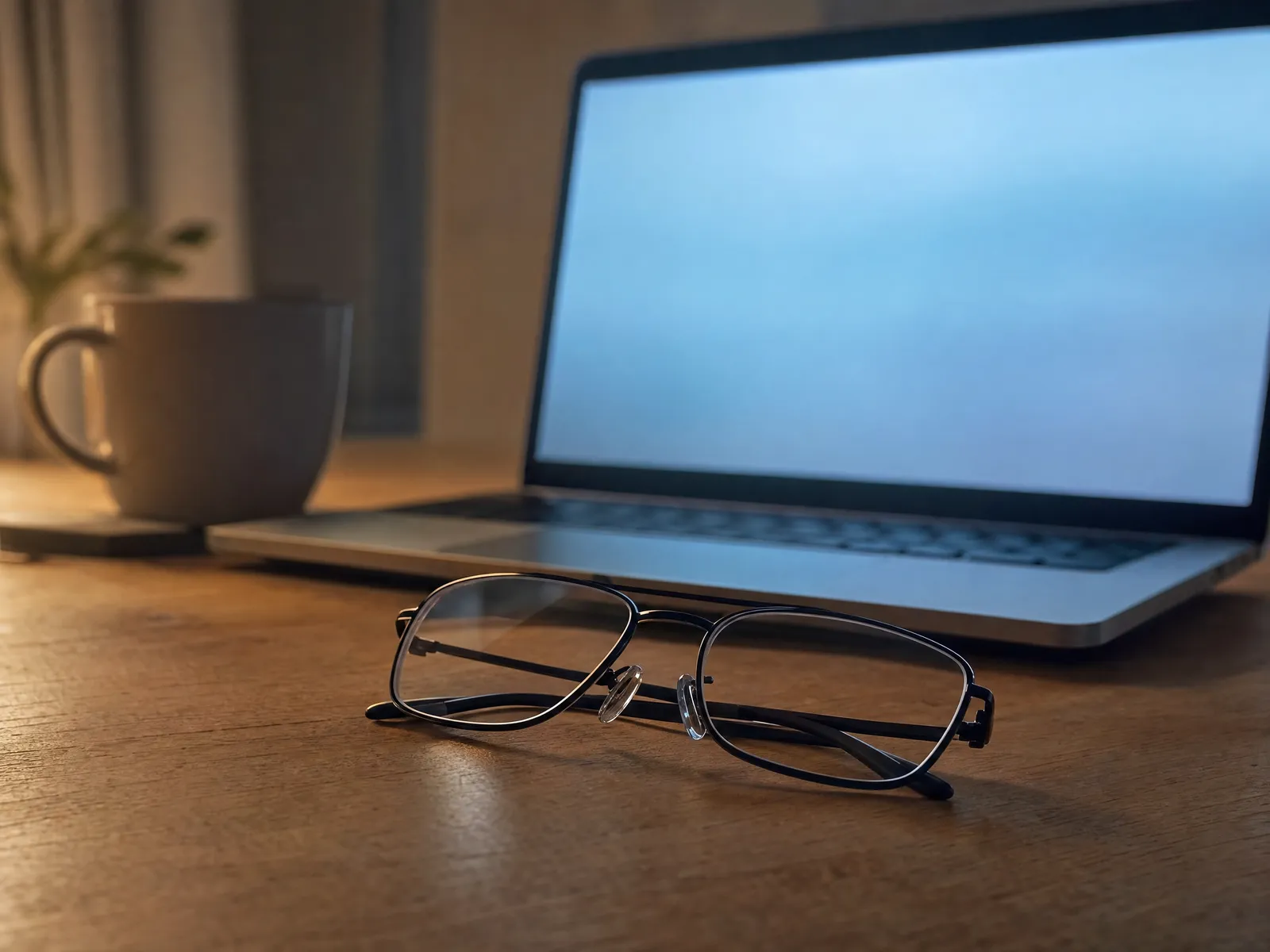
Do Blue Light Glasses Work? What the Trials Actually Found
Do blue light glasses work? A 2023 Cochrane review of 17 trials found no benefit for eye strain. What the evidence shows for sleep and retinal protection, and what actually helps.

Vision Changes After 50: Presbyopia, Night Vision, Floaters and More
Which vision changes after 50 are ordinary aging and which ones need an appointment. Presbyopia, night glare, floaters, dry eye and the real red flags, sourced.
Early Signs of Cataracts and What the Timeline Actually Looks Like
The early signs of cataracts, what cataract vision looks like, and the real timeline from the first clouding to surgery, sourced to the NEI, AAO and AOA.