Are Home Health Devices Covered by Medicare, FSA, or HSA?
Are home health monitoring devices covered by Medicare? Usually not. But FSA and HSA dollars cover far more. Here is what each program actually pays for.

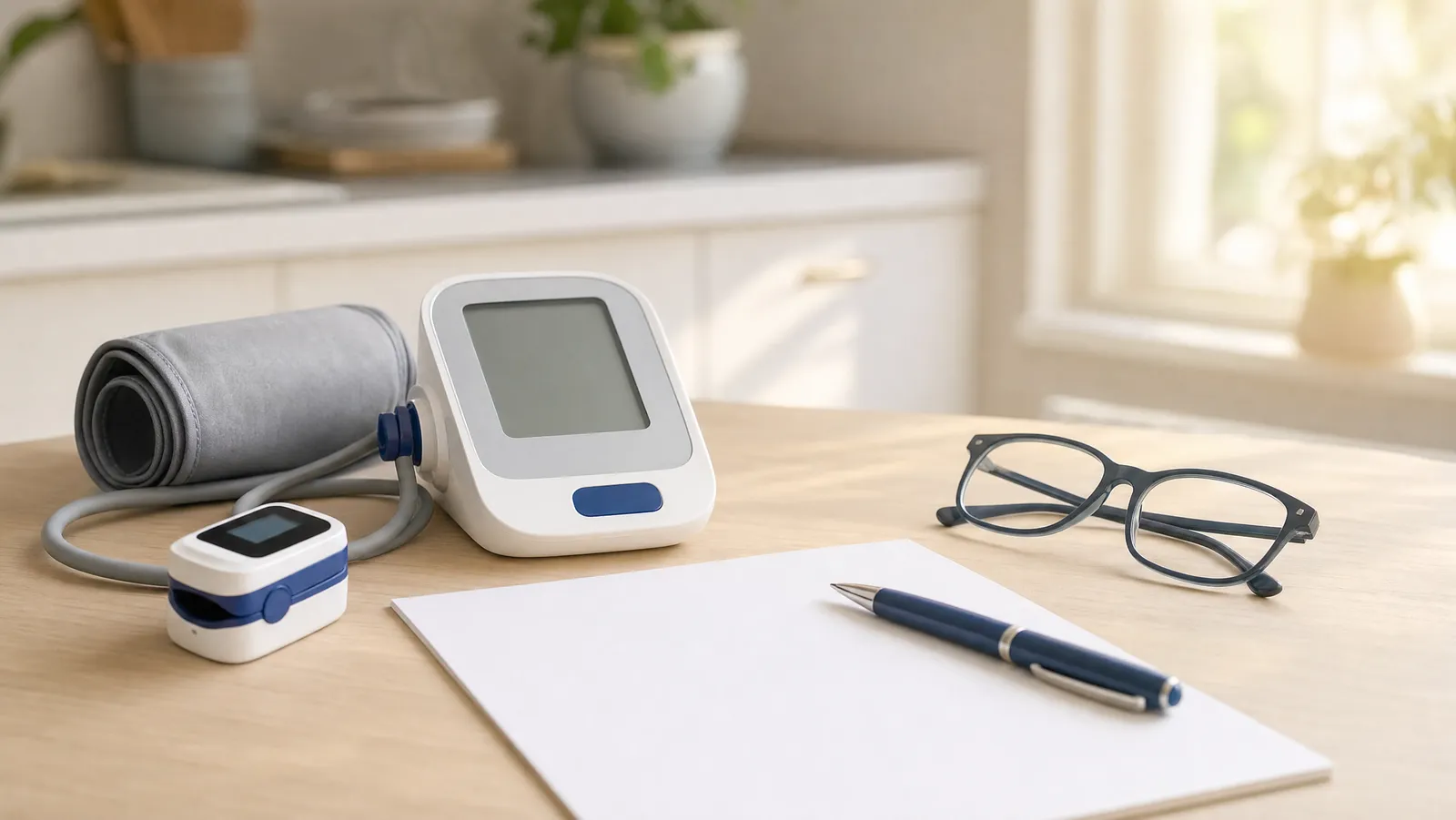
Affiliate disclosure: This article contains affiliate links. As an Amazon Associate we earn from qualifying purchases, at no extra cost to you. Learn more.
The three programs work very differently. Medicare pays for a short list of devices as durable medical equipment, and a routine home blood pressure cuff is not on that list. FSA and HSA dollars, by contrast, cover a much wider range of monitors as qualified medical expenses — usually with no prescription and no prior approval.
The question we get most often about at-home health monitoring devices is a money question: are home health monitoring devices covered by Medicare, or by an FSA or HSA? People are often surprised by the answer, because the program that feels the most generous — Medicare — has by far the narrowest rules for this category, while the pre-tax accounts most people barely think about will quietly reimburse a cuff, a pulse oximeter, and a thermometer in the same shopping trip.
Below is how each program works, which devices clear the bar, and what to do when none of them do. One caveat up front: coverage depends on your individual plan, and this is general information rather than insurance or tax advice. Confirm with your plan and your clinician before buying anything you expect to be reimbursed.
The Three Programs at a Glance
- Medicare Part B (durable medical equipment). Narrow. The item must be prescribed for use in your home and must meet Medicare's definition of durable medical equipment. You typically pay 20 percent of the Medicare-approved amount after the annual Part B deductible.
- Medicare Advantage (Part C). Covers everything Original Medicare covers, and many plans add a separate over-the-counter allowance you can spend on exactly the kind of monitors Part B refuses.
- Health FSA. Employer-sponsored, funded with pre-tax salary. Broad list of eligible expenses. Money generally has to be spent within the plan year.
- HSA. Paired with a high-deductible health plan. Same broad expense list as an FSA, but the balance rolls over year to year and the account belongs to you.
The practical takeaway: if you are shopping for a monitor, check your FSA or HSA first, your Medicare Advantage catalog second, and Part B last.
The Medicare Rule in Plain English
Medicare Part B has no "home health gadget" benefit. It has a durable medical equipment benefit, and the definition is narrow on purpose.
According to Medicare.gov, durable medical equipment must meet all of these tests: an expected lifetime of at least three years, primarily and customarily used to serve a medical purpose, generally not useful to someone in the absence of an illness or injury, and appropriate for use in the home. Part B covers medically necessary DME when your doctor or other treating clinician orders it for use in your home.
That third test is the one that quietly disqualifies most consumer health tech. A smartwatch that counts steps and takes an ECG is useful whether or not you are sick, so it does not read as durable medical equipment no matter how much health data it collects.
If a device does qualify, the cost structure is the same as most other Part B services. According to Medicare.gov, after you meet the Part B deductible you pay 20 percent of the Medicare-approved amount, provided your supplier accepts assignment. CMS set the annual Part B deductible at 283 dollars for 2026. Two other conditions matter more than people expect: both the prescribing clinician and the supplier must be enrolled in Medicare, and if the supplier does not accept assignment, there is no cap on what they can charge you.
Devices Medicare Generally Does Cover
The covered list is real, it is just specific. These are the home monitoring items most likely to qualify:
- Blood sugar monitors and testing supplies. Medicare.gov lists blood sugar monitors, test strips, lancets, and control solutions as covered DME for people with diabetes, with quantity limits that depend on whether you use insulin.
- Continuous glucose monitors. Medicare.gov states that Part B may cover a CGM and its supplies when a clinician prescribes it consistent with the device's FDA indications and you meet at least one criterion: you are treated with insulin, or you have a history of problematic hypoglycemia. CMS guidance also requires a visit with the ordering clinician within six months of the order to evaluate diabetes control and confirm eligibility. Note the shape of that rule — it is criteria-based, not a blanket benefit for anyone with a diabetes diagnosis.
- CPAP devices for obstructive sleep apnea. According to Medicare.gov, Medicare may cover a 12-week trial of CPAP therapy after a sleep apnea diagnosis, and may continue coverage after the trial if you have an in-person visit where your clinician documents that the therapy is helping.
- Home dialysis equipment and supplies. Medicare.gov states that Part B covers home dialysis equipment and supplies for people with end-stage renal disease. CMS's Medicare Benefit Policy Manual (Chapter 11) lists a sphygmomanometer with cuff and stethoscope among the home dialysis supplies furnished under the ESRD bundled payment — a manual blood pressure setup supplied through the dialysis facility, not a consumer digital cuff of your choosing.
Notice the pattern. Each item manages a diagnosed condition, each requires an order, and each is useless to a healthy person.
Devices Medicare Generally Does Not Cover
Here is the finding that surprises most of our readers: Original Medicare does not cover routine home blood pressure monitors. Not the inexpensive drugstore cuff, and not the validated upper-arm model your cardiologist told you to buy. Home blood pressure monitors do not appear on Medicare.gov's list of covered durable medical equipment, and there is no Part B benefit for routine home blood pressure monitoring. There are two documented exceptions.
Exception one: home dialysis. As noted above, a sphygmomanometer with cuff and stethoscope is part of the covered home dialysis supply bundle for people with end-stage renal disease, furnished through the dialysis facility.
Exception two: ambulatory blood pressure monitoring. This is the 24-hour device you wear on a belt, not a cuff you keep on the nightstand. Under CMS National Coverage Determination 20.19, Medicare covers ABPM for beneficiaries with suspected white coat hypertension — defined as average office readings above 130 systolic but below 160, or above 80 diastolic but below 100, taken at two separate office visits with at least two measurements each, plus at least two out-of-office readings below 130/80 — and for beneficiaries with suspected masked hypertension. CMS also requires the device to be capable of producing standardized plots of blood pressure over 24 hours with daytime and nighttime windows marked, and the results to be interpreted by the treating clinician. NCD 20.19 states that for eligible patients, ABPM is covered once per year.
Neither exception helps the person who simply wants to track their pressure at home. If that is you, plan to pay for it — and spend the money well. Our guide to the best home blood pressure monitors covers which models are clinically validated, the only spec that really matters.
The same logic applies to most of this category:
- Pulse oximeters for general home monitoring. Medicare covers oximetry testing in specific clinical contexts, but a fingertip oximeter for routine self-monitoring is not a Part B benefit.
- Smart scales, consumer thermometers, and body-composition scales.
- Fitness trackers, smartwatches, smart rings, and sleep trackers. These fail the "not useful in the absence of illness" test decisively.
Medicare Advantage and Over-the-Counter Allowances
This is the workaround most people miss. Medicare Advantage plans must cover everything Original Medicare covers, but many also offer a supplemental over-the-counter allowance — a fixed dollar amount, often loaded onto a flex card, that you spend from a plan-approved catalog. Blood pressure cuffs, pulse oximeters, thermometers, and pill organizers are exactly the kind of items those catalogs carry.
According to KFF's analysis of the 2026 Medicare Advantage landscape, 66 percent of individual Medicare Advantage plans offer an over-the-counter allowance in 2026, down from 73 percent in 2025. Among Special Needs Plans, 94 percent offer one.
Two cautions. This is entirely plan-dependent — allowance size, catalog, and ordering process all vary, and as the KFF numbers show, plans are trimming the benefit. And allowances usually expire quarterly or annually. Log into your plan portal, find the OTC catalog, and check the balance and the deadline before shopping elsewhere.
FSA and HSA Money Opens a Much Wider Door
Pre-tax health accounts run on a completely different rulebook, and it is a far more generous one for this category.
IRS Publication 502 defines medical expenses to include the costs of equipment, supplies, and diagnostic devices needed for the diagnosis, cure, mitigation, treatment, or prevention of disease. That single phrase — diagnostic devices — is why home monitors clear the bar so easily. Publication 502 gives a direct example: if you have diabetes and use a blood sugar test kit to monitor your blood sugar, you can include the cost of the kit in your medical expenses.
In practice, blood pressure monitors, pulse oximeters, thermometers, glucose meters and strips, and continuous glucose monitors are routinely treated as eligible. Retailers label these items "FSA eligible" or "HSA eligible" at checkout, and many run a dedicated eligible-items storefront. That label is a merchant's classification, not an IRS ruling — useful as a first filter, but your plan administrator has the final say.
The limit that does apply: Publication 502 is explicit that medical care expenses must be primarily to alleviate or prevent a physical or mental disability or illness, and do not include expenses that are merely beneficial to general health, such as vitamins or a vacation. That is why a fitness tracker or a smart ring is a harder case than a cuff, and why administrators often ask for a letter of medical necessity from your clinician for dual-purpose items that have both a wellness and a medical use. If you are buying something borderline, ask your administrator what documentation they want before you spend the money.
The two accounts differ in one way that matters:
- FSAs are use-it-or-lose-it. Under IRS rules you generally must incur eligible expenses by the end of the plan year or forfeit what is left. Employers may offer either a grace period of up to two and a half extra months or a limited carryover, but not both. For 2026, Revenue Procedure 2025-32 sets the health FSA salary reduction limit at 3,400 dollars and the maximum carryover at 680 dollars.
- HSAs roll over and belong to you. No annual deadline, no forfeiture. For 2026, IRS Revenue Procedure 2025-19 sets the HSA contribution limit at 4,400 dollars for self-only coverage and 8,750 dollars for family coverage.
One rule specifically for readers approaching 65: according to IRS Publication 969, you cannot contribute to an HSA for any month you are enrolled in Medicare — but you can still take tax-free distributions from an existing balance to pay qualified medical expenses. An HSA you built before Medicare is a legitimate way to buy the monitors Medicare will not.
Getting a Device Covered: A Practical Checklist
If you think your device might qualify under Part B, work the process in this order:
- Ask the clinician to document medical necessity in the chart, not just to write a prescription. The order should name the device, the diagnosis, and why it is needed at home.
- Confirm the supplier is enrolled in Medicare and accepts assignment. Medicare.gov has a supplier directory. A supplier who does not accept assignment can bill you above the approved amount.
- Check the Medicare Advantage OTC catalog before paying out of pocket, if you are in a Part C plan.
- Save every receipt and the itemized description. FSA and HSA administrators reimburse on documentation, and a credit card statement usually is not enough.
- Ask about a letter of medical necessity for any dual-purpose item before you buy it.
- Call the number on your card. Five minutes beats a denied claim.
Paying Out of Pocket Without Overspending
For most people reading this, the device will not be covered — and that is survivable, because this category is cheap relative to almost anything else in health care. A validated upper-arm cuff, a fingertip pulse oximeter, and a good digital thermometer are a modest one-time purchase next to most recurring health care costs.
When you are spending your own money, accuracy is the only feature worth paying for. Validation status, correct cuff sizing, and a readable display matter far more than app ecosystems or trend graphs. Our walkthrough on how to choose a home health monitoring device breaks down which specifications change the reading and which are marketing.
Then pay with pre-tax money. Running an eligible device through an FSA or HSA effectively discounts it by your marginal tax rate — often a bigger saving than any sale price.
The Bottom Line
Medicare's durable medical equipment benefit was built for wheelchairs and oxygen concentrators, not for the home monitoring category that has grown up around it. Expect coverage for diabetes supplies, CPAP, and home dialysis equipment under specific criteria — and expect to pay for your own blood pressure cuff unless you are on dialysis or your doctor orders a 24-hour ambulatory study. Then look at the two places the money actually is: your Medicare Advantage over-the-counter allowance, and your FSA or HSA.
Rules change every year, and every plan is different. Confirm your own coverage with your plan before you buy. When you are ready to pick the device itself, our complete home health monitoring guide walks through what we recommend in each category and why.
FAQ
Does Medicare cover blood pressure monitors?
Generally no. Home blood pressure monitors are not listed among the durable medical equipment Medicare.gov says Part B covers, and there is no Part B benefit for routine home blood pressure monitoring. The two exceptions are the sphygmomanometer supplied as part of covered home dialysis supplies, and ambulatory blood pressure monitoring, which CMS covers once per year under National Coverage Determination 20.19 for suspected white coat or masked hypertension.
Are home health monitoring devices FSA eligible?
Most are. IRS Publication 502 includes equipment, supplies, and diagnostic devices needed for the diagnosis, treatment, or prevention of disease as medical expenses, which is why blood pressure monitors, pulse oximeters, thermometers, and glucose meters are commonly reimbursable. Items that are mainly wellness-oriented, such as fitness trackers, are the gray area — ask your plan administrator whether a letter of medical necessity is required.
Can an HSA be used after enrolling in Medicare?
You can spend it, but you cannot add to it. IRS Publication 969 states that you are not eligible to contribute to an HSA for any month you are enrolled in Medicare, while distributions from an existing balance for qualified medical expenses remain tax-free. For a device Medicare will not cover, that existing balance is often the best money to use.
Keep reading
Which Health Numbers Are Worth Tracking at Home After 50?
The health metrics to track at home after 50 — blood pressure, resting heart rate, weight trend, waist-to-height ratio — and which numbers to skip.
How to Choose a Home Health Monitoring Device
How to choose a home health monitoring device: start with the health question you need answered, then buy the validated, correctly sized, readable model.
The Best At-Home Health Monitoring Devices for Seniors: A Complete Guide (2026)
The best home health monitoring devices for seniors in 2026: blood pressure monitors, pulse oximeters, smart scales, ECG and glucose monitors explained.