How to Choose a Home Health Monitoring Device
How to choose a home health monitoring device: start with the health question you need answered, then buy the validated, correctly sized, readable model.

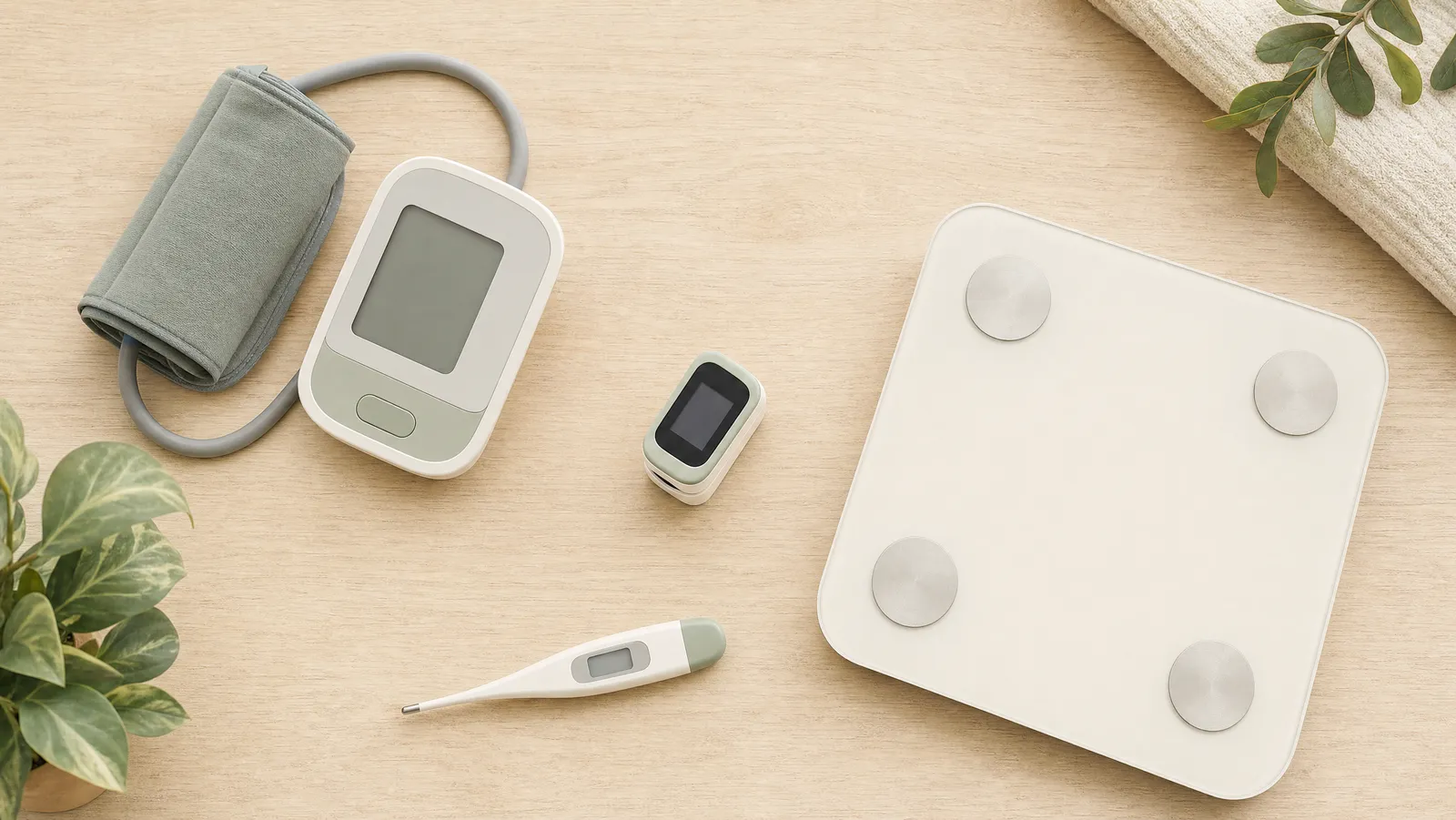
Affiliate disclosure: This article contains affiliate links. As an Amazon Associate we earn from qualifying purchases, at no extra cost to you. Learn more.
How to choose a home health monitoring device comes down to one order of operations: start with the health question you actually want answered, then buy the validated, correctly sized, easy-to-read device that answers it. The device with the longest feature list is almost never the one that changes anything.
That order gets reversed constantly. People buy the gadget first and then go looking for a reason to wear it, which is how a drawer fills up with abandoned home health monitoring devices that were never wrong so much as never needed. The framework below is the one we apply to every category we cover: goal first, accuracy second, everything else after that.
One note before we start: a home device produces data, not a diagnosis — anything you measure is a conversation-starter with your clinician, not a substitute for one.
Start With the Question You Are Trying to Answer
Before comparing models, finish this sentence: I want to know whether ___. The answer points at a category, and the category narrows the field far faster than reading reviews does.
- "My clinician asked me to bring in home blood pressure readings." You need an automatic upper-arm cuff monitor. See the best blood pressure monitors.
- "I want to see my weight trend instead of one alarming morning number." A smart scale that logs to an app and averages over weeks. See the best smart scales.
- "I have been told I have an irregular heartbeat, or I get palpitations I cannot describe to my doctor." A single-lead ECG recorder that captures the rhythm while it is happening. See the best at-home ECG monitors.
- "I have a lung condition and want to track oxygen saturation." A fingertip pulse oximeter, with realistic expectations about its limits. See the best pulse oximeters.
- "I want to move more and see whether my sleep is improving." A wearable tracker built for legibility rather than athletic dashboards. See the best fitness trackers for seniors.
- "I want to understand how specific meals affect my blood sugar." A short trial of an over-the-counter continuous glucose monitor, used as an education tool rather than a diagnostic one.
If none of those sentences fit, that is genuinely useful information — it usually means the honest next step is deciding which health numbers to track after 50 rather than buying anything at all. A device bought without a question attached tends to generate anxiety instead of answers.
Validation Is the One Spec That Matters Most
Every product page advertises accuracy. Very few devices have had it independently tested. Validation means the device was measured against a reference standard by researchers who did not sell it, under a published protocol, with a pass/fail threshold.
Blood pressure is the clearest worked example because it is the one category where the infrastructure actually exists. The universal standard is ANSI/AAMI/ISO 81060-2, and its core criterion is strict: the device's readings must differ from the trained-observer reference by no more than 5 mm Hg on average, with a standard deviation of 8 mm Hg or less, for both systolic and diastolic pressure. That threshold, not a marketing phrase, is what "validated" refers to.
Two free registries publish the results. validatebp.org, the US Blood Pressure Validated Device Listing, is maintained with the American Medical Association. stridebp.org is an international scientific initiative that systematically reviews published validation studies — and, notably, rejects a meaningful share of studies that were published as passes. If a monitor appears on neither list, nobody independent has shown it is accurate. We cover the evidence in depth in are home blood pressure monitors accurate.
Here is the part to carry into other categories: most consumer devices have no equivalent registry. There is no validatebp.org for smart scales, sleep trackers, or wrist-based heart-rate sensors. The best available proxy there is peer-reviewed comparison against a laboratory reference, which some manufacturers publish and many do not. Treat missing independent testing as unknown accuracy, not proven inaccuracy, and lower your confidence accordingly.
Regulatory Clearance and What It Does Not Cover
"FDA cleared" is not a quality grade, and it is not a blanket endorsement of a product. Three distinctions are worth knowing.
Clearance applies to a specific claim. A 510(k) clearance means the FDA judged a device substantially equivalent to a predicate device already on the market for a defined intended use. It does not require large randomized trials, and it does not certify performance in every population.
Wellness devices are not cleared at all. The FDA's guidance General Wellness: Policy for Low Risk Devices, reissued as final guidance on January 6, 2026, describes low-risk products intended for general wellness purposes that the agency says it does not intend to examine to determine whether they are devices at all, let alone whether they meet device requirements. A step count, a sleep score, or a "readiness" metric usually lives here. That is not a scandal; it just means no regulator checked the number.
A cleared feature does not make the whole device a medical instrument. The irregular-rhythm notification on a smartwatch is the standard example. Samsung's FDA-cleared notification feature carries explicit labeling limits: it is not intended to provide a notification on every episode of irregular rhythm suggestive of atrial fibrillation, the absence of a notification does not indicate that no disease process is present, and it is not intended for people with other known arrhythmias or under 22 years old. The ECG app on the same watch is cleared for over-the-counter use, but it records a single lead — a clinical ECG records twelve.
Clearance tells you one function was reviewed for one purpose. Every other number on the screen is unregulated by default.
Fit and Sizing Change the Reading More Than Brand Does
The most consequential spec on a blood pressure monitor is not the brand on the box. It is whether the cuff fits your arm.
Research presented at an American Heart Association scientific conference in 2022 quantified it. When a regular-size adult cuff was used on people who actually needed a different size, systolic readings shifted by these amounts:
- People who needed an extra-large cuff read 19.7 mm Hg higher than with the correct cuff.
- People who needed a large cuff read about 4.8 mm Hg higher.
- People who needed a small cuff read about 3.8 mm Hg lower.
The clinical consequence in that study was blunt: using a regular cuff on people who needed a larger one misclassified 39% of participants as hypertensive, while using an oversized cuff missed 22% of participants who did have hypertension. In the extra-large group, average readings fell from 143.9/86.5 mm Hg with the wrong cuff to 124.2/79.1 mm Hg with the right one.
Measure the circumference of your upper arm at the midpoint between shoulder and elbow before you order, and check it against the cuff range printed in the listing. Many monitors ship with one cuff and sell others separately, so whether the right cuff exists for that model is a buying criterion, not an afterthought.
The principle generalizes. A finger too cold for a pulse oximeter, a sensor applied to the wrong site — the fit failure is usually larger than the device-to-device difference you spent an hour researching.
Readability and Usability After 50 Deserve Real Weight
A device you cannot read in your own bathroom light is not accurate; it is illegible. Age-related vision changes make this a specification, not a preference — a 2021 review in the journal Vision notes that presbyopia, the loss of near focus, begins to affect function around age 40, and that contrast sensitivity drops off most in low illumination. We check five things:
- Display size and contrast. Large black-on-white or white-on-black digits beat a stylish low-contrast grey screen every time.
- Button count. Two buttons that do obvious things beat six that do clever ones.
- Does the reading appear on the device itself? Some cuffs and scales show nothing on-device and push everything to a phone. That is a fine design for some households and a dealbreaker in others.
- Cuff and sensor application with limited grip strength. A one-piece "slip-on" cuff can be managed one-handed; a two-piece cuff with a D-ring and a stiff hook-and-loop closure often cannot.
- Can a partner or caregiver read it? If someone else helps with measurements or reports them to a clinician, they need to see the number too.
None of these appear on a spec sheet. All of them determine whether the device is still in use in six months.
The App Question Is Really Three Questions
Apps are neither good nor bad here. They are a trade: convenience and trend lines in exchange for setup friction and a data relationship. Ask three things.
Do you need one at all? If your goal is a weekly log for a clinician, a device with on-board memory and a paper notebook works and never needs an update. If your goal is a trend across months, an app earns its place.
Can you get the data out? Look for CSV export or a PDF summary you can email or print. An app that shows you a graph but will not hand you the underlying readings makes the appointment harder, not easier.
What happens to the data? This is the part most people assume is settled and is not. According to the Federal Trade Commission, many companies that collect health information — a fitness tracker, a diet app, a connected blood pressure cuff — are not covered by HIPAA, which governs health records held by most doctors' offices, hospitals, and insurers. The gap is filled instead by the FTC's Health Breach Notification Rule, updated in 2024, which requires health apps and connected-device makers to notify users and the FTC after a breach of identifiable health information. Notification after the fact is a weaker protection than HIPAA's rules on use and disclosure, so read the privacy policy for what the company does with your data in the ordinary course, not just what happens when something goes wrong.
Cost, Subscriptions, and Consumables Are the Line Item People Miss
The sticker price is often the smallest number. Before buying, total the three-year cost:
- Sensor replacements. Continuous glucose monitors are the clearest case. Sensors last roughly two weeks, and 2026 retail comparisons of Dexcom's Stelo and Abbott's Lingo put a month's supply in the range of roughly $84 to $99, or on the order of $1,000 a year for continuous wear — far more than the device you thought you were buying.
- Replacement cuffs and accessories. Cuffs wear out, and a second cuff size for a spouse is a separate purchase on most monitors.
- Memberships. Some wearables put trend history or coaching behind a monthly subscription while the hardware works without it. Confirm which features survive if you cancel.
Some of these costs are recoverable. We break down whether Medicare, FSA, or HSA cover home health devices — the answers differ sharply by category and by whether a clinician ordered the device.
A Device You Will Actually Use Beats a Better Device You Will Not
This is the least technical criterion and the most predictive one. A validated monitor kept in the bathroom drawer next to your toothbrush generates a year of readings. A slightly more accurate one that lives in a closet and needs a phone pairing every time generates three readings and a vague sense of guilt.
We suggest choosing for the worst-case moment of use: tired, in poor light, without your glasses, possibly one-handed. Then attach the measurement to something you already do — after brushing your teeth, the same two mornings each week. If your clinician has asked for a specific schedule, follow that — the American Heart Association's home blood pressure guidance, for example, calls for two readings a minute apart in the morning and two in the evening, not a single weekly check. Absent instructions, a consistent routine tends to be more useful than sporadic checks.
Mistakes We See Most Often
- Buying an unvalidated device because it is cheaper or better reviewed. Reviews measure satisfaction, not accuracy. Check the registry first for any category that has one.
- Using the wrong cuff size. The single largest source of error in home blood pressure, and completely free to fix.
- Over-measuring. Ten readings a day produces noise, and noise produces anxiety. Normal biological variation looks like a problem when you sample it constantly.
- Treating a trend line as a diagnosis. A wearable's sleep stages, stress score, or overnight heart-rate dip are algorithm estimates, not clinical findings. Bring the pattern to your clinician; do not act on it alone.
- Buying for the household instead of the person. One person's goal, one device. Shared profiles work only if everyone actually uses their own.
Putting the Framework to Work
Write down the question. Check whether independent validation exists in that category, and prefer a device that has it. Confirm the sizing. Look at the display in the light you will actually use. Total the consumables. Then buy the least complicated device that clears those bars — and take it to your next appointment so the readings become part of the conversation rather than a private worry.
If you are still deciding which category fits, our at-home health monitoring guide walks through every type side by side, with what each one measures well and where each one falls short.
FAQ
Does a home health monitoring device need to be FDA cleared?
It depends on what you are asking it to do. For measurements that inform medical decisions — blood pressure, heart rhythm, blood oxygen — we recommend a device cleared for that specific use and, where a registry exists, independently validated too. For wellness metrics like steps or sleep estimates, clearance is neither required nor typically sought, which is a reason to treat those numbers as informative rather than definitive.
How many home health devices does one person need?
Usually one, sometimes two. Each device should map to a question you or your clinician actually has. Buying a second device before the first one has produced a useful log is a common way to end up with two unused devices instead of one useful one.
Can a smartwatch replace a blood pressure cuff?
Not for blood pressure. A smartwatch may carry a cleared feature for irregular-rhythm notification or a single-lead ECG, but those are heart-rhythm functions, not blood pressure measurement, and their labeling explicitly limits what they can rule out. If your goal is home blood pressure readings, we recommend a validated upper-arm cuff monitor, and treating the watch as a separate tool for a separate question.
Keep reading
Which Health Numbers Are Worth Tracking at Home After 50?
The health metrics to track at home after 50 — blood pressure, resting heart rate, weight trend, waist-to-height ratio — and which numbers to skip.
Are Home Health Devices Covered by Medicare, FSA, or HSA?
Are home health monitoring devices covered by Medicare? Usually not. But FSA and HSA dollars cover far more. Here is what each program actually pays for.
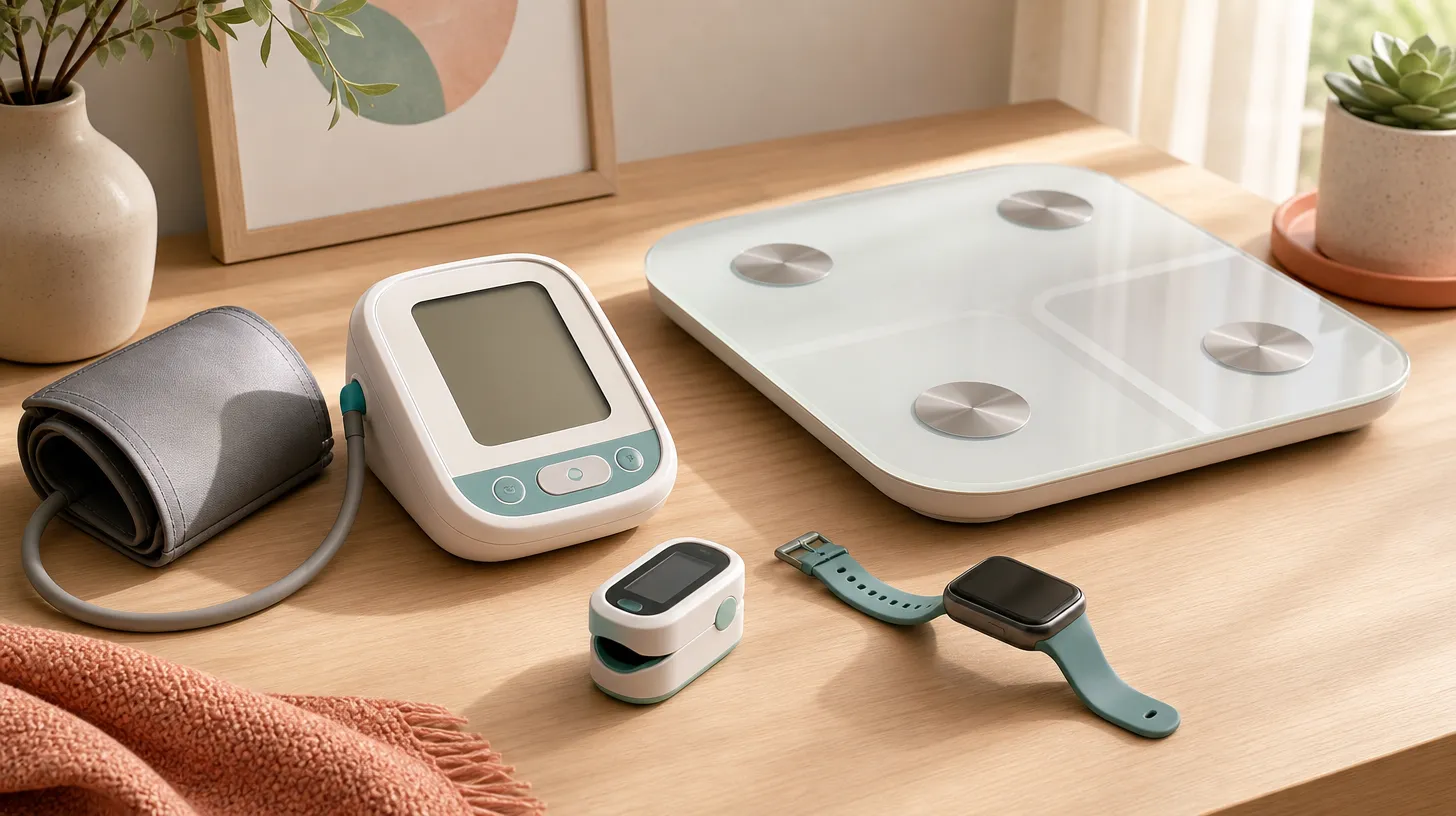
The Best At-Home Health Monitoring Devices for Seniors: A Complete Guide (2026)
The best home health monitoring devices for seniors in 2026: blood pressure monitors, pulse oximeters, smart scales, ECG and glucose monitors explained.