The Best At-Home Health Monitoring Devices for Seniors: A Complete Guide (2026)
The best home health monitoring devices for seniors in 2026: blood pressure monitors, pulse oximeters, smart scales, ECG and glucose monitors explained.

Affiliate disclosure: This article contains affiliate links. As an Amazon Associate we earn from qualifying purchases, at no extra cost to you. Learn more.
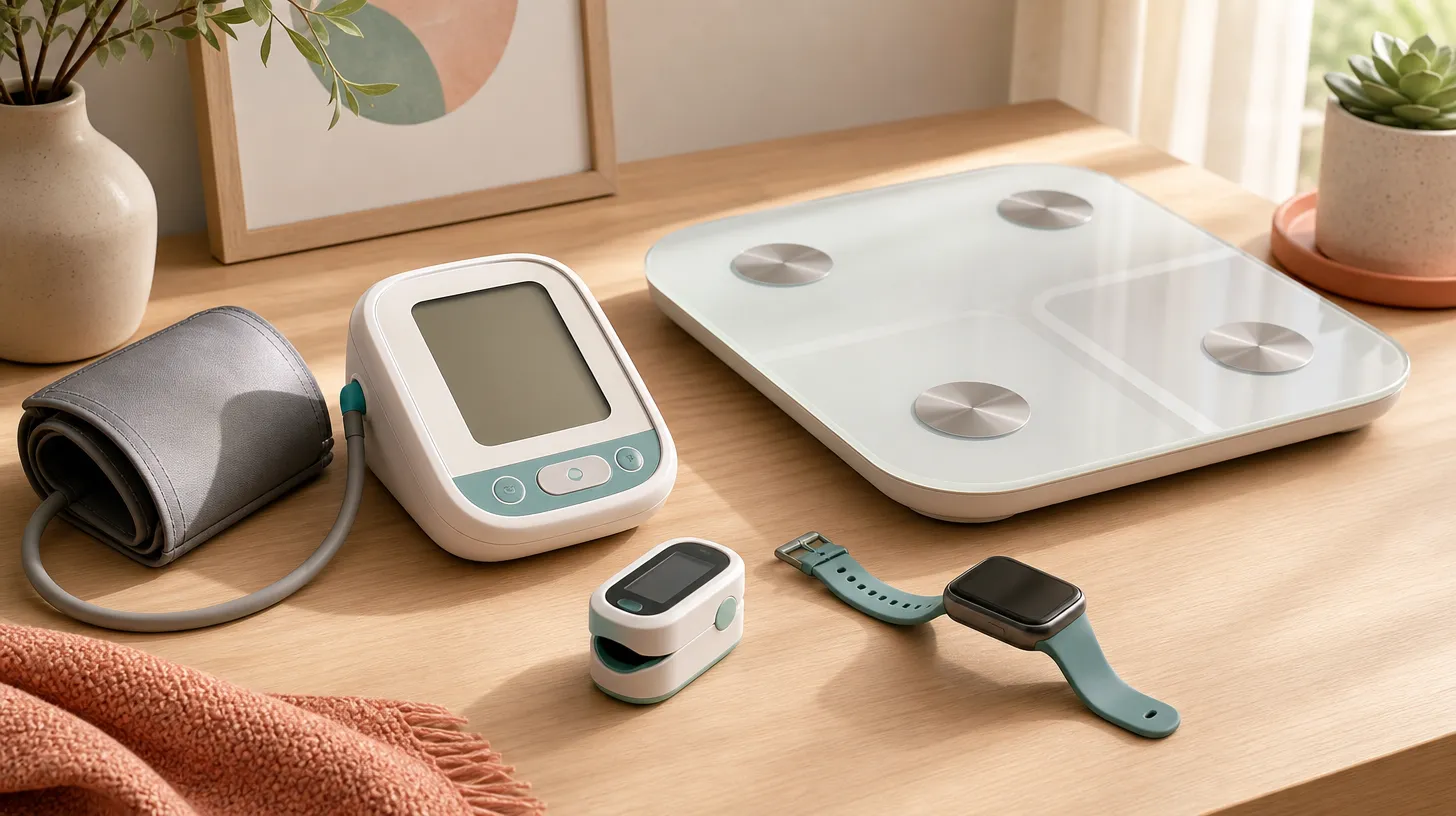
The best home health monitoring devices for seniors track the numbers that matter most after 50 — blood pressure, blood oxygen, weight and body composition, heart rhythm, and blood sugar — using validated, easy-to-read tools you can use at your kitchen table. This guide maps the whole landscape: what each category of device does, which readings are worth watching, and how to choose equipment you will actually trust and use.
At their simplest, home health monitoring devices are consumer tools that measure a vital sign or health metric and, increasingly, save the reading to an app so you and your clinician can see how it changes over time. Some are old friends in new packaging, like the blood pressure cuff; others, like over-the-counter glucose sensors, are genuinely new to the shelf. What they share is a purpose: turning your health from a snapshot taken once a year into a moving picture you can actually see.
That shift is powerful, but it comes with a caveat we will return to throughout this guide. A home device is only as good as the choice behind it and the technique used with it. A validated, well-fitted blood pressure cuff used correctly can change how a condition is managed; a bargain-bin gadget used casually can produce noise that worries you for no reason. Our aim here is to help you build a small, trustworthy kit — and to know what each number does and does not mean.
There is a good reason this equipment has moved from the doctor's office to the nightstand. According to the U.S. Centers for Disease Control and Prevention, about 71.6% of adults aged 60 and older had hypertension in data collected from August 2021 through August 2023. Conditions like that are far easier to manage when you can watch the numbers move week to week instead of once a year, and when you arrive at appointments with a record rather than a guess.
Below we walk through each type of device, along with the standards and normal ranges that make the readings meaningful. This guide is educational and not a substitute for medical advice; talk to your clinician about your numbers and before acting on any reading.
Blood pressure monitors
Blood pressure is the single most useful number most people can track at home, and it is where we would start. The best home blood pressure monitors are automatic, cuff-style devices worn on the upper arm. According to the American Heart Association, an automatic, cuff-style, upper-arm (bicep) monitor is what it recommends; wrist and finger monitors are not, because they tend to give less reliable results.
Accuracy depends on the device and your technique. The AHA advises choosing a monitor that has been validated — you can check the U.S. Blood Pressure Validated Device Listing at validatebp.org — and then bringing it to your next appointment so your health care professional can confirm it matches the office equipment. That single habit answers the most common question about how accurate home blood pressure monitors are: a validated cuff, checked once against a clinical reading, is trustworthy enough to help guide care.
Technique matters as much as the machine when you are measuring your blood pressure at home. Sit with your back supported and feet flat on the floor, rest quietly for five minutes, keep the cuff at heart level, and avoid caffeine or exercise beforehand. Take two or three readings a minute apart, both morning and evening, and record them.
Two features are worth paying for. Cuff size is the first: a cuff that is too small reads falsely high, so measure your upper-arm circumference and buy the size that fits, not the one in the box. The second is an irregular-heartbeat indicator, which many monitors now include; it will not diagnose anything, but a symbol that keeps appearing is a reason to mention rhythm to your doctor. Look for a monitor that stores several readings, or averages them, so you are not transcribing numbers by hand.
What are you looking for? According to the American Heart Association, a normal reading is less than 120/80 mm Hg. Systolic pressure of 120 to 129 is considered "elevated," and 130/80 or higher is high blood pressure — the point where stage 1 hypertension begins (140/90 or higher is stage 2) — under the 2017 ACC/AHA thresholds. One high reading is not a diagnosis — patterns are, which is exactly why home monitoring over days and weeks is so valuable. The AHA also stresses that home monitoring supplements, but does not replace, regular visits with your clinician; its value is showing whether treatment is working between those visits.
Pulse oximeters and blood oxygen
A pulse oximeter is a small clip that slips onto a fingertip and estimates the oxygen saturation of your blood (SpO2) along with your pulse rate. The best pulse oximeters are FDA-cleared fingertip models with a clear, well-lit display and a fast, stable reading you can take in a few seconds.
What counts as normal? For most healthy people, oxygen saturation sits between 95% and 100%. Readings below that range can occur with lung or heart conditions and are worth a call to your clinician, particularly if they come with breathlessness, confusion, or a bluish tinge to the lips or fingertips.
Two limitations are important, and we want you to know them up front. First, these are estimates, not lab values. According to the U.S. Food and Drug Administration, cleared pulse oximeters are held to an accuracy of roughly plus or minus 3% across the 70 to 100% range — so a display of 95% could reflect a true value a few points higher or lower. Second, the FDA has warned that pulse oximeters can be less accurate in people with darker skin pigmentation, and that cold hands, nail polish, and poor circulation can all throw off a reading. For those reasons, we treat the trend over time as the signal, not a single digit, and we never let a "normal" number override how someone actually feels.
To get a fair reading, warm your hands, sit still, remove nail polish, and let the number settle for several seconds rather than glancing and looking away. Most healthy people at home have little reason to check oxygen daily; a pulse oximeter earns its keep for those living with a chronic heart or lung condition, recovering from a respiratory infection, or spending time at high altitude, where saturation naturally runs a little lower. If a reliable reading sits below your usual range and you feel unwell, that is a reason to contact a clinician rather than to keep re-testing until you get a number you like.
Smart scales and body composition
A modern bathroom scale does more than weigh you. The best smart scales sync each reading to an app and use bioelectrical impedance — a tiny, imperceptible electrical current — to estimate body composition, such as body-fat percentage and muscle mass.
Weight itself is a genuinely useful trend to watch after 50. A sudden gain can flag fluid retention worth mentioning to a clinician, and an unplanned loss can be an early sign of something that deserves attention. We would lean on the weight and its direction of travel first, and treat the body-composition estimates as rough guides rather than lab-grade measurements — bioelectrical impedance readings can vary with hydration, time of day, and recent meals. Weigh yourself at the same time each day, ideally first thing in the morning, and watch the weekly average instead of the daily noise.
Many scales also estimate figures like visceral fat, water percentage, and even bone-mass proxies. These can be interesting, but the more exotic the metric, the wider the margin of error, so we would not make health decisions on the strength of a single derived number. A shared account feature can be a quiet advantage in a household: several people can step on the same scale and have readings routed to their own profiles automatically.
For older adults, one body-composition figure is worth extra attention: muscle mass. Preserving lean muscle supports strength, balance, and the ability to get out of a chair unaided — the everyday capacities that keep you independent. If a smart scale nudges you to protect that muscle with regular strength training, it has earned its place on the bathroom floor. Just remember that the scale reports estimates; it is a motivator and a trend-tracker, not a diagnostic instrument.
At-home ECG and heart-rhythm monitors
For heart rhythm, at-home ECG monitors have gone from novelty to genuinely useful. A single-lead device records the electrical activity of your heart and screens for irregular rhythms in about half a minute, right from your fingertips.
The best-known example, AliveCor's KardiaMobile, is a small sensor pad that pairs with a smartphone. According to AliveCor, KardiaMobile records a single-lead EKG in 30 seconds and is FDA-cleared to detect atrial fibrillation (AFib), bradycardia (a slow heart rate), tachycardia (a fast one), and normal sinus rhythm. Several smartwatches now include an ECG feature as well; the Apple Watch, for instance, is cleared to check for signs of AFib.
There are more capable options for people who want them. AliveCor also makes a six-lead version of KardiaMobile, and multi-lead recordings can capture more of the heart's electrical picture than a single lead. Most of these devices let you email a PDF of the recording, which is genuinely useful: instead of describing a fluttering feeling that has since passed, you can hand your clinician the actual trace from the moment it happened.
Why does this matter after 50? Atrial fibrillation becomes more common with age and often comes and goes without symptoms, so a device you can use the moment you feel a flutter can capture what a once-a-year office visit misses. That said, a single-lead trace is a screening tool, not a diagnosis. It cannot rule out a heart attack and does not replace a full 12-lead ECG performed by a clinician. If your device flags an abnormal rhythm — or if you have chest pain, fainting, or severe shortness of breath — treat that as a prompt to seek care, not as a final verdict.
Fitness and health trackers
Wearables tie many of these signals together on one wrist or one finger. The best fitness trackers for seniors — wristbands, smartwatches, and increasingly smart rings — continuously log steps, heart rate, and sleep, and many add blood-oxygen spot checks and irregular-rhythm notifications. Think of them less as medical devices and more as a running diary of your body's daily patterns, useful for noticing when something drifts from your own normal.
The most useful decision is form factor. Looking at smart rings compared with smartwatches, rings (such as the Oura Ring or Samsung's Galaxy Ring) are lighter, comfortable to sleep in, and often last several days on a charge — but they have no screen and rely on the phone app to show data. Smartwatches (Apple Watch, Fitbit, Garmin) display information right on the wrist and can add features like on-demand ECG and fall detection, but they need charging more often and can feel bulky. For someone mainly interested in sleep and recovery trends, a ring is often the easier daily companion; for someone who wants an all-in-one device with alerts, a screen, and an ECG, a watch usually wins.
A caution worth repeating: consumer wearables are wellness tools, not medical instruments. Their step counts and sleep stages are great for spotting trends and staying motivated, but their heart-rate and oxygen numbers are estimates. Features such as AFib notifications and fall detection can prompt a helpful conversation with your doctor, yet they are designed to flag possibilities — not to diagnose or to be relied on in an emergency.
Glucose and metabolic monitors
Blood sugar used to require a prescription and a fingerstick. That changed recently with over-the-counter continuous glucose monitors (CGMs) — small sensors worn on the back of the upper arm that read glucose in the fluid just under the skin every few minutes and stream the results to a phone.
According to the U.S. Food and Drug Administration, it cleared the first over-the-counter continuous glucose monitor, Dexcom's Stelo, in March 2024; Dexcom has said the sensor became available to buy that August. Abbott soon followed with two OTC sensors, Lingo and Libre Rio, cleared in June 2024. There is an important distinction to understand: these consumer CGMs are intended for adults who do not use insulin. Abbott states that Lingo is a general health-and-wellness product and is not for people with diabetes, and Stelo is likewise aimed at people not taking insulin. Anyone managing diabetes should use a prescription CGM under a clinician's guidance rather than a wellness sensor.
These sensors are a recurring cost rather than a one-time purchase. According to Dexcom, Stelo launched at $89 a month by subscription (or $99 for a one-time two-pack), and since each sensor is worn for roughly two weeks, ongoing use adds up — worth weighing against the insight you actually gain. For someone curious about their metabolic responses, a month or two of wearing a sensor to learn how specific meals, a walk after dinner, or a poor night's sleep move their glucose can be more instructive than open-ended use.
For most people over 50 without diabetes, an inexpensive fingerstick glucose meter remains a perfectly good way to spot-check a reading, while an OTC CGM offers a two-week window into how meals, sleep, and exercise move your blood sugar. Either way, the goal is information and pattern-spotting — not self-diagnosis. Talk to your clinician about which numbers, if any, you should be watching, and what to do with what you see.
Cost, FSA/HSA, and Medicare coverage
A practical question runs under all of this: whether Medicare and FSA or HSA cover these devices. The answer differs by program, so it pays to check before you buy.
Tax-advantaged health accounts are the easy win. Blood pressure monitors, blood glucose meters and test strips, and pulse oximeters are generally eligible for reimbursement through a flexible spending account (FSA) or health savings account (HSA). That is because the IRS treats devices used to monitor or treat a medical condition as qualified medical expenses under Section 213(d). For some items, a pulse oximeter among them, your plan administrator may ask for documentation of medical necessity, so it is worth keeping any note or recommendation from your clinician.
Medicare is stricter. Original Medicare generally does not pay for a standard home blood pressure monitor; coverage is limited to specific situations, such as ambulatory monitoring for suspected "white coat" hypertension or a monitor for patients on home dialysis for end-stage renal disease. Since January 2024, Medicare Part B has covered self-measured blood pressure monitoring services — the training on how to use a device and the clinician review of your home readings — but not the cost of the monitor itself for most people. When a device is part of a remote patient monitoring program that your doctor orders, Medicare can cover the monitoring, and some Medicare Advantage plans include a home monitor in their wellness benefits. The takeaway: confirm coverage with your specific plan, and lean on your FSA or HSA for the hardware.
How to choose the right device
So how to choose a home health monitoring device comes down to five practical filters we apply to every category above:
- Clearance and validation. Favor devices that are FDA-cleared and, for blood pressure, independently validated (validatebp.org). Clearance means a device met a testing standard — it is the floor, not a guarantee of a perfect reading.
- The right measurement site. Upper-arm cuffs beat wrist cuffs for blood pressure; fingertip clips are standard for oxygen. Match the device to how the number is best measured, not to what looks sleekest.
- Readability and ease of use. A large, backlit display, simple buttons, and a comfortable, correctly sized cuff matter more than an app with fifty features you will never open. If it is fiddly, it will not get used.
- Data you can share. If you want your clinician involved, choose a device that stores readings and exports them cleanly, rather than one that locks your own numbers behind a subscription.
- Cost and coverage. Factor in the consumables — replacement cuffs, sensors, test strips — not just the sticker price, and check FSA or HSA eligibility before you pay.
Above all, buy the device you will actually use. The most accurate monitor in the world is worthless in a drawer. We suggest starting with one number, usually blood pressure, building the habit until it is automatic, and adding devices only as each one earns a place in your routine.
Which numbers are worth tracking after 50
If you are wondering which health numbers to track after 50, the reassuring news is that you do not need to monitor everything. A short, high-value list covers most of what matters for healthy aging:
- Blood pressure, because hypertension is common and largely silent — the CDC figure above is a reminder of just how widespread it is among older adults.
- Resting heart rate and rhythm, to help catch irregularities such as AFib early, while they are easiest to act on.
- Weight and its trend, as an early signal of fluid shifts or unintended loss.
- Blood oxygen, especially useful if you have a heart or lung condition or during a respiratory illness.
- Blood sugar, particularly if you have risk factors for type 2 diabetes, such as a family history or excess weight around the middle.
A few important numbers still belong in the clinic, not on your countertop. Cholesterol panels, hemoglobin A1c, kidney function, and bone-density scans are best handled through your clinician, even though at-home versions of some tests exist. Home monitoring is at its strongest for the day-to-day vitals that fluctuate — blood pressure, rhythm, weight, oxygen, glucose — where frequent, in-context readings tell a story a single lab draw cannot.
The purpose of tracking is not to collect data for its own sake; it is to notice change early and to arrive at appointments with real information instead of a guess. Pick the two or three numbers most relevant to your own health, measure them consistently, and bring the record to your clinician. That is the moment at-home monitoring stops being a gadget habit and starts being better care.
Explore the full series
- The Best Affordable Pulse Oximeters in 2026 — Fingertip devices for checking blood-oxygen (SpO2) at home.
- The Best Home Blood Pressure Monitors of 2026 — Our tested picks for accurate, easy-to-read upper-arm monitors.
- How to Measure Your Blood Pressure at Home (Accurately) — The correct step-by-step technique for readings you can trust.
- Are Home Blood Pressure Monitors Accurate? What the Evidence Says — What validation really means and how far to trust your cuff's numbers.
- The Best Smart Scales and Body-Composition Scales of 2026 — Scales that make the weight trend — the number that matters — easy to watch.
- The Best At-Home ECG Monitors of 2026 — Single-lead EKG devices for checking your heart rhythm at home.
- The Best Fitness and Health Trackers for Seniors in 2026 — Easy-to-wear trackers and watches for daily activity, sleep, and safety.
- Smart Rings vs. Smartwatches for Health Tracking: Which Is Right for You? — Which wearable form factor fits how you live — and what each one measures well.
- Over-the-Counter Continuous Glucose Monitors: A Guide for Non-Diabetics — What the new no-prescription glucose sensors do, and what the evidence actually supports.
- Are Home Health Devices Covered by Medicare, FSA, or HSA? — What Medicare will and will not pay for, and how FSA and HSA funds change the math.
- How to Choose a Home Health Monitoring Device — A repeatable way to pick a device: validation, fit, readability, and running costs.
- Which Health Numbers Are Worth Tracking at Home After 50? — The short list of measurements that earn their place, and the ones you can skip.
Keep reading
Are Home Health Devices Covered by Medicare, FSA, or HSA?
Are home health monitoring devices covered by Medicare? Usually not. But FSA and HSA dollars cover far more. Here is what each program actually pays for.
How to Choose a Home Health Monitoring Device
How to choose a home health monitoring device: start with the health question you need answered, then buy the validated, correctly sized, readable model.

The Best Fitness and Health Trackers for Seniors in 2026
The best fitness tracker for seniors in 2026: five easy-to-use picks with readable displays, days of battery life, and safety alerts, from $30 to $195.