The Best At-Home ECG Monitors of 2026
Our picks for the best at home ECG monitor in 2026: KardiaMobile, EMAY, and OMRON compared on leads, subscriptions, and what a home EKG can really detect.

Affiliate disclosure: This article contains affiliate links. As an Amazon Associate we earn from qualifying purchases, at no extra cost to you. Learn more.
◆ The verdict
5 reviewed- 1Our PickKardiaMobile 1-Lead EKG Monitor, Medical-Grade FDA-Cleared Personal Heart MonitorCheck price ▸
- 2Best Multi-LeadKardiaMobile 6L Max EKG Monitor, Includes One-Year KardiaCare MembershipCheck price ▸
- 3Best Ultra-PortableKardiaMobile Card Credit-Card Sized EKG, Medical-Grade & FDA-Cleared Personal Heart MonitorCheck price ▸
- 4Best Without a SmartphoneEMAY Portable ECG Monitor | Record ECG and Heart Rate | Compatible with Smartphone and PCCheck price ▸
- 5Best BP + EKG ComboOMRON Complete 2-in-1 Blood Pressure Monitor + EKG for Home UseCheck price ▸
If you want the short answer: the best at home ECG monitor for most people is the AliveCor KardiaMobile, a single-lead, FDA-cleared personal EKG that records a medical-grade tracing in 30 seconds, needs no cords or Bluetooth pairing, and requires no subscription for its core readings — around $79 as of July 2026. Better Life Span is reader-supported; if you buy through links on this page we may earn a small commission, at no cost to you.
We compared five devices for this guide: three FDA-cleared models from AliveCor's Kardia line, a standalone recorder from EMAY that works without a smartphone, and OMRON's FDA-cleared blood-pressure-plus-EKG combo. Personal EKGs have quietly become one of the most useful at-home health monitoring devices for adults over 50, and the reason is atrial fibrillation (AFib) — an irregular heart rhythm that becomes more common with every decade and often comes and goes without warning. A device you can use the moment you feel a flutter captures what a scheduled appointment usually cannot.
One thing before the picks, because it matters more than any feature below: a home ECG is a screening tool. It cannot rule out a heart attack, and it does not replace a 12-lead ECG or medical care. If you have chest pain, fainting, or severe shortness of breath, call 911 now — do not stop to take another recording.
A home ECG is a screening tool, not a diagnosis
Every device in this guide records an electrocardiogram — a tracing of your heart's electrical activity over time. The difference between your cardiologist's machine and a pocket EKG is perspective. A clinic's 12-lead ECG views the heart from twelve electrical angles at once; the devices here record one angle (or six, in the case of the KardiaMobile 6L Max). Clinical explainers are blunt about what that means: a single-lead ECG captures the heart's electrical activity from one angle, can miss problems visible only from other angles, and is far less sensitive for detecting a heart attack than a 12-lead ECG.
The regulators say the same thing. The FDA authorization that created the over-the-counter consumer ECG app category describes these apps as tools for recording and classifying heart rhythm — telling AFib apart from normal sinus rhythm — not for diagnosing a heart attack or replacing traditional testing. AliveCor is equally direct in its own product documentation: its devices do not check for heart attack and do not replace checkups with your physician.
It is also worth being precise about the phrase FDA-cleared, which applies to the AliveCor and OMRON picks in this roundup. According to the FDA, 510(k) clearance means a manufacturer has demonstrated that its device is substantially equivalent to one already legally on the market. That is a real regulatory bar — but it is a different and less demanding one than the premarket approval process reserved for the highest-risk devices. Cleared means legitimate. It does not mean the FDA has certified a gadget as a substitute for your cardiologist.
Rhythm problems become more common after 50
AFib is the arrhythmia these devices are built around, and the numbers explain why. The CDC estimates that about 12.1 million people in the United States will have AFib by 2030. Prevalence climbs steeply with age: population studies put it at roughly 5 to 10 percent of people in their 70s, and in one 30-year cohort study that followed adults from age 70 to 100, more than half of participants developed AFib at some point during follow-up.
The stakes are real. According to the CDC, AFib is responsible for roughly 1 in 7 strokes, and people with untreated AFib are about five times more likely to have a stroke than people without it. That is exactly why detection matters: every treatment decision starts with knowing the rhythm problem exists.
The catch is that AFib is easy to miss. Research has long estimated that at least one in three people with AFib has no obvious symptoms, and according to Healthline, roughly 40 percent of people with the condition have the paroxysmal form — episodes that start and stop on their own, lasting anywhere from seconds to days. A rhythm that only misbehaves on Tuesday nights is precisely what a 15-minute annual physical will miss, and precisely what the best home heart monitor for AFib is designed to catch: you record during the episode, then hand your doctor the evidence.
Lead count, explained: single-lead vs. six-lead
Think of each ECG lead as a camera angle on the same event. One angle can tell you a lot; more angles reveal detail a single view cannot.
A single lead — what the KardiaMobile, KardiaMobile Card, EMAY, and OMRON all record — is enough to answer the core question: is the rhythm regular, and does it look like AFib? AliveCor's single-lead devices are FDA-cleared to detect AFib, tachycardia (a fast heart rate), bradycardia (a slow heart rate), and normal sinus rhythm.
Six leads capture more of the heart's electrical picture. The KardiaMobile 6L Max detects six arrhythmia determinations: AFib, bradycardia, tachycardia, and sinus rhythm with PVCs (premature ventricular contractions), with SVE (supraventricular ectopy), or with wide QRS. If a doctor has ever mentioned ectopic or premature beats to you, the extra leads may earn their keep. But note what six leads do not do: they do not turn a screening tool into a diagnostic machine, and they still cannot detect a heart attack.
Smartwatches occupy a related niche — several record a single-lead ECG at the wrist and passively flag irregular rhythms in the background. The approach is credible: the American Heart Association reported a large study in which a wearable's irregular-rhythm detections were confirmed as AFib by a follow-up ECG patch 98 percent of the time. Even so, a dedicated pad or card gives you a deliberate, on-demand recording that is built to be exported and shared. If you like the idea of all-day rhythm notifications on your wrist, our guide to the best fitness trackers for seniors covers those options.
Subscriptions and recurring costs: Kardia and the KardiaMobile alternatives
Sticker price is only half the math with these devices. The other half is what they cost in year two.
- Standard KardiaMobile and KardiaMobile Card: the core four detections — AFib, bradycardia, tachycardia, normal sinus rhythm — work through the free Kardia app with no subscription required. An optional KardiaCare membership (extra fee) adds more detections and cardiologist reviews, but it is genuinely optional.
- KardiaMobile 6L Max: the KardiaCare membership is required to use this device. Year one is included in the purchase price; after that it auto-renews as a paid subscription unless you cancel. The membership does include four board-certified cardiologist EKG reviews per year, with results within 24 hours (extra reviews run $39 each), plus automatic emailing of results.
- EMAY and OMRON: no subscription at all.
We flag the 6L Max's mandatory membership prominently because it changes the total cost of ownership in a way a price tag does not show. If any required membership is a dealbreaker for you, the EMAY recorder and the OMRON combo are the true KardiaMobile alternatives in this lineup — and the standard KardiaMobile itself never charges for its core readings.
Our criteria for the best personal EKG monitor
Every pick had to clear the same bars:
- Documented legitimacy — FDA clearance for the Kardia and OMRON picks, and manufacturer-documented detection claims for every device — no gray-market imports.
- A realistic 30-second recording. A device you fumble with while your heart is racing is a device you will stop using.
- Simple sharing. A reading your doctor never sees helps no one, so we favored devices that export or email a PDF or sync to a standard health app.
- Honest total cost, counting required subscriptions, sealed versus replaceable batteries, and included accessories.
- Fit for real users over 50 — forgiving workflows, and at least one option that skips the smartphone entirely.
We worked from manufacturer-documented specifications and prices as of July 2026 rather than star ratings, and we weighted medical usefulness — will this produce a tracing your clinician can act on? — over gadget appeal.
Our five picks, in detail
Our Pick: AliveCor KardiaMobile
The standard KardiaMobile has the fewest steps between "I feel a flutter" and a saved EKG of anything we evaluated: rest your fingers on the two sensors near your phone, and 30 seconds later the free Kardia app shows a determination — no cords, no Wi-Fi, no Bluetooth pairing. It weighs under an ounce, and its replaceable CR2016 battery lasts up to two years at two to three EKGs a day. Per AliveCor, it is the number-one cardiologist-recommended personal EKG brand, with more than 350 million EKGs recorded. At around $79 as of July 2026, FSA/HSA eligible, it is the default choice for most people.
Best Multi-Lead: AliveCor KardiaMobile 6L Max
The 6L Max records six leads — fingers on the top electrodes, bottom sensor resting on your left leg or knee — for six times the electrical picture of a single-lead device, with determinations in 30 seconds. That lets it flag sinus rhythm with PVCs, SVE, or wide QRS, which the single-lead models cannot. At around $129 as of July 2026 (down from a $199 list price), it includes a year of KardiaCare with four cardiologist reviews. Just go in clear-eyed: the membership is mandatory for this model and becomes a paid subscription after the included year.
Best Ultra-Portable: AliveCor KardiaMobile Card
Arrhythmias rarely wait for a convenient moment, and the Card is the device you will actually have with you: a genuinely credit-card-sized EKG that slides into a wallet. It pairs over Bluetooth and records the same single-lead, 30-second EKG with the same core four detections as the standard KardiaMobile, no subscription required, and its built-in battery is rated for a minimum of 2,000 EKGs. It runs around $84 as of July 2026. The trade-offs: the sealed battery is not replaceable, and there is a Bluetooth pairing step the standard KardiaMobile avoids.
Best Without a Smartphone: EMAY Portable ECG Monitor
The EMAY handheld records a single-lead (Lead I) ECG and stores it on the device itself — no smartphone needed at the moment of recording. You review readings later over Bluetooth on a phone or by USB on a computer, on your schedule. There is no subscription, and the built-in lithium battery recharges rather than needing replacement. At around $90 as of July 2026, it is the right pick for a less phone-centric user — or a parent you are buying for. Press record now, show the doctor later, is a feature here, not a limitation.
Best BP + EKG Combo: OMRON Complete 2-in-1
High blood pressure and rhythm problems are both worth watching after 50, and OMRON built one device for both: an upper-arm cuff with OMRON Advanced Accuracy Technology plus a single-lead EKG, giving you and your doctor a simultaneous view of pressure and rhythm. It stores 90 readings on the device and unlimited readings in the free OMRON connect app, flags readings taken while moving, and its wide-range cuff fits arms 9 to 17 inches. It costs around $115 as of July 2026. It is bulkier than a pocket EKG — but if a validated cuff is already on your shopping list (see our guide to the best home blood pressure monitors), one device, one app, and one daily habit beat two of each.
Getting trustworthy readings from a home ECG
A few habits separate useful recordings from noise:
- Record during symptoms. The entire point of owning one of these is catching an intermittent rhythm in the act. If you feel palpitations, fluttering, or skipped beats, sit down and record then — not an hour later.
- Hold still for the full 30 seconds. Sit, rest your forearms on a table, relax your shoulders, and do not talk. Movement is the most common reason for an unreadable tracing.
- Keep a short log. Note what you felt, what you were doing, and when. A tracing plus context is far more useful to your clinician than either alone.
- Share the PDFs — do not self-interpret. Bring recordings to your appointments or email them ahead. Never start, stop, or change a medication based on a home reading.
- Skip these devices if you have a pacemaker or ICD. Manufacturers state these monitors are not tested or recommended for people with implanted pacemakers or defibrillators. Ask your cardiology team about monitoring that works with your device.
- Know the red flags. Chest pain or pressure, fainting, and severe shortness of breath are emergency symptoms. A reassuring tracing cannot rule out a heart attack — do not let a normal-looking result talk you out of calling 911.
FAQ
Can a home ECG monitor detect a heart attack?
No. Personal EKGs — single-lead and six-lead alike — are designed to identify rhythm problems such as AFib. A heart attack is a blood-flow problem that these devices are not designed or cleared to detect, and manufacturers state this plainly. If you have chest pain, pressure, fainting, or severe shortness of breath, call 911 immediately instead of taking another recording.
Do I need a subscription to use a home EKG?
It depends on the device. The standard KardiaMobile and the KardiaMobile Card deliver their core four detections with no subscription. The KardiaMobile 6L Max requires a KardiaCare membership — included for year one, then a paid auto-renewing subscription. The EMAY and OMRON devices never require a subscription.
Are home ECG monitors accurate for detecting AFib?
They perform well at this specific job. The Kardia and OMRON devices in this guide are FDA-cleared for their listed rhythm detections, and the American Heart Association reported a large study in which a consumer wearable's irregular-rhythm detections were confirmed as AFib 98 percent of the time by a follow-up ECG patch. Even so, a home detection is a starting point, not a diagnosis — every concerning reading should be confirmed and interpreted by a clinician.
Should someone with a pacemaker or ICD use a personal EKG?
No. AliveCor states its devices are not tested or recommended for people with implanted pacemakers or defibrillators, and EMAY likewise does not recommend its recorder for pacemaker users. If you have an implanted cardiac device, your cardiology team can recommend monitoring that is appropriate for your hardware.
The bottom line
For most people, the standard KardiaMobile is the one to buy: the simplest workflow, proven detections, around $79 as of July 2026, and no required subscription. Choose the 6L Max if premature or ectopic beats are part of your story and the bundled cardiologist reviews justify a mandatory membership; the Card if the best monitor is the one that lives in your wallet; the EMAY if you want nothing to do with apps at recording time; and the OMRON if you would rather one device cover both blood pressure and rhythm.
Wherever you land, keep the device in its lane. A personal EKG earns its place alongside the blood pressure cuff and the scale in our complete home health monitoring guide by doing one thing well: recording evidence of an intermittent rhythm so your doctor can act on it. It screens between visits; it does not diagnose, and it cannot rule out a heart attack. Chest pain, fainting, or severe shortness of breath means emergency care now — not another recording. This article is general information, not medical advice.

KardiaMobile 1-Lead EKG Monitor, Medical-Grade FDA-Cleared Personal Heart Monitor
The KardiaMobile is a single-lead, FDA-cleared personal EKG that takes a medical-grade recording in 30 seconds — just rest your fingers on the sensors near a phone running the free Kardia app, with no cords, Wi-Fi, or Bluetooth pairing. It detects AFib, tachycardia, bradycardia, and normal sinus rhythm, and lets you email EKG PDFs to your doctor. The device weighs under 1 ounce, runs on a replaceable CR2016 battery that lasts up to two years at 2-3 EKGs per day, and is FSA/HSA eligible.
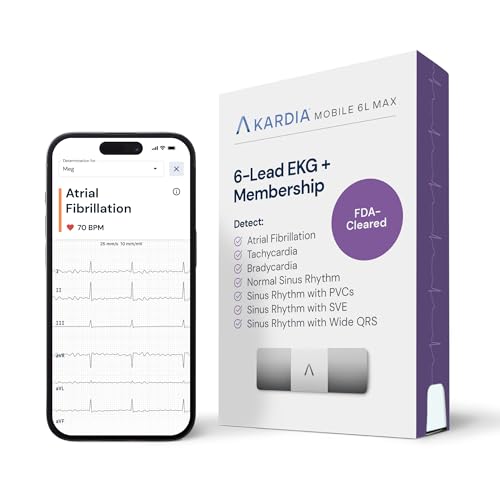
KardiaMobile 6L Max EKG Monitor, Includes One-Year KardiaCare Membership
The KardiaMobile 6L Max is a six-lead, FDA-cleared EKG that delivers determinations in 30 seconds, capturing six times the electrical picture of a single-lead device. It detects six common arrhythmias: AFib, bradycardia, tachycardia, and sinus rhythm with PVCs, with SVE, or with wide QRS. To record, you place your fingers on the top electrodes and rest the bottom sensor on your left leg or knee; it connects over Bluetooth to most smartphones and tablets and is FSA/HSA eligible. Purchase includes one year of the required KardiaCare membership, with four board-certified cardiologist EKG reviews per year.
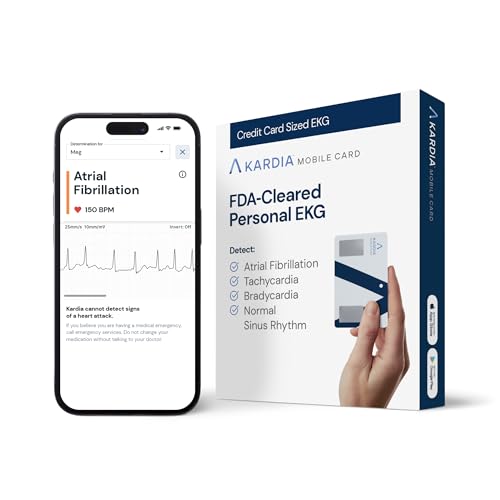
KardiaMobile Card Credit-Card Sized EKG, Medical-Grade & FDA-Cleared Personal Heart Monitor
The KardiaMobile Card is a credit-card-sized, FDA-cleared EKG that genuinely slides into a wallet. It connects to your smartphone over Bluetooth and records a medical-grade single-lead EKG in 30 seconds, detecting AFib, bradycardia, tachycardia, and normal sinus rhythm with no subscription required. The built-in battery lasts a minimum of 2,000 EKGs with auto shut-off after 10 seconds of inactivity, and you can record, save, and share results with your doctor through the free Kardia app. FSA/HSA eligible.
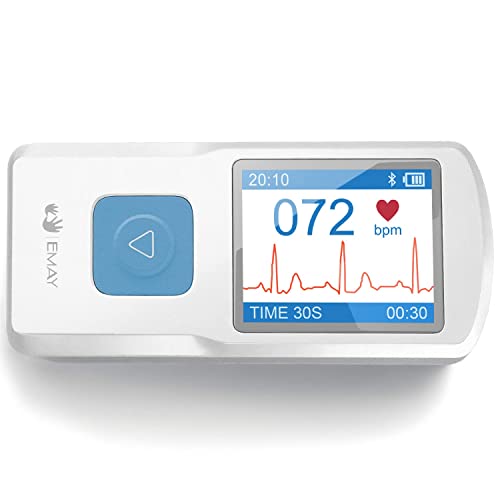
EMAY Portable ECG Monitor | Record ECG and Heart Rate | Compatible with Smartphone and PC
The EMAY is a handheld single-lead (Lead I) ECG recorder that stores readings on the device itself, so no smartphone is needed at the moment of recording. When you want to review or share, connect over Bluetooth to a phone or by USB to a PC. It runs on a built-in rechargeable lithium battery, requires no subscription, and is intended for over-the-counter home use.

OMRON Complete 2-in-1 Blood Pressure Monitor + EKG for Home Use
The OMRON Complete combines an upper-arm blood pressure monitor with OMRON Advanced Accuracy Technology and a single-lead EKG in one device, giving you and your doctor a simultaneous view of blood pressure and heart rhythm. It stores up to 90 readings on the device and unlimited readings in the free OMRON connect app over Bluetooth, with Apple Health and Google Fit support. Body Movement Detection flags readings taken while moving, the wide-range D-ring cuff fits arms 9 to 17 inches, and a storage case and 4 AA batteries are included.
Keep reading
Over-the-Counter Continuous Glucose Monitors: A Guide for Non-Diabetics
An over the counter continuous glucose monitor is sold without a prescription. Here is what the FDA cleared, what the evidence shows, and who should skip it.
Are Home Blood Pressure Monitors Accurate? What the Evidence Says
Are home blood pressure monitors accurate? Validated upper-arm models are — but most devices sold online never passed testing. Here's how to check yours.
The Best Home Blood Pressure Monitors of 2026
Our picks for the best home blood pressure monitor in 2026, from validated Omron accuracy to big-screen and smart models, plus how to get a reliable reading.