Over-the-Counter Continuous Glucose Monitors: A Guide for Non-Diabetics
An over the counter continuous glucose monitor is sold without a prescription. Here is what the FDA cleared, what the evidence shows, and who should skip it.

Affiliate disclosure: This article contains affiliate links. As an Amazon Associate we earn from qualifying purchases, at no extra cost to you. Learn more.
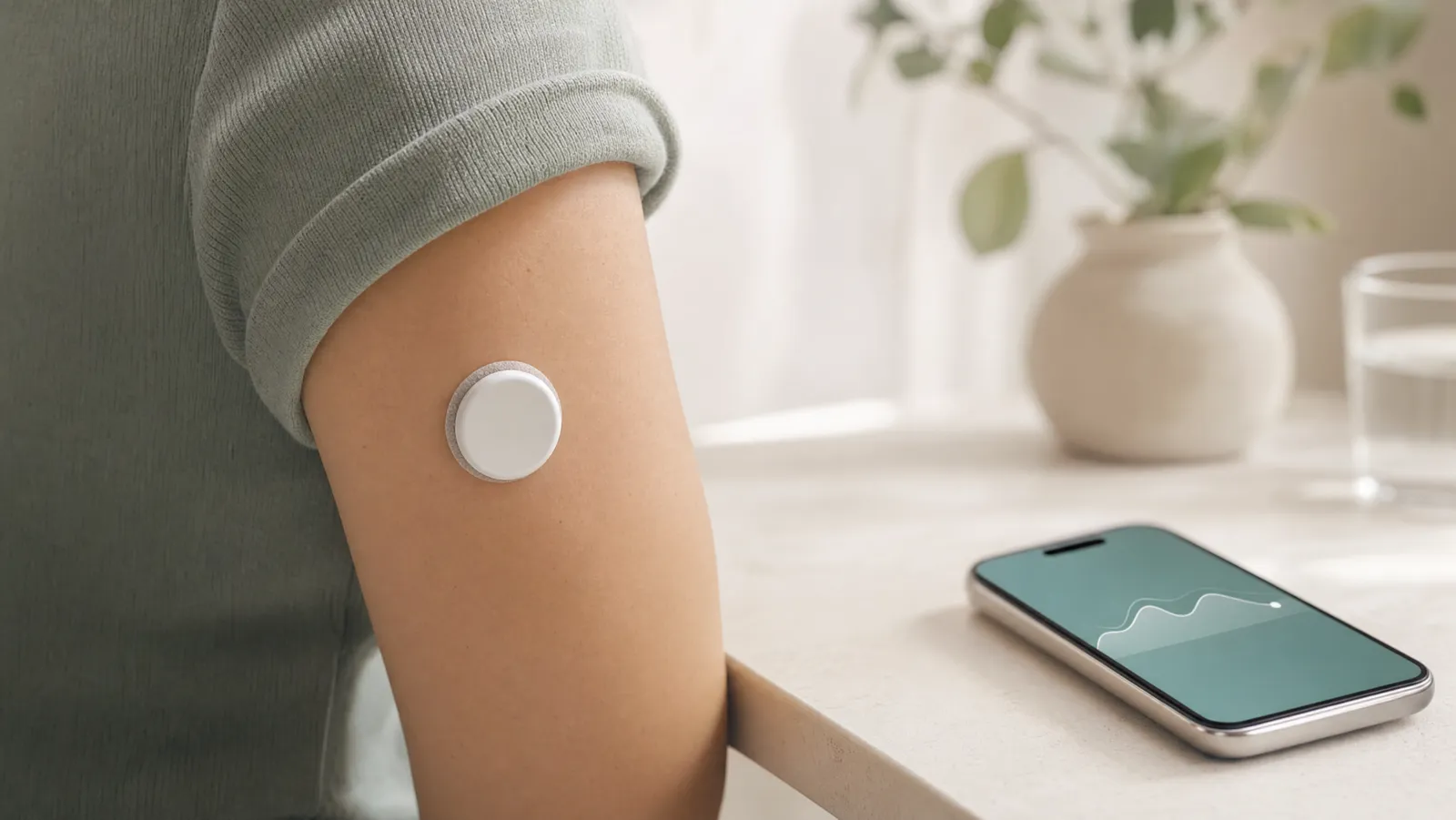
Over-the-counter continuous glucose monitors are wearable sensors, sold without a prescription since 2024, that estimate the glucose in the fluid just under your skin every few minutes and send the numbers to a phone app. They are cleared for adults who do not use insulin. For someone without diabetes, an over the counter continuous glucose monitor is best understood as an educational tool, not a diagnostic one.
That distinction gets lost quickly. A CGM is now one of the easiest home health monitoring devices to buy on impulse — a two-week trial costs about what a decent dinner does — and the app hands you a stream of numbers that nobody has taught you to read. Below, we cover what the FDA actually cleared, what the research supports in people without diabetes, and how to read your own graph without talking yourself into a condition you do not have.
Inside the Sensor: Interstitial Fluid, Not Blood
A CGM does not measure blood. A thin filament sits a few millimeters under the skin of your upper arm, in the interstitial fluid around your cells, where an enzyme reaction produces a small electrical signal the transmitter converts into a glucose estimate. Stelo, for example, reports a new value every 15 minutes.
This is the single most misunderstood point about consumer CGMs, and it explains most of the "my sensor is broken" complaints. Glucose has to move from your bloodstream into the interstitial space, and the sensor itself adds delay. According to the Association of Diabetes Care and Education Specialists, that lag time can be up to about 15 minutes, though it is often less — and published studies have reported a range of roughly 5 to 25 minutes depending on the person and the circumstances.
Practically, the lag means two things:
- The gap is widest when glucose is moving fast. Right after a sugary drink, or during hard exercise, a sensor reading and a fingerstick taken at the same moment can differ meaningfully. Neither is lying; they are measuring different compartments.
- They agree best during flat, stable periods. If you ever compare the two, do it after a few hours of steady state, not mid-spike.
None of this makes a CGM useless. It does mean the number on screen is an estimate of a related fluid, not the lab value your clinician orders.
The OTC Sensors Now on the Market
The over-the-counter category is genuinely new. In March 2024, the FDA cleared the Dexcom Stelo Glucose Biosensor System as the first CGM available without a prescription. The agency's announcement described it as a device that "allows people, 18 years and older, to continuously measure, record, analyze and display glucose values," and stated it is "intended for people who do not use insulin, such as individuals with diabetes treating their condition with oral medications, or those without diabetes who want to better understand how diet and exercise may impact blood sugar levels."
Three OTC systems are worth knowing by name:
- Stelo by Dexcom. Adults 18 and older not on insulin. Sensors are designed for 15 days of wear, with a reading every 15 minutes. Dexcom lists a one-month supply — two sensors — at 99 dollars on its own site as of August 2026, marked FSA/HSA eligible. Its fine print notes that 77.9 percent of sensors lasted the full 15 days, so budget for the occasional early failure.
- Lingo by Abbott. Cleared in June 2024 alongside a sibling product. Abbott describes Lingo as being "designed for consumers 18 years and older who are looking to improve their overall health and wellness," and states plainly that it is "not intended for diagnosis of diseases, including diabetes." Its biosensor runs 14 days. Abbott's site advertises a two-week starter plan, which includes one sensor, at 54 dollars as of August 2026.
- Libre Rio by Abbott. Cleared at the same time, but aimed at a different reader: adults 18 and older with type 2 diabetes who do not use insulin and who, in Abbott's words, typically manage their diabetes through lifestyle modifications. Abbott describes its Libre biosensors as worn on the back of the arm for up to 15 days. One caveat: unlike Stelo and Lingo, Libre Rio has not had a broad U.S. retail launch, so treat it as cleared rather than readily available.
Subscription "metabolic health" apps often bundle one of these same sensors with coaching and a proprietary score, so check what is actually in the box before comparing prices. Pricing here moves fast; confirm current figures with the manufacturer.
The FDA Cleared These for Adults Not on Insulin
The clearance language is narrow, and it is worth reading literally. Stelo's own safety information describes it as intended "to continuously measure, record, analyze, and display glucose values in people 18 years and older not on insulin." Abbott uses the same framing for Lingo: "for users 18 years and older not on insulin."
The manufacturer's stated limitations matter just as much:
- Not for problematic hypoglycemia. Stelo's safety page states the system is not designed for people with problematic hypoglycemia, because it is not designed to alert the user to that condition. Prescription CGMs carry low-glucose alarms; these do not.
- Not evaluated in people on dialysis.
- Do not ignore symptoms. The guidance is explicit: consult your healthcare provider when sensor readings are not consistent with your symptoms of a high or low.
- Do not adjust medication on your own. Stelo's labeling tells users to consult a healthcare provider before making any medication adjustments based on sensor readings.
Said plainly: if you take insulin, or have a history of severe or unrecognized low blood sugar, an OTC sensor is not the right device for you — you need a prescription CGM with alarms and a clinician watching the data with you. Whatever your situation, talk with your own clinician before changing anything based on what a sensor shows.
The Evidence in People Without Diabetes Is Thinner Than the Marketing
This is the crux, so we will be blunt: the promises being made for CGMs in healthy adults run well ahead of what has actually been published.
Start with the guidelines. The American Diabetes Association's Standards of Care in Diabetes states that there is presently insufficient evidence to support the use of continuous glucose monitoring for screening or diagnosis of prediabetes or diabetes — language that has carried through the 2024, 2025, and 2026 editions.
Then the trials. A systematic review and meta-analysis of CGM as a behavior-change tool, published in the International Journal of Behavioral Nutrition and Physical Activity, pooled 25 randomized controlled trials covering 2,996 participants — of which only 3 studied adults with overweight and obesity rather than diabetes. Pooled across all of those trials, the authors reported non-significant changes in BMI (-0.4 kg/m2, p = 0.08) and body weight (-0.7 kg, p = 0.07); they did not report separate weight results for the non-diabetes trials. They concluded that "further research on the use of CGM-based biological feedback in populations without diabetes is needed to support the efficacy of this intervention in a variety of populations."
Then the measurement question. Researchers at Mass General Brigham analyzed CGM data from 972 adults aged 40 and older and published the results in Diabetes Technology and Therapeutics. Among people with type 2 diabetes, CGM metrics lined up closely with HbA1c. In people with prediabetes, that relationship weakened. In people without diabetes, it disappeared. As study author Dr. Rodriguez put it, CGMs "may be useful as behavioral 'biofeedback' tools... but they do not directly reflect longer term blood sugar control."
So the honest summary for a healthy adult shopping for a continuous glucose monitor for weight loss: the evidence is thin. Not disproven — thin. Fewer than a handful of randomized trials, no demonstrated weight benefit, and no professional body recommending it for screening.
Reading Your Own Data Without Scaring Yourself
Normal glucose in a person without diabetes still moves. A rise after a meal is physiology, not pathology; a graph with peaks is what a working metabolism looks like.
For general context, here are the reference ranges the major bodies publish — all of which come from blood tests ordered by a clinician, not from a sensor:
- Fasting plasma glucose. According to the CDC, 99 mg/dL or below is normal, 100 to 125 mg/dL falls in the prediabetes range, and 126 mg/dL or above indicates diabetes. The American Diabetes Association adds that an abnormal result usually needs to be repeated on a second day before a diagnosis is made.
- A1C. According to the CDC, below 5.7 percent is normal, 5.7 to 6.4 percent is the prediabetes range, and 6.5 percent or above indicates diabetes.
- Two hours into an oral glucose tolerance test. The American Diabetes Association lists below 140 mg/dL as normal, 140 to 199 mg/dL as prediabetes, and 200 mg/dL or above as diabetes. Note that this threshold comes from a standardized glucose drink given in a clinic, not from an ordinary meal.
Two cautions before you hold your own graph up against those numbers. First, they were validated against venous blood draws, not interstitial estimates, so a sensor reading of 143 after a bowl of pasta does not put you in a diagnostic category. Second, researchers have warned that the Glucose Management Indicator — the estimated A1C many CGM apps display — can run roughly 0.6 percentage points above a laboratory A1C, which could leave people without diabetes believing they have prediabetes when they do not.
A sensor reading is a data point, not a verdict. It is one reason we think any conversation about which health numbers to track after 50 should start with the measurements that have been validated against real outcomes, and treat everything else as supplementary.
Three Situations Where a CGM Genuinely Helps
These devices are not worthless. There are narrow cases where two weeks of data earns its cost.
1. Prediabetes awareness. The gap here is real: the CDC's National Diabetes Statistics Report estimated that 97.6 million U.S. adults had prediabetes in 2021, and that only about 19 percent of them had ever been told by a health professional. A sensor showing an unexpectedly high pattern is a reasonable prompt to go get an A1C or fasting glucose test — a nudge toward testing, not a substitute for it.
2. Seeing your own food responses. Two people can eat the same bowl of oatmeal and produce noticeably different curves. Watching that on your own arm is more persuasive than reading it in a nutrition article — which is precisely the "biofeedback" role the Mass General Brigham researchers described. Keep the conclusion modest: you are learning about two weeks of your responses, not discovering a personalized diet.
3. Connecting habits to glucose. A walk after dinner, a short night of sleep, a stressful afternoon — all of these show up on the graph, and seeing the association makes an abstract recommendation concrete. Glucose is only one signal, though. Pairing a two-week sensor stint with a weight trend from one of the best smart scales and a simple sleep log gives you far more context than a glucose curve alone.
Cost, Coverage, and FSA/HSA Dollars
At list prices, this is not a casual purchase if you plan to wear one continuously. Stelo's one-month supply of two sensors lists at 99 dollars on Dexcom's site as of August 2026 and is marked FSA/HSA eligible; Lingo's two-week, one-sensor starter plan lists at 54 dollars as of the same date. Wear a sensor year-round at those rates and you are into four figures annually — gym-membership money, for a device with a much thinner evidence base.
Three practical notes on paying for one:
- FSA and HSA funds are the most realistic route. Dexcom explicitly flags Stelo as FSA/HSA eligible; check your plan administrator's rules, since eligibility for wellness-category products is not uniform.
- Do not assume insurance covers it. These are sold over the counter as consumer or wellness products, and CGM coverage has historically hinged on a diabetes diagnosis and specific clinical criteria. Verify with your own plan.
- Buy the smallest quantity first. A single two-week sensor tells you most of what a first-timer learns. Subscriptions are for people who already know they will use the data.
If you are weighing a CGM against other purchases for your household, our walkthrough on how to choose a home health monitoring device covers the questions worth asking — validation, actionability, and whether the number will actually change what you do — before any device earns a spot on your arm.
Deciding Whether an OTC CGM Is Worth It
A short decision list, based on everything above.
A two-week sensor may be worth it if:
- You have prediabetes and want to see how your own meals and walks behave, with your clinician in the loop.
- You learn well from immediate feedback and will actually change something in response.
- You can look at a 160 mg/dL spike after birthday cake and shrug.
We suggest skipping it if:
- You use insulin or have a history of severe or unrecognized lows. You need a prescription device with alarms.
- You are trying to find out whether you have diabetes. Ask your clinician for the blood test — it is cheaper and it is the diagnostic standard.
- Watching numbers around food tends to make your eating more anxious rather than more informed.
- The 99 dollars would do more good in a validated blood pressure monitor, which has decades of outcome evidence behind it.
An over the counter continuous glucose monitor is a legitimate, FDA-cleared device that answers one narrow question well: what does my glucose appear to do over the next two weeks. It does not diagnose diabetes, it does not replace a lab test, and it has not been shown to help healthy adults lose weight. Treat it as a short experiment with a clear question attached and it can teach you something; treat it as a metabolic verdict and it will mostly teach you to worry. For where it fits alongside everything else you might measure at home, see our guide to home health monitoring devices.
FAQ
Can an over-the-counter CGM diagnose diabetes?
No. A CGM estimates glucose in interstitial fluid; diagnosis requires clinician-ordered blood testing — a fasting plasma glucose, an A1C, or an oral glucose tolerance test. The American Diabetes Association's Standards of Care states there is presently insufficient evidence to support using continuous glucose monitoring for screening or diagnosis of prediabetes or diabetes. If your sensor data concerns you, the next step is a lab test, not a longer wear period.
Do OTC continuous glucose monitors work for people who take insulin?
They are not cleared for it. The FDA's clearance covers people who do not use insulin, and Dexcom states that Stelo is not designed for people with problematic hypoglycemia because it does not alert users to that condition. If you take insulin or have had severe low blood sugar, you need a prescription CGM with low-glucose alarms and clinician oversight.
How long does an OTC CGM sensor last?
Stelo's sensors are designed for 15 days of wear and Abbott's Lingo runs 14 days; Abbott describes its Libre biosensors as worn for up to 15 days. Real-world duration is slightly shorter on average: Dexcom's own disclosure notes that 77.9 percent of Stelo sensors lasted the full 15 days, so occasional early replacement is part of the running cost.
Keep reading
Are Home Blood Pressure Monitors Accurate? What the Evidence Says
Are home blood pressure monitors accurate? Validated upper-arm models are — but most devices sold online never passed testing. Here's how to check yours.
The Best At-Home ECG Monitors of 2026
Our picks for the best at home ECG monitor in 2026: KardiaMobile, EMAY, and OMRON compared on leads, subscriptions, and what a home EKG can really detect.
The Best Home Blood Pressure Monitors of 2026
Our picks for the best home blood pressure monitor in 2026, from validated Omron accuracy to big-screen and smart models, plus how to get a reliable reading.