The Best Fitness and Health Trackers for Seniors in 2026
The best fitness tracker for seniors in 2026: five easy-to-use picks with readable displays, days of battery life, and safety alerts, from $30 to $195.

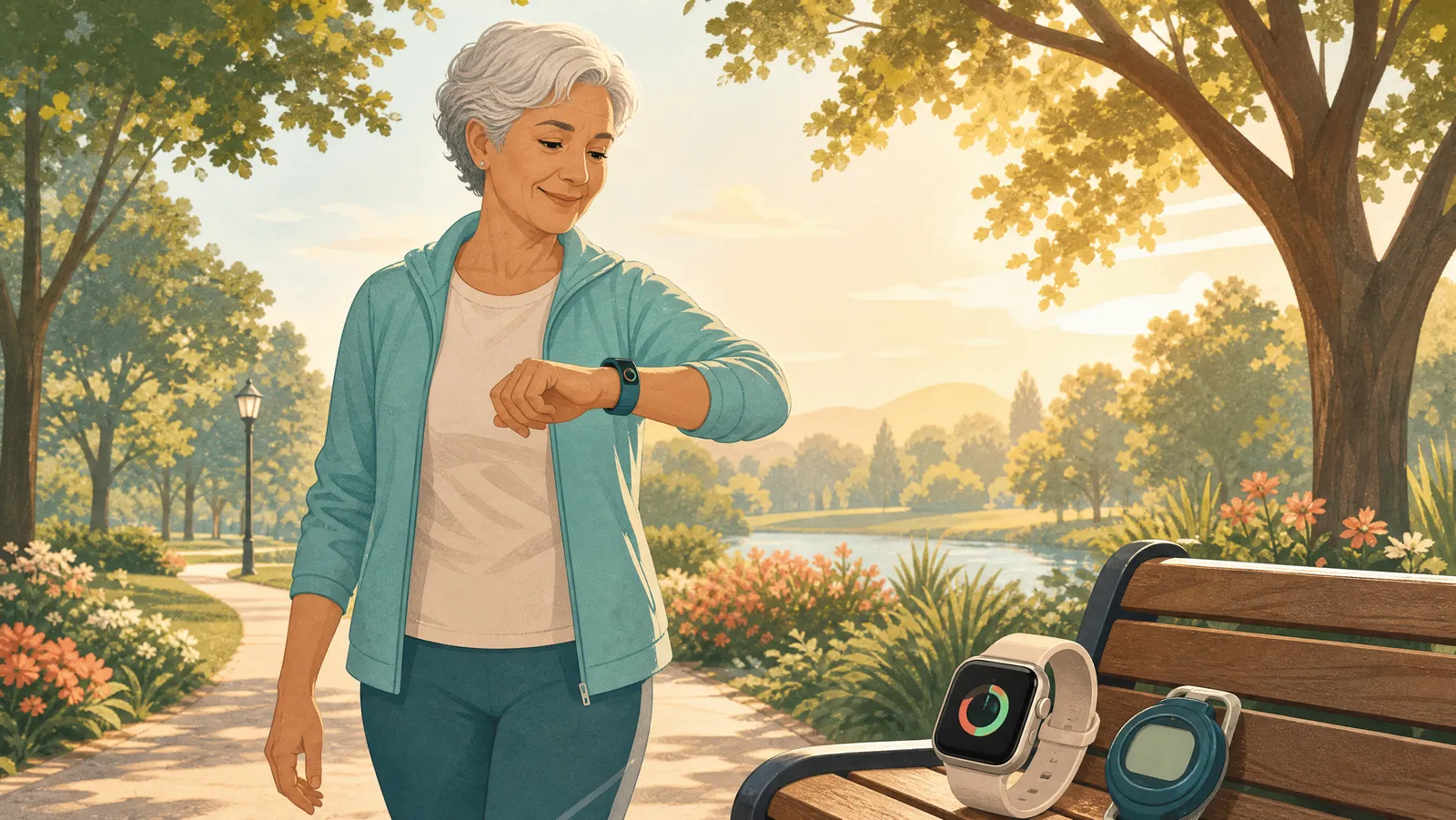
Affiliate disclosure: This article contains affiliate links. As an Amazon Associate we earn from qualifying purchases, at no extra cost to you. Learn more.
◆ The verdict
5 reviewed- 1Our PickFitbit Charge 6 Fitness Tracker with Google Apps - Obsidian/Black - Small&Large Bands IncludedCheck price ▸
- 2Best for SimplicityFitbit Inspire 3 Health & Fitness Tracker - Midnight Zen/BlackCheck price ▸
- 3Best for Emergency FeaturesGarmin vívosmart® 5, Health & Fitness Tracker, S-M, WhiteCheck price ▸
- 4Best Smartwatch UpgradeGarmin vívoactive® 5, Health & Fitness GPS Smartwatch, 42mm, IvoryCheck price ▸
- 5Best No-App OptionPedometer Watch Senior Friendly No App No Phone Required, Fitness TrackerCheck price ▸
The best fitness tracker for seniors in 2026 is the Fitbit Charge 6: a slim band, around $128 as of July 2026, that covers heart rate, sleep, stress, and built-in GPS without any smartwatch complexity. Want emergency-contact alerts? We like the Garmin vivosmart 5. Want no apps at all? The $29.99 Pautios pedometer watch keeps things genuinely simple.
Better Life Span is reader-supported; if you buy through links on this page we may earn a small commission, at no cost to you.
A wearable tracker is the easiest entry point into home health monitoring devices: strap it on and it quietly counts your steps, watches your heart rate, and scores your sleep — no cuffs, no test strips, no appointments. The catch is that most trackers are designed for 30-year-old marathoners, not 70-year-old walkers. Small gray text, touch-only screens, daily charging, and subscription paywalls are minor annoyances at 35 and dealbreakers at 75.
So we judged this category on different terms: display readability, battery life measured in days, physical buttons, emergency features, and how much you get without paying a monthly fee. Below you will find the five trackers we would actually put on an older adult's wrist, what the step-count research says, and — because these are wellness gadgets, not medical devices — which of their numbers to hold loosely.
The case for counting steps after 50
You do not need 10,000 steps a day. The research on older adults consistently lands lower than that famous target, and the gains start surprisingly early.
According to a 2022 meta-analysis of 15 international cohorts (47,471 adults) published in The Lancet Public Health, the risk of death from any cause fell progressively with more daily steps — but for adults 60 and older, the benefit leveled off at about 6,000 to 8,000 steps per day. People in the higher step quartiles had a 40 to 53 percent lower mortality risk than those in the lowest quartile. Adults under 60 kept benefiting up to roughly 8,000 to 10,000 steps.
The floor is even more encouraging. A 2019 study in JAMA Internal Medicine that followed 16,741 older women (average age 72) found that those averaging about 4,400 steps per day had a 41 percent lower death rate over the following years than those averaging around 2,700, with benefits leveling off near 7,500 steps.
Two honest caveats. These are observational studies: they show that people who walk more tend to live longer, not that a wristband causes it. And buying a tracker changes nothing by itself. What a tracker does well is make an invisible number visible, so that "I should move more" becomes "I'm at 3,900 steps — one more loop around the block gets me to my goal." For older adults, that goal can be modest and still meaningful.
Features that matter in a health tracker for older adults
The best health tracker for older adults is rarely the one with the most sensors. After comparing current listings, we think five things separate a tracker that gets worn daily from one that ends up in a drawer:
- A display you can actually read. Larger text and a bright screen matter more than resolution. The Garmin vivosmart 5 was explicitly designed with a bigger, brighter display and larger text than its predecessor, and the vivoactive 5's AMOLED watch face is readable at arm's length.
- Battery measured in days, not hours. A tracker that dies nightly never builds a habit. The vivosmart 5 and the Pautios watch run up to 7 days per charge; the vivoactive 5 claims up to 11 days in smartwatch mode.
- A physical button. Touchscreens frustrate dry fingertips and tremor. The vivosmart 5 pairs its touchscreen with a real button; the Pautios keeps everything on one simple watch.
- Emergency features — with clear eyes about their limits. According to the CDC, more than one in four adults 65 and older falls each year, leading to about 3 million emergency department visits. Garmin's incident detection can message emergency contacts with your live location, but only during select activities and only with your phone nearby (more below). It is a supplement, not a medical-alert system.
- Useful basics without a subscription. Steps, heart rate, and sleep should work free forever. Fitbit's deeper analysis moves behind the paid Google Health Premium plan after a 3-month trial, which is worth knowing before you get attached to those screens.
Band, smartwatch, or no-app watch: choosing a form factor
Our five picks span three form factors, and the right one depends mostly on temperament.
Slim bands (Fitbit Charge 6, Inspire 3, Garmin vivosmart 5) are light, discreet, and comfortable for sleep tracking, but their narrow screens show one or two numbers at a time. They suit people who want data collected quietly and reviewed later on a phone.
Smartwatches (Garmin vivoactive 5) give you a proper watch face, bigger text, and room for extras like on-wrist maps and music — at the cost of size and a slightly steeper learning curve. The trade-off mirrors the smart rings vs smartwatches debate playing out across the wearables market: comfort and battery on one side, a readable screen on the other. If you already wear a watch every day, replacing it with a smartwatch is the path of least resistance — and for many older adults, the best smartwatch for seniors is simply the one with the biggest text and the longest battery.
No-app watches (Pautios) put everything — setup, step count, heart rate — on the watch itself. No smartphone, no account, no syncing. The trade-off is real: there is no backup and no long-term trend history. But for a determined non-smartphone user, a tracker that needs a phone is a tracker that never gets used.
Our selection process
We started from the needs above — readability, multi-day battery, buttons, safety features, subscription-free basics — rather than from spec sheets. Every product fact in this guide comes from the manufacturer's current Amazon listing, checked in July 2026, and prices are noted as of July 2026 (they move often). We favored the two brands with the longest consumer health-tracking track records, Fitbit and Garmin, and added one budget no-app option for readers who do not use a smartphone, with an honest caveat about its lesser-known brand. We do not repeat marketing claims about medical accuracy for any of them.
The five best fitness trackers for seniors in 2026
The product cards on this page carry the full specs and links; here is the context for why each pick made the list.
Our Pick: Fitbit Charge 6
At around $128 as of July 2026 (list $159.95), the Charge 6 offers the most complete health picture of any simple band we compared: 24/7 heart rate, a nightly Sleep Score, a Daily Readiness score, stress tracking, and 40-plus exercise modes with automatic detection. Built-in GPS means a walk gets mapped even if your phone stays home, and the band can broadcast your heart rate to compatible treadmills and ellipticals — handy in a gym class. Google Maps directions and Wallet tap-to-pay on the wrist are genuinely useful, not gimmicks. Two caveats: the deepest insights require Google Health Premium after the included 3-month trial, and as of July 2026 this listing ships on a scheduled date rather than being immediately in stock.
Best for Simplicity: Fitbit Inspire 3
The Inspire 3, about $93 as of July 2026, is the tracker we suggest for anyone who says "I just want something simple that works with my phone." It is a slim, lightweight band, yet it still includes the features that matter most in this category: irregular heart rhythm notifications, SpO2, resting heart rate, sleep tracking with a daily score, and a gentle vibrating smart-wake alarm. It requires a reasonably recent phone (Apple iOS 16.4+ or Android 11+). There is no built-in GPS — it borrows your phone's — and the small display shows less at a glance than a watch. Like the Charge 6, this listing ships on a scheduled date rather than showing as immediately in stock.
Best for Emergency Features: Garmin vivosmart 5
The vivosmart 5, $144.99 as of July 2026, is the pick when peace of mind is the point. Heart-rate alerts can be configured to flag abnormally high or low readings, and its incident detection and Assistance features can send a message and live location to your emergency contacts during select activities. Be clear about the fine print, though: according to Garmin's own support documentation, these safety features require your paired phone to be with you, running Garmin Connect, with a data plan and network coverage — and Garmin says incident detection should not be relied on as a primary way to get emergency help. We also like the physical button beside the touchscreen and the up-to-7-day battery. The display is more basic than a Fitbit's, and it costs more.
Best Smartwatch Upgrade: Garmin vivoactive 5
At $194.99 as of July 2026 — about 35 percent below its $299.99 list price — the vivoactive 5 is the step-up for anyone who wants a real watch. The bright AMOLED screen is the easiest to read of our picks, battery life stretches up to 11 days in smartwatch mode, and it layers on sleep coaching, nap detection, HRV status, and Garmin's Body Battery energy score. A thoughtful touch: a wheelchair mode that tracks pushes instead of steps. It stores music from Spotify, Amazon Music, or Deezer for phone-free listening. The trade-offs are size on the wrist and sport-first menus that take a little learning.
Best No-App Option: Pautios No-App Pedometer Watch
The Pautios, $29.99 as of July 2026, exists for one person: the older adult who does not use a smartphone, or does not want one involved. Setup and readouts happen entirely on its large color touchscreen — steps, distance, calories, activity time, real-time heart rate, manual blood-oxygen spot checks, and basic sleep tracking. It charges in about 1.5 hours, runs up to 7 days, and carries an IP68 water-resistance rating. Our honest take: this is a little-known brand, so treat its heart-rate and SpO2 numbers as rough wellness estimates, and know that there is no backup or trend history beyond what the watch shows. As a motivating daily step counter, though, $30 is hard to argue with.
Wrist readings are estimates, not medical tests
This is the section we most want you to remember. Consumer trackers are wellness products, not medical devices. The FDA's general wellness policy — updated in guidance issued in January 2026 — deliberately keeps low-risk trackers and their heart-rate, sleep, and activity features outside medical-device regulation, precisely because they are not cleared to diagnose or treat anything.
In practice, that means:
- Wrist heart rate is an optical estimate that can be thrown off by movement, fit, and skin. Trends across weeks are more meaningful than any single reading.
- SpO2 (blood oxygen) on these devices is a spot-check estimate. Garmin states plainly that its Pulse Ox feature is not a medical device.
- Sleep stages are inferred from motion and heart rate, not brain waves. Use the scores to compare your nights against each other, not against a sleep lab.
- Irregular-rhythm notifications are a prompt, not a verdict. Fitbit's feature was FDA-cleared in 2022 to check passively for signs of atrial fibrillation while you are still or asleep — and in validation data it correctly identified AFib episodes 98 percent of the time compared with an ECG patch — but according to Google, a notification is not a diagnosis and should be taken to your doctor, and the feature is not intended for people already diagnosed with AFib.
If any reading ever conflicts with how you feel — chest discomfort, breathlessness, faintness — trust your symptoms, not your wrist, and seek care. And since a tracker only sees activity, many readers pair one with a bathroom scale that tracks weight trends over time; our guide to the best smart scales covers which body-composition numbers deserve the same healthy skepticism.
FAQ
What is the easiest fitness tracker for an elderly person to use?
For someone without a smartphone, the Pautios no-app pedometer watch is the easiest by a wide margin — everything is set and read on the watch itself. For someone comfortable with a phone, the Fitbit Inspire 3 is the simplest of the app-connected picks: one slim band, automatic tracking, and a straightforward app.
Do you need a smartphone to use a fitness tracker?
Four of our five picks require one — the Fitbits need Apple iOS 16.4+ or Android 11+, and the Garmins pair with the Garmin Connect app (the vivosmart 5 even borrows the phone's GPS). The exception is the Pautios watch, which needs no app or phone at all.
Can a fitness tracker call 911 after a fall?
None of our picks calls 911. The closest is the Garmin vivosmart 5, whose incident detection can send a message and live location to emergency contacts during select activities — but per Garmin, only when your paired phone is with you and has coverage, and Garmin cautions it is not a primary way to obtain emergency assistance. If falls are the main concern, a dedicated medical-alert system is the more dependable tool, with a tracker as a complement.
How many steps a day should a 70-year-old aim for?
The 2022 Lancet Public Health meta-analysis found mortality benefits for adults 60 and older leveled off around 6,000 to 8,000 steps per day, and the 2019 JAMA Internal Medicine study of older women found meaningfully lower death rates starting around 4,400 steps. A reasonable approach: learn your current baseline for a week, then add 500 to 1,000 steps. Check with your doctor before a big jump in activity, especially with heart or joint conditions.
Bottom line: the best tracker is the one that stays on your wrist
Start with how you live, not with a spec sheet. Phone-averse? Spend $30 on the Pautios and enjoy your step count. Want simple and connected? The Fitbit Inspire 3. Want the fullest picture in a band, the strongest safety net, or a true watch? That is the Charge 6, the vivosmart 5, and the vivoactive 5, in that order. Whichever you choose, treat its numbers as friendly estimates that start conversations — with yourself about tomorrow's walk, and with your doctor about anything that looks off. A tracker is one piece of a bigger picture; our at-home health monitoring guide covers how it fits alongside blood pressure monitors, scales, and the rest of the home toolkit.
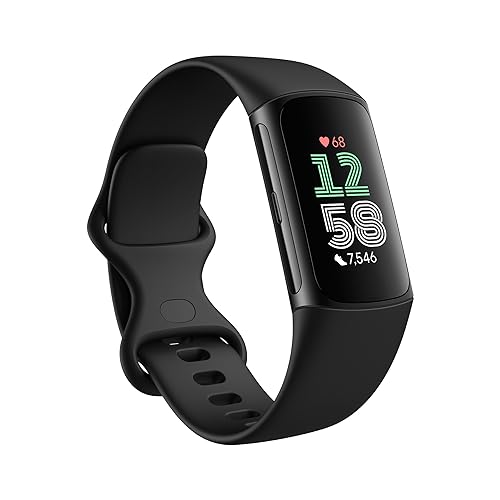
Fitbit Charge 6 Fitness Tracker with Google Apps - Obsidian/Black - Small&Large Bands Included
The Fitbit Charge 6 tracks 24/7 heart rate, all-day activity, calories, Active Zone Minutes, Daily Readiness, and sleep with a personalized nightly Sleep Score. It offers 40-plus exercise modes with built-in GPS and automatic exercise tracking, and it can broadcast your real-time heart rate to compatible gym equipment such as treadmills and ellipticals. Google Maps turn-by-turn directions, Google Wallet tap-to-pay, and YouTube Music controls run right on the wrist. Small and large bands are included, along with a 3-month Google Health Premium trial (subscription sold separately).

Fitbit Inspire 3 Health & Fitness Tracker - Midnight Zen/Black
The Inspire 3 is a slim, lightweight band with 24/7 heart rate, all-day activity tracking, and reminders to move. It adds irregular heart rhythm notifications, SpO2 (blood oxygen), resting heart rate, and a daily Stress Management Score, plus automatic sleep tracking with a detailed daily Sleep Score and a smart wake vibrating alarm. It offers 40-plus exercise modes with automatic exercise tracking, works with Apple iOS 16.4+ and Android 11+, and includes a 3-month Google Health Premium membership.

Garmin vívosmart® 5, Health & Fitness Tracker, S-M, White
The vivosmart 5 is a slim band that pairs a touchscreen with a physical button and a bigger, brighter display with larger text than the vivosmart 4. It tracks heart rate with configurable low and high alerts, Pulse Ox spot checks (not a medical device), Body Battery energy, respiration, stress, and sleep with improvement insights, and runs up to 7 days per charge — it is safe for swimming and showering. Incident detection and Assistance can send messages and a live location to emergency contacts during select activities, as long as your paired phone is with you and has coverage.

Garmin vívoactive® 5, Health & Fitness GPS Smartwatch, 42mm, Ivory
The vivoactive 5 is a full GPS smartwatch with a bright AMOLED touchscreen and up to 11 days of battery in smartwatch mode (5 days always-on). It offers a sleep score with personalized coaching, nap detection, HRV status, and Body Battery energy monitoring that draws on sleep, naps, stress, and workouts. There are 30-plus built-in indoor and GPS sports apps, preloaded workouts, and a wheelchair mode that tracks pushes instead of steps, plus music storage from Spotify, Amazon Music, or Deezer playlists in a 42mm case.

Pedometer Watch Senior Friendly No App No Phone Required, Fitness Tracker
This pedometer watch requires no app and no smartphone — everything is set and read on the watch itself, on a large color LCD touchscreen designed to be senior-friendly. It tracks steps, distance, calories, and activity time, with real-time heart rate and manual blood-oxygen spot checks that are wellness estimates, not medical readings, plus basic sleep tracking. A magnetic charger tops it up in about 1.5 hours for up to 7 days per charge, and it carries an IP68 water-resistance rating.
Keep reading
The Best At-Home Health Monitoring Devices for Seniors: A Complete Guide (2026)
The best home health monitoring devices for seniors in 2026: blood pressure monitors, pulse oximeters, smart scales, ECG and glucose monitors explained.
Which Health Numbers Are Worth Tracking at Home After 50?
The health metrics to track at home after 50 — blood pressure, resting heart rate, weight trend, waist-to-height ratio — and which numbers to skip.
Are Home Health Devices Covered by Medicare, FSA, or HSA?
Are home health monitoring devices covered by Medicare? Usually not. But FSA and HSA dollars cover far more. Here is what each program actually pays for.