Do OTC Hearing Aids Actually Work? What the Evidence Says
Do OTC hearing aids work? Trials say yes for adults with mild to moderate loss, roughly matching a clinic fit. Here is the evidence, and where it stops.

Affiliate disclosure: This article contains affiliate links. As an Amazon Associate we earn from qualifying purchases, at no extra cost to you. Learn more.
Yes, for a narrow and specific group. In randomized trials, adults with mild to moderate hearing loss who set up an over-the-counter hearing aid themselves did about as well after six weeks as adults fitted by an audiologist. That result is real and it has now been replicated. It is also smaller than the advertising implies.
The honest version takes a few more sentences. The trials behind that headline are short, mostly small, usually compare self-fitting against professional fitting of the same device, and several were funded or staffed by the companies that make the hardware. Meanwhile the category's biggest real-world failure has nothing to do with electronics: people are poor judges of their own hearing loss, and the FDA's entry ticket to this category is self-diagnosis. Below is what the research measured, where it stops, and who these devices reliably fail. If you have already decided and want hardware recommendations, start with our roundup of the best OTC hearing aids.
The short answer
- They work for the loss they were designed for. The FDA created the OTC category in a final rule issued August 17, 2022, effective that October 17, for adults 18 and older with perceived mild to moderate hearing loss. The agency states plainly that these devices are not for severe or profound loss.
- They roughly match a clinic fit in short trials. A systematic review and meta-analysis in Otolaryngology–Head and Neck Surgery, pooling 15 studies and 774 participants with searches run through August 2025, found no significant difference between self-fitting OTC and professionally fitted hearing aids on self-reported benefit or speech-in-noise scores.
- They deliver less amplification than a prescription formula would. Research on self-fitting devices finds users select gain below standard clinical targets, especially at high frequencies, where most speech clarity lives.
- Real owners are satisfied, but slightly less so. In the MarkeTrak 25 survey reported in Seminars in Hearing in 2025, 76% of OTC hearing aid owners were satisfied, against 83% of prescription owners.
- A large share of OTC buyers are not doing this alone. In that same survey, 72% of OTC owners had a professional hearing evaluation and 56% had professional help with fitting. Only 20% used no professional services at all, and satisfaction was lower in both groups without them.
That last point matters more than any lab measurement. Much of the published "OTC works" evidence describes people who had a hearing test first.
"Work" is three separate questions, and they have three different answers
Hearing aid research does not have one outcome. It has at least three, and marketing blurs them together.
Audibility is whether quiet sounds become loud enough to hear. This is the easy one. Any competent amplifier moves the needle here, and OTC devices generally succeed.
Speech in noise is whether you can follow one voice in a restaurant. This is the hard one, and it is the complaint that actually sends people shopping. Amplification helps, but it does not restore the brain's ability to separate a voice from background clatter, and no hearing aid at any price fully solves it.
Adherence and satisfaction is whether the device stays in your ear after month two. This is the outcome that decides whether you got anything for your money. The National Institute on Deafness and Other Communication Disorders reports that only about one in five people who would benefit from a hearing aid actually uses one.
When someone asks whether OTC hearing aids work, they usually mean the second and third questions. Most of the evidence answers the first.
The trials that produced the headline
The study everyone cites is a randomized clinical trial by De Sousa and colleagues published in JAMA Otolaryngology–Head and Neck Surgery in June 2023. It compared a self-fitting OTC hearing aid with remote support against the same category of device fitted by an audiologist using best practices. At six weeks, outcomes were comparable.
Read the disclosures before you read the conclusion. The trial was supported by the National Institutes of Health and by hearX Group, which makes the Lexie Lumen device used in the study and supplied both the hardware and software support for data collection. Multiple authors reported consulting fees, and one reported equity, from hearX. That does not make the finding wrong. It does mean it should not stand alone.
It no longer has to. The 2026 meta-analysis noted above, led by the same researcher, pooled the wider literature and found the same pattern of no meaningful difference across four standard outcome measures, including the QuickSIN speech-in-noise test. A separate crossover study in Trends in Hearing in 2025 went further: across 21 participants, the self-fitted condition actually beat the clinician-fitted condition on self-reported benefit and on speech in noise. Three of that paper's authors are employees of Concha Labs, the device manufacturer.
The pattern is consistent. The evidence base is also, repeatedly, produced by people with a stake in the answer. In a young field that is not unusual, but it is worth knowing.
The limits the trials do not test
The published comparisons share four structural blind spots.
- They are short. Most were field trials of roughly 10 days to 8 weeks. Hearing aid abandonment is a multi-year problem, and almost nothing in this literature runs long enough to see it.
- They usually compare the same device against itself. The typical design pits self-fitting of a given hearing aid against professional fitting of that same hearing aid. That tests the fitting method, not the hardware. It says nothing about the cheapest devices on a marketplace listing page.
- They are small. The 2026 meta-analysis pooled 774 participants across 15 studies, with 739 analyzed. That is a modest evidence base for a category sold to tens of millions of people.
- Participants were supported. Remote support, research staff, and screening audiograms are standard in these studies. The unsupported shopper buying from a search ad is not the person who was studied.
Three places OTC devices fall short
The first gap is amplification itself. A 2025 gain analysis published in Audiology Research found that self-fitting OTC hearing aids produced gain that matched NAL-NL2 prescriptive targets within a loose 10 dB tolerance but not a stricter 5 dB one, with users generally choosing less amplification than the formula prescribes, particularly in the higher frequencies that carry consonant sounds. People under-amplify themselves. Trials suggest the resulting outcomes are still good, but "good" and "optimal" are not the same word.
The second gap is verification. A clinic fitting includes real-ear measurement, where a probe microphone confirms what the device is actually doing inside your ear canal, plus counseling and follow-up adjustments. No app can do that. We compare the two routes in detail in OTC hearing aids vs prescription hearing aids.
The third gap is headroom. The FDA's final rule caps OTC output at 111 dB SPL, or 117 dB SPL for devices using input-controlled compression. Notably, the agency declined to set a separate gain limit, reasoning that a gain cap would reduce effectiveness for soft sounds. The output ceiling is the hard boundary, and it is a real one for anyone whose loss is worse than they think.
The dementia claim needs a careful reading
You will see hearing aids sold as brain protection. Be careful here.
The ACHIEVE trial, published in The Lancet in 2023, randomized 977 adults aged 70 to 84 with untreated mild to moderate hearing loss to a best-practice hearing intervention or a health education control, and followed them for three years. In the full cohort, the result was null. Hearing intervention did not reduce three-year cognitive decline.
A prespecified analysis found something more interesting: among participants recruited from the ARIC cardiovascular cohort, who had higher baseline risk, cognitive decline was about 48% slower with hearing intervention. Among healthy community volunteers, there was no effect. The most defensible reading is that treating hearing loss may protect thinking in older adults already at elevated risk, and that this remains a subgroup finding, not a demonstrated general benefit.
The 2024 Lancet Commission on dementia lists hearing loss among 14 modifiable risk factors and attributes roughly 7% of dementia cases to it. That is an association drawn from population data, not proof that buying hearing aids prevents dementia. And ACHIEVE used prescription-grade fittings by audiologists, not OTC devices. Nobody has run that trial.
The people OTC hearing aids do not work for
This is where the category fails hardest, and where the failure is predictable.
- Anyone with FDA red-flag signs. The FDA advises consulting a doctor, preferably an ear specialist, for red flags including visible ear deformity from birth or trauma; fluid, pus, or blood from the ear within the past six months; ear pain or a history of excessive earwax; dizziness or vertigo; sudden or fluctuating change in hearing; and hearing loss or ringing in only one ear or a clear difference between ears.
- Severe or profound loss. The FDA excludes it from the category outright. An analysis of NHANES data published in Ear & Hearing in 2024 estimated that about 49.5 million US adults, or 21.2%, report a little or moderate trouble hearing, the OTC target group, while a much smaller share report a lot of trouble hearing or consider themselves deaf and need professional care.
- Conductive or medically treatable loss. Amplifying past an untreated middle-ear problem treats a symptom and delays a diagnosis.
- Anyone under 18. Outside the category entirely.
- People who misjudge their own hearing. This is the quiet one. A 2025 study in OTO Open of 116 patients found that only 57% of those with genuine mild to moderate loss correctly identified themselves as OTC candidates when judged against their high-frequency thresholds, rising to 73% using a mid-frequency range. Most patients whose loss fell outside the mild to moderate band overestimated their hearing. The authors' recommendation was blunt: get a hearing test before you buy.
An audiogram is often free or low-cost. It converts a guess into a fact, and it is the single highest-value step in this entire process.
The features that separate a device that works from one that does not
- It is a hearing aid, not an amplifier. A 2023 study in the American Journal of Audiology compared evidence-based OTC presets against a clinical NAL-NL2 fitting and against a personal sound amplification product across 37 participants. The presets performed comparably to the clinical fitting and beat the PSAP, which used a single, poorly suited frequency response, on listening effort, sound quality, and real-world speech recognition. The distinction is not cosmetic, and we unpack it in how OTC hearing aids differ from sound amplifiers.
- It shapes sound by frequency, not just volume. Age-related loss is usually worst in the high frequencies. A device with one loudness knob raises the rumble along with the speech.
- It was set up with a hearing check, ideally a real one. Either an in-app in-situ test or, better, an audiogram you bring to the setup.
- "FDA-cleared" is not the same as "FDA-registered." Registration is a filed form. The FDA has said that labeling claims such as "FDA Registered" and "FDA Certified" may be misleading. Preset and remote-controlled OTC hearing aids are exempt from premarket review, while self-fitting OTC hearing aids are class II devices that must clear a 510(k) under 21 CFR 874.3325. So the absence of a clearance claim on a preset device is not a red flag, but the presence of a registration claim is never evidence that anyone reviewed anything.
- The return window is long enough to fail in. Adaptation takes weeks. A 30-day window is the minimum useful test, and a 45- or 60-day window is better.
Our take
OTC hearing aids work. The qualifier is the whole story: they work about as well as a professional fitting, over a few weeks, for adults with genuine mild to moderate loss, on decent hardware, when the person setting them up has some idea what their hearing actually looks like. Strip away any of those conditions and the evidence stops supporting the claim.
What we would tell a relative: get your hearing tested first, even if you plan to buy online. Then treat a few hundred dollars on an OTC pair as a low-cost way to answer the question that actually determines the outcome, which is whether you will wear them. If you find yourself turning them up and still missing words, that is not a sign to buy a better OTC device. It is a sign to see an audiologist. For the hardware side of the decision, see our complete OTC hearing aid guide.
Are OTC hearing aids worth the money?
For most adults with mild to moderate loss, yes. The MarkeTrak 25 data reported in Seminars in Hearing put the median OTC price at $150 per device against $1,560 for a prescription device, with satisfaction of 76% versus 83%. That is a small satisfaction gap for a roughly tenfold price difference, though the comparison flatters OTC because most of those owners had professional help along the way.
Do OTC hearing aids work for severe hearing loss?
No. The FDA limits the OTC category to perceived mild to moderate hearing loss in adults and states these devices are not for severe or profound loss. The rule caps device output at 111 dB SPL, or 117 dB SPL with input-controlled compression, which is not enough headroom for a severe loss. Severe, sudden, or one-sided hearing loss needs a clinician.
How long does it take to adjust to OTC hearing aids?
Plan on several weeks. Amplified environments sound harsh at first because your brain has spent years without high-frequency input, and the published field trials typically ran 10 days to 8 weeks before measuring outcomes. Wear them daily in quiet settings first, then add harder environments. Buy from a seller whose return window outlasts the adjustment period.
Can OTC hearing aids help with tinnitus?
Possibly, and only indirectly. No OTC hearing aid is authorized by the FDA to treat tinnitus; the category is limited to perceived mild to moderate hearing loss in adults. Amplifying ambient sound may make ringing less noticeable for some people, and some devices include masking sound programs, but the Cochrane review of sound therapy for tinnitus rated the evidence low quality and found no proof that such devices outperform a control condition. Ringing in only one ear is an FDA red flag that warrants a doctor's evaluation before you buy anything. We cover the details in OTC hearing aids for tinnitus.
Keep reading
Are OTC Hearing Aids FSA, HSA, or Medicare Eligible?
Are OTC hearing aids FSA eligible? Yes, and HSA too. Original Medicare is a flat no, Medicare Advantage usually helps. Here is how to pay for them in 2026.
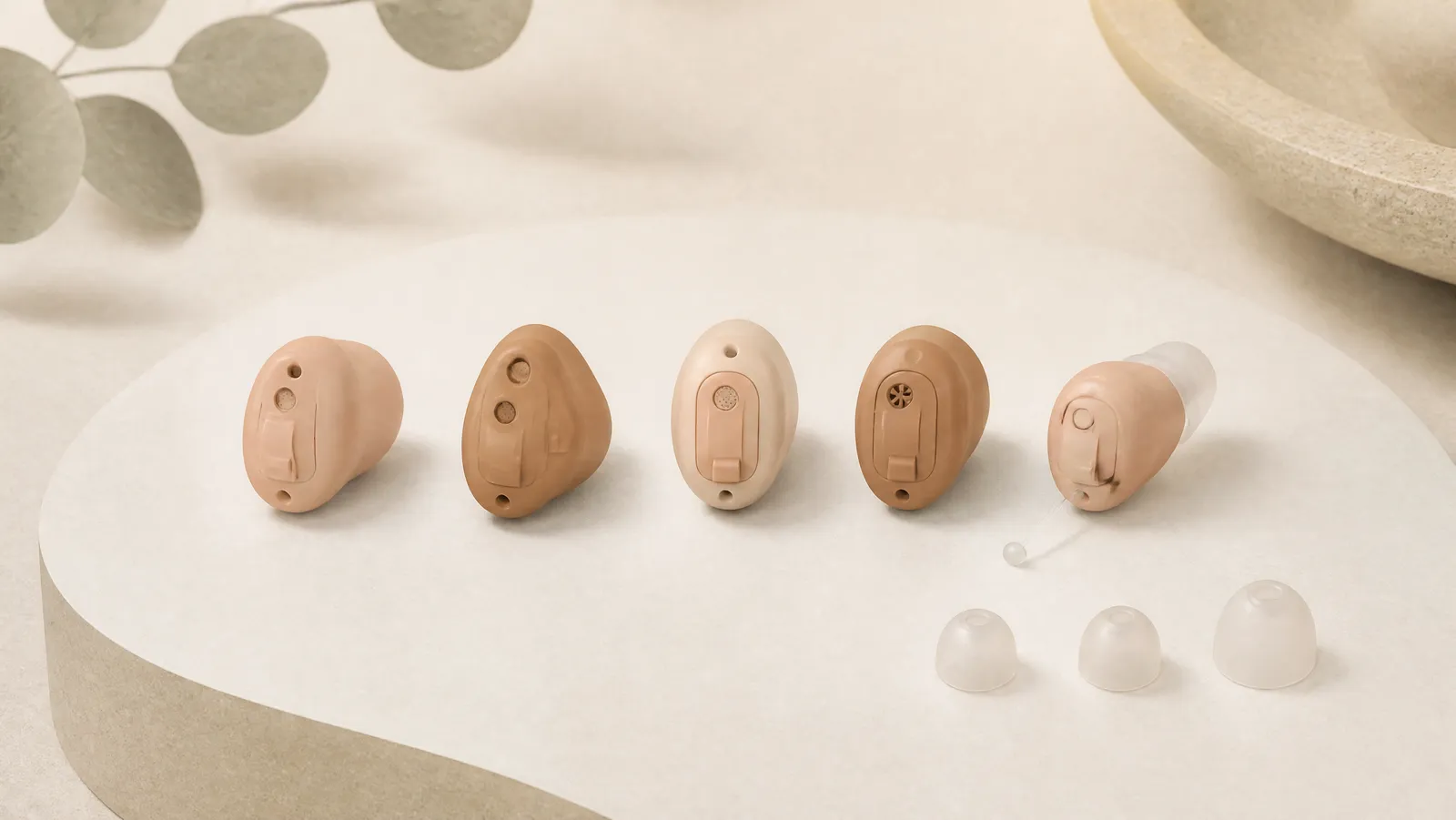
The Most Discreet OTC Hearing Aids of 2026
Invisible OTC hearing aids do not really exist, but some are genuinely discreet. Five in-canal picks for 2026, and what going smaller actually costs you.
OTC Hearing Aids and Severe Hearing Loss: Where the Limit Is
OTC hearing aids for severe hearing loss are outside the FDA category, which covers perceived mild to moderate loss. Here is where the line sits, and why.