OTC Hearing Aids for Tinnitus: What Helps and What Does Not
OTC hearing aids for tinnitus: amplification may make ringing less intrusive if you also have hearing loss, but no OTC device treats tinnitus. The evidence.


Affiliate disclosure: This article contains affiliate links. As an Amazon Associate we earn from qualifying purchases, at no extra cost to you. Learn more.
If you have hearing loss and constant ringing, an over-the-counter device may make the ringing less intrusive. Not because it treats the ringing, but because it gives your ears something else to hear. That is the honest case for OTC hearing aids for tinnitus: no OTC device is authorized to treat tinnitus, and some patterns of tinnitus need a doctor before they need a purchase.
The National Institute on Deafness and Other Communication Disorders (NIDCD) puts tinnitus at 10 to 25 percent of adults and adds that "most people who have it have some degree of hearing loss." That overlap is what lands over-the-counter hearing aids in tinnitus conversations, and it is where the marketing gets slippery: a device sold for hearing loss is a different regulatory object from one authorized to relieve tinnitus.
The short answer
An OTC hearing aid is worth considering if all of this is true:
- You have trouble hearing, not just ringing. The FDA's OTC category covers adults 18 and older with perceived mild to moderate hearing loss. Hearing loss is the indication; tinnitus is not.
- The ringing is in both ears, has been there a while, and came on gradually.
- You have no ear pain, drainage, dizziness, or sudden change in hearing.
- You understand you are buying amplification, and any tinnitus relief is a side effect of hearing better.
It is the wrong first move if:
- The ringing is in one ear only, pulses with your heartbeat, started suddenly, or came with vertigo, pain, or drainage.
- Your hearing is fine and ringing is the only symptom. Amplification has nothing to amplify.
What to expect: many people with hearing loss say tinnitus bothers them less once they wear hearing aids, but the controlled trial evidence for that is thin. Expectations matter more here than brand, which is also our conclusion about whether OTC hearing aids actually work in general.
See a doctor first if any of these apply
Tinnitus is a symptom, not a diagnosis. NIDCD lists these as reasons to see a physician rather than buy an OTC hearing aid, and they match the red flags the FDA requires on OTC packaging:
- "Hearing loss or tinnitus (ringing) in only one ear, or a noticeable difference in how well you can hear in each ear."
- "Fluid, pus, or blood coming out of your ear within the previous 6 months."
- "Pain or discomfort in your ear."
- "Sudden hearing loss or quickly worsening hearing loss."
- "Hearing loss that has gotten more and then less severe within the last 6 months."
- "Episodes of vertigo (severe dizziness) with hearing loss."
- "A history of excessive ear wax or suspicion that something is in your ear canal."
Add one the FDA list does not name explicitly. The American Academy of Otolaryngology–Head and Neck Surgery Foundation (AAO-HNSF) clinical practice guideline on tinnitus singles out pulsatile tinnitus — a whooshing that keeps time with your pulse — as a reason to image the head and neck, alongside tinnitus that localizes to one ear, focal neurological abnormalities, and asymmetric hearing loss. The concern is a vascular cause; the guideline notes pulsatile tinnitus can signal intracranial hypertension.
None of that means something is wrong with you; the same guideline notes that most people with one-sided ringing and hearing loss do not turn out to have a tumor. It means the question is medical, and a retail box cannot answer it. The guideline recommends a prompt, comprehensive hearing evaluation when tinnitus is one-sided, persistent for six months or longer, or paired with hearing difficulty.
The reason amplification makes tinnitus less noticeable
Tinnitus is loudest in silence, and hearing loss manufactures silence. The quiet room gets quieter, the refrigerator hum disappears, and the ringing is left holding the floor. Restore the ambient sound and the ringing has competition.
The AAO-HNSF guideline puts it plainly: "Hearing amplification can improve a patient's QOL by both treating hearing loss and making the tinnitus less noticeable." Two separate effects, and only one is aimed at the tinnitus.
There is a second mechanism. Open-fit hearing aids let outside sound into the canal normally, which the guideline describes as "promoting a masking/partial masking effect." OTC devices with vented or open domes do this incidentally. You do not need a tinnitus feature to get partial masking. You need an ear that is not plugged.
Hence the guideline's seventh key action statement: "Clinicians should recommend a hearing aid evaluation for patients with hearing loss and persistent, bothersome tinnitus." Note both conditions. Remove the hearing loss and the recommendation does not apply.
The evidence, and where it stops
The AAO-HNSF graded that recommendation Grade C, based on observational studies — one of the weakest evidence tiers the document assigns to anything. Its supporting text says so out loud: "Despite the lack of high-quality evidence supporting hearing aids as a treatment for tinnitus, the GDG felt that recommending a hearing aid evaluation would enable tinnitus patients to make better decisions." The panel recommended the evaluation, not the outcome.
The controlled evidence is thinner. The 2018 Cochrane review of sound therapy for tinnitus, covering amplification devices and sound generators, pooled eight studies with 590 participants and concluded: "There is no evidence to support the superiority of sound therapy for tinnitus over waiting list control, placebo or education/information with no device." It found that using "a combination device, hearing aid or sound generator might result in little or no difference in tinnitus symptom severity," and rated the quality of the evidence, using GRADE, as low.
That is easy to over-read in both directions. Cochrane did not find that hearing aids fail. It found that nobody has run the trials that would settle it.
The uncontrolled literature is more encouraging. The guideline cites a review in which 17 of 18 trials showed benefit from hearing aid use, then lists why such studies are hard to trust: "selection bias, small sample size, short treatment duration, and use of confounding additional treatments such as sound therapy and/or counseling."
One confounder the marketing never mentions: tinnitus often improves on its own. The guideline cites a cohort in which nearly 50 percent of patients with significant tinnitus improved after 5 years, 43 percent of them reporting complete resolution. Anything bought during a bad stretch looks effective during the good stretch that follows.
The fair statement: plausible mechanism, broadly positive clinical experience, trial evidence too weak to promise you anything.
Masking features, and what they are and are not
"Tinnitus masking" is a real regulated category, and it is not the one OTC hearing aids live in.
The FDA classifies a tinnitus masker under 21 CFR 874.3400 as "an electronic device intended to generate noise of sufficient intensity and bandwidth to mask ringing in the ears or internal head noises." It is class II, and its special control is patient labeling about professional diagnosis, fitting, and follow-up care. The cleared tinnitus sound generators we checked in the FDA device database are all prescription devices. One clearance describes its product as "a tool to generate sounds to be used in a Tinnitus Management Program to temporarily relieve patients suffering from Tinnitus." Note temporarily, and note that the professional is inside the authorized indication.
An OTC hearing aid that plays white noise is doing something mechanically similar and legally different. The OTC indication is perceived mild to moderate hearing loss in adults. A noise program is a feature, the way a Bluetooth radio is a feature — not a tinnitus treatment the FDA reviewed.
Which brings us to the phrase that does the most damage here. "FDA-registered" means a company filed a form. The FDA states that a registration-database listing "does not denote approval, clearance, or authorization of that facility or its medical devices." Tinnitus buyers are a favorite target for that wording, as they are for the gap between how OTC hearing aids differ from sound amplifiers.
Within the OTC category, preset devices are exempt from FDA premarket review entirely; only self-fitting OTC hearing aids, classified under 21 CFR 874.3325, must clear a 510(k). Neither status is a tinnitus claim.
If background sound is what you want, you may not need hardware for it. NIDCD notes that tabletop and smartphone sound generators "are typically used as an aid for relaxation or sleep" — which is when many people find tinnitus most intrusive, and a free app costs nothing to test. If you want that sound in your ears instead of the room, that is a real use case for OTC hearing aids with Bluetooth — but only the models that genuinely stream phone audio, since plenty advertise Bluetooth for app control alone.
Interventions with better evidence than any device
Rank the AAO-HNSF guideline's recommendations by evidence quality and the devices are not at the top. Cognitive behavioral therapy is.
- Cognitive behavioral therapy (CBT). "Clinicians should recommend CBT to patients with persistent, bothersome tinnitus." Graded A, based on multiple systematic reviews of randomized controlled trials — the strongest grade in the guideline. Be precise about what it does: the Cochrane review cited there found CBT improved tinnitus-related depression and quality of life across eight trials, with no effect on subjective tinnitus loudness across six. CBT does not turn the ringing down. It changes how much of your life the ringing occupies. The guideline includes a sample eight-week program.
- Sound therapy. An "Option" only, meaning clinicians may offer it. Among its listed risks: "consequences of recommending an intervention of uncertain efficacy; promoting false hope; costs associated with sound therapy." That is a guideline panel warning about this exact product category.
- Education, sleep and stress management. Patient education is a recommendation in its own right; the guideline lists improved quality of life and increased ability to cope among its benefits, and the first item on its patient-education list is that tinnitus is "a symptom and not a disease." The CBT protocol also covers relaxation and sleep hygiene.
One thing to skip. Guideline statement eleven: "Clinicians should not recommend Ginkgo biloba, melatonin, zinc, or other dietary supplements for treating patients with persistent, bothersome tinnitus." A recommendation against, citing uncertain content and dosage in over-the-counter preparations, drug interactions, and adverse events in older adults. The panel likewise advises against routinely prescribing antidepressants, anticonvulsants, anxiolytics, or intratympanic medications for tinnitus.
Devices that do carry an FDA-authorized tinnitus indication exist, but they are prescription devices in a separate classification. The last question below has the specifics.
If you decide to try an OTC device
Assuming hearing loss, no red flags, and realistic expectations:
- Buy for the hearing loss, not the ringing. If the device does not clearly improve your hearing, it will not do much for your tinnitus.
- Get a return window longer than the adjustment period. Amplification sounds harsh at first; give it several weeks of daily wear.
- Prefer open or vented fittings. Plugging the canal removes ambient sound and forfeits the partial masking the guideline describes.
- Treat both ears if both ears ring. One-sided ringing is a red flag, not a shopping constraint.
- Ignore cure language. "Tinnitus relief mode" labels an unreviewed feature. "Clinically proven to eliminate tinnitus" is a claim nobody in this category is entitled to make.
- Do not pay a premium for a masking program alone. Your phone generates white, pink, and rain noise for free.
Our take
We would tell a relative three things. First, get the one-sided, pulsatile, sudden, or painful versions looked at before spending a dollar. That is not caution theater; it is the FDA's own red-flag list. Second, if hearing loss sits underneath the ringing, treating the hearing loss is low-risk and worth trying, and an OTC device is a cheap way to learn whether you will wear hearing aids at all — read our complete OTC hearing aid guide first. Third, if the tinnitus itself is wrecking your sleep and concentration, the best-evidenced intervention is CBT, not a device.
NIDCD is blunt that "currently, there is no cure for tinnitus, but there are ways to reduce symptoms." The honest version of this article is shorter than the marketing version: amplification may make tinnitus less intrusive for people who also have hearing loss, and nobody has proven it in a decent trial. Buy accordingly.
Do hearing aids help tinnitus?
Many people with hearing loss report that tinnitus bothers them less while wearing hearing aids, and the AAO-HNSF guideline recommends a hearing aid evaluation for patients with both hearing loss and persistent, bothersome tinnitus. But that recommendation is graded C on observational studies, and the 2018 Cochrane review found no evidence that hearing aids or sound generators beat a waiting list, placebo, or education.
Can OTC hearing aids make tinnitus worse?
Some people find amplification makes tinnitus more noticeable at first, particularly with an over-amplified device or a closed dome that blocks ambient sound. Lowering the volume and switching to an open or vented fitting may help. If ringing worsens sharply, turns one-sided, or arrives with pain, dizziness, or hearing loss, stop and see a clinician.
Are there OTC hearing aids with tinnitus masking?
Some OTC hearing aids include noise or "relief" sound programs, and they do work as background sound. What they do not carry is an FDA-authorized tinnitus indication. The FDA regulates tinnitus maskers separately under 21 CFR 874.3400, and the cleared tinnitus sound generators we checked are prescription devices fitted by a hearing professional.
Is there an FDA-approved device for tinnitus?
There is an FDA-authorized one, which is not the same phrase. In March 2023 the agency granted De Novo marketing authorization to a combined acoustic and electrical stimulation device, indicated to "temporarily relieve the symptoms of tinnitus in patients 18 years of age and older" with at least moderate tinnitus and "intended to be self-administered by the patient following prescription by a healthcare professional." Prescription, temporary relief, and a new classification of its own. Not an over-the-counter hearing aid.
Keep reading

Are OTC Hearing Aids FSA, HSA, or Medicare Eligible?
Are OTC hearing aids FSA eligible? Yes, and HSA too. Original Medicare is a flat no, Medicare Advantage usually helps. Here is how to pay for them in 2026.
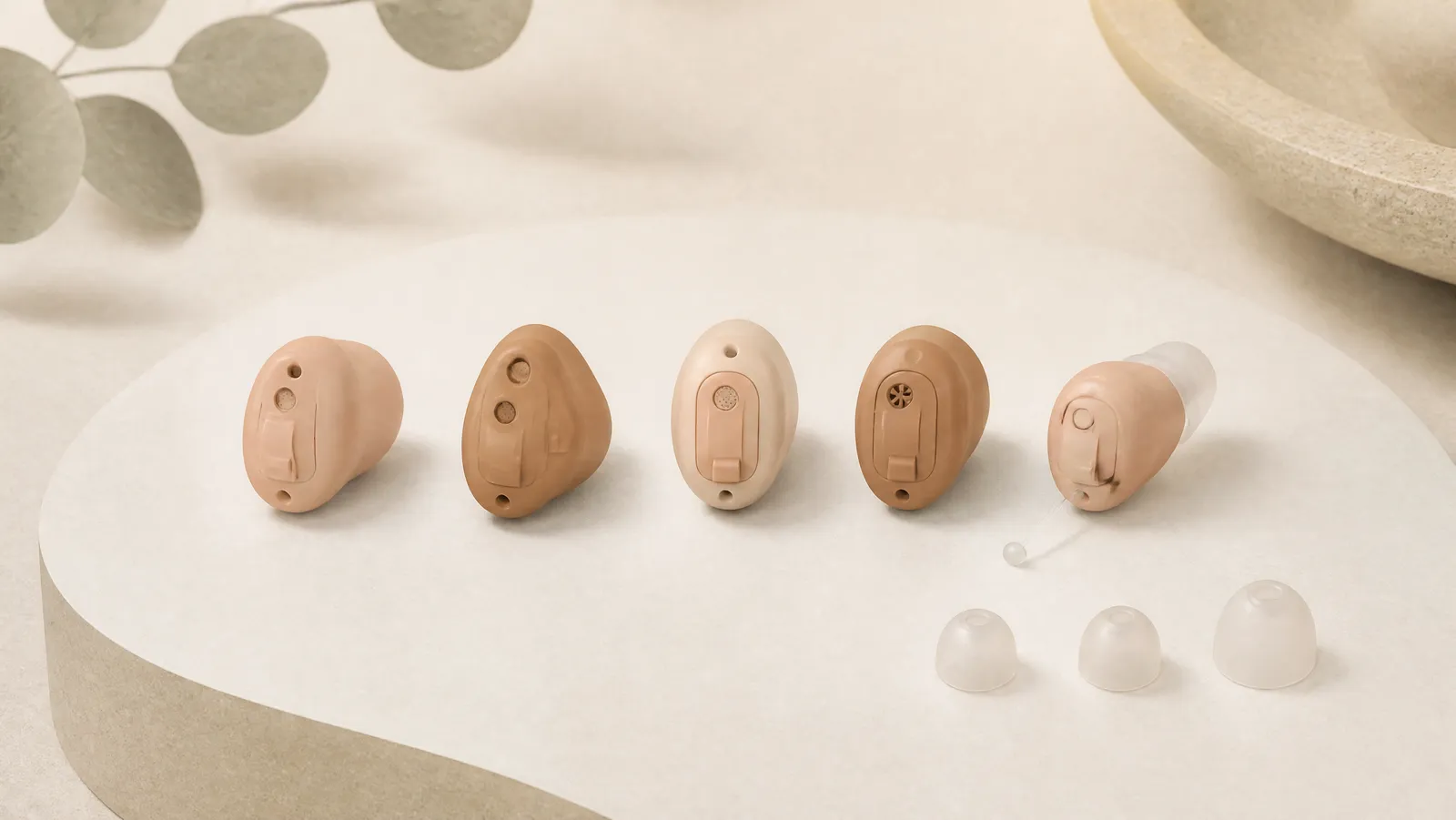
The Most Discreet OTC Hearing Aids of 2026
Invisible OTC hearing aids do not really exist, but some are genuinely discreet. Five in-canal picks for 2026, and what going smaller actually costs you.
OTC Hearing Aids and Severe Hearing Loss: Where the Limit Is
OTC hearing aids for severe hearing loss are outside the FDA category, which covers perceived mild to moderate loss. Here is where the line sits, and why.