How to Test Your Balance at Home: 4 Fall-Risk Self-Checks After 50
How to test your balance at home: four tests clinicians use, the published cut-off number for each, and the results that mean see a doctor.

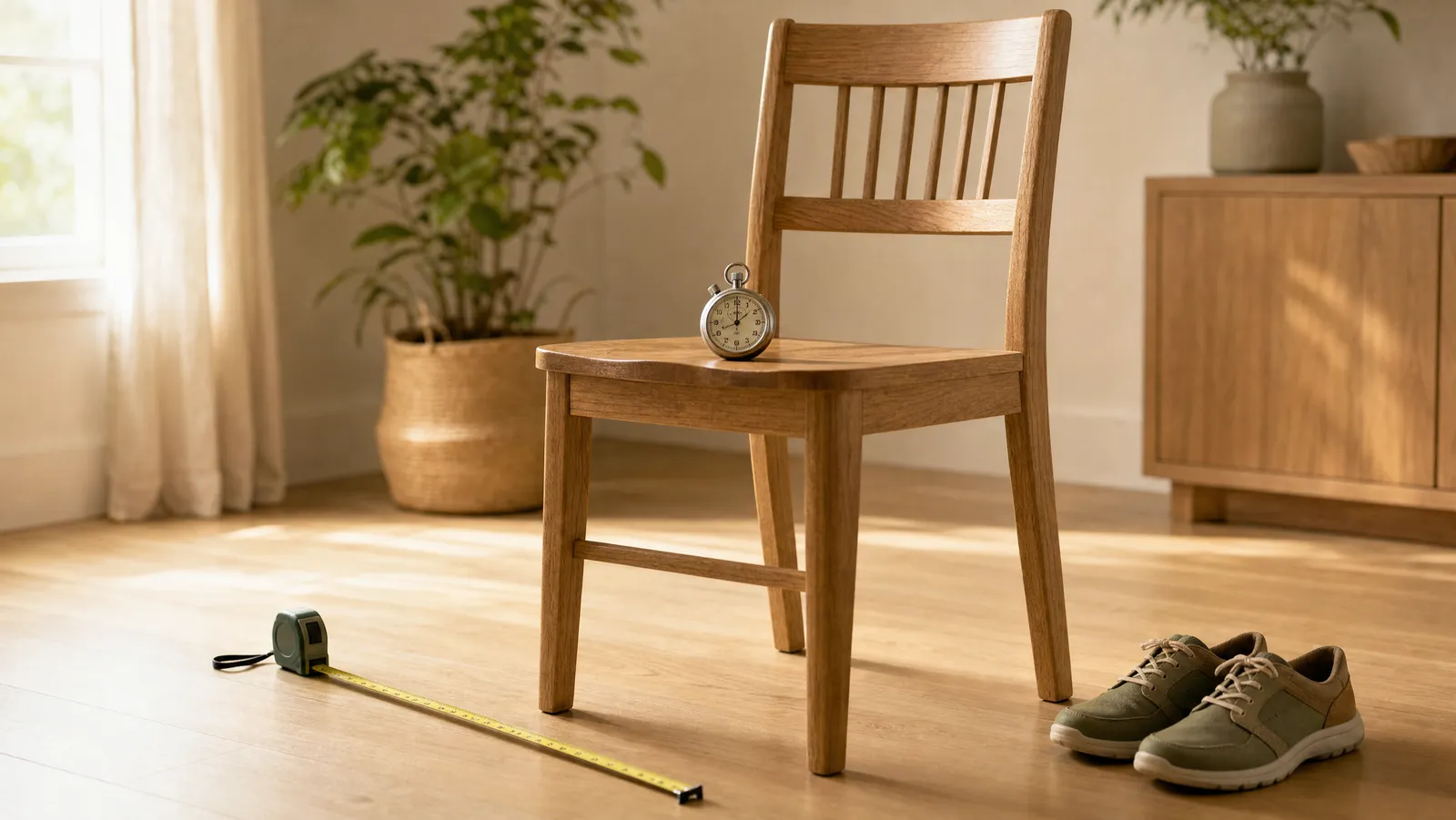
Affiliate disclosure: This article contains affiliate links. As an Amazon Associate we earn from qualifying purchases, at no extra cost to you. Learn more.
Yes, you can test your balance at home, and it takes about fifteen minutes. The four screens clinicians reach for most are the 30-second chair stand, the Timed Up and Go, the CDC's 4-stage balance test, and your own walking speed. You need a firm kitchen chair, a clear hallway, a stopwatch, and someone standing next to you the first time.
Here is how to test your balance at home in the order a clinician would run it, with the real threshold numbers and what each result means. Three of the four come from the CDC's STEADI toolkit, so the cutoffs are published rather than invented.
According to the CDC, about one in four adults aged 65 and older (28%) report falling each year, roughly 36 million falls, and about 37% of those who fell reported an injury that needed medical treatment or restricted their activity for at least a day. Most of what works for preventing falls after 50 is cheap and unglamorous, and knowing your own starting numbers is the first piece of it. Testing itself prevents nothing. Acting on the result might.
Set Up the Room Before You Test Anything
These tests deliberately make your balance work harder. That is the point, and also the risk.
- Keep something solid within arm's reach. A wall, a counter, a heavy table. Not a rolling chair, not a towel rail.
- Have someone with you the first time. The CDC's 4-stage balance form tells clinicians to help the patient into position, let go, and "remain ready to assist the patient if they should lose their balance." Do the same, above all for the one-leg stage.
- Wear your normal shoes and use your usual walking aid. The CDC's Timed Up and Go form specifies that patients "wear their regular footwear and can use a walking aid, if needed."
- Stop if you feel dizzy, light-headed or short of breath. Sit down. "Stopped early" is a result, and a more useful one than a number you forced.
- Count the near-misses. A hand on the wall, a foot shooting out, a stumble on the turn. A near-fall during a test is the result.
Fixing the room is a separate job from measuring it. The CDC's STEADI algorithm lists home hazards such as throw rugs and a slippery tub floor among the things a clinician should ask about, and our guide to the best grab bars for seniors covers what anchors into a wall.
Test 1: The 30-Second Chair Stand
What it measures: leg strength and endurance, the CDC's stated purpose. Weak legs are one of the quiet reasons a stumble becomes a fall, and lower-body weakness is on the CDC's own list of fall risk factors.
What you need: per the CDC, a chair with a straight back and no arm rests, seat about 17 inches high, plus a stopwatch. Measure the chair; seat height changes the score.
- Sit in the middle of the chair, feet flat on the floor.
- Cross your arms over your chest, hands on the opposite shoulders, crossed at the wrists, back straight.
- On "Go", rise to a full standing position and sit back down, repeating for 30 seconds while a helper times and counts.
- Count every full stand. The CDC adds that if you are more than halfway up at 30 seconds, it counts.
If you have to push off with your arms, the CDC instruction is to stop and record zero. That is not a failure of effort. It is the finding.
The threshold. The CDC's scoring panel lists "Chair Stand Below Average Scores" by age and sex, and says that "a below average score indicates a risk for falls." Below average means fewer stands than:
- Ages 60 to 64 — 14 for men, 12 for women
- Ages 65 to 69 — 12 for men, 11 for women
- Ages 70 to 74 — 12 for men, 10 for women
- Ages 75 to 79 — 11 for men, 10 for women
- Ages 80 to 84 — 10 for men, 9 for women
- Ages 85 to 89 — 8 for both
- Ages 90 to 94 — 7 for men, 4 for women
These are population norms, not a pass line. The clinical publisher bpacnz, reproducing the same CDC table, traces the figures to Rikli and Jones in the Journal of Aging and Physical Activity, 1999. One stand under your band means little on its own. A wide gap, or a drop between rounds, is the part worth raising with your doctor.
Test 2: Timed Up and Go
What it measures: mobility, per the CDC. It bundles standing, walking, turning and sitting into one number, and the turn is often where the time goes.
What you need: a standard armchair, a stopwatch, and a line of tape on the floor 3 metres (10 feet) away.
- Sit back in the chair in your regular shoes, with your walking aid if you use one.
- On "Go", stand up from the chair.
- Walk to the line at your normal pace. Not your best pace.
- Turn, walk back at your normal pace, and sit down again.
- Timing starts on the word "Go" and stops when you are seated again.
The threshold. The CDC's 2017 STEADI form states: "An older adult who takes ≥12 seconds to complete the TUG is at risk for falling."
That is not the only published number. A summary of the 2022 World Falls Guidelines presented by the University of Nottingham's PRAISED programme lists a Timed Up and Go of 15 seconds or more, and a gait speed of 0.8 m/s or less, as that algorithm's reference points. Twelve is the CDC's line, 15 is the World Falls Guidelines line, and landing between them is a conversation with your doctor, not a diagnosis.
Have your helper watch, not just time. The CDC form asks clinicians to note a slow tentative pace, loss of balance, short strides, little or no arm swing, steadying yourself on walls, shuffling, and turning as one rigid block. Those signs, it warns, "may signify neurological problems that require further evaluation."
Test 3: The 4-Stage Balance Test
What it measures: static balance, per the CDC. Four standing positions that get progressively harder, each held for 10 seconds.
What you need: a stopwatch, a wall within reach, and a spotter. No cane or walker for this one, and eyes open throughout. Both are CDC instructions.
- Feet side by side.
- Semi-tandem — the instep of one foot touching the big toe of the other.
- Tandem — one foot directly in front of the other, heel touching toe.
- One foot — stand on a single leg.
You may hold your arms out or move your body, but you must not move your feet. Hold a position for 10 seconds without moving your feet or needing support and you go on to the next. If you cannot, the CDC instruction is to stop there.
The threshold. The CDC states: "An older adult who cannot hold the tandem stand for at least 10 seconds is at increased risk of falling." Stage 3 is the one that counts.
For the one-leg stage, the best norms come from Springer and colleagues in the Journal of Geriatric Physical Therapy in 2007, who timed 549 healthy adults at Walter Reed Army Medical Center barefoot and to failure, not against the CDC's 10-second cap. Mean eyes-open times across three trials fell from 26.9 seconds at ages 60 to 69, to 15.0 at 70 to 79, and 6.2 at 80 and above. Performance, they concluded, "is age-specific and not related to gender."
That study is also why we would not test with your eyes shut at home: eyes-closed means collapse to 2.8, 2.0 and 1.3 seconds for those same three bands.
If the tandem hold is where you come unstuck, the CDC's suggestion to clinicians is referral to physical therapy for gait and balance exercises, or to an evidence-based fall prevention programme such as Tai Chi. The balance exercises for seniors that follow are a longer subject than one section.
Test 4: Your Walking Speed Over 4 Metres
What it measures: how fast you walk when nobody is pushing you. Gait speed sits inside the 2022 World Falls Guidelines fall-risk algorithm.
How to do it. The protocol in Shirley Ryan AbilityLab's Rehabilitation Measures Database adds 2 metres of run-up before the timed distance and 2 metres after it. Timing starts when your first foot passes the start line and stops when it enters the deceleration zone. Walk at a comfortable speed, two trials, averaged.
That wants about 8 metres (26 feet) of clear floor. If your hallway is shorter, time a measured 4 metres from a standing start and read it as slightly slow. Then divide 4 by your time: 4 metres in 4.0 seconds is 1.0 m/s, 4 metres in 5.0 seconds is 0.8 m/s.
The threshold, and why it is contested. The World Falls Guidelines reference point is 0.8 m/s or less. An individual participant data meta-analysis by Hicks, Menant and Lord of Neuroscience Research Australia, pooling 28 prospective studies and 7,608 participants and presented to the British Geriatrics Society, found walking below 0.8 m/s was associated with a relative risk of falling of 1.27 (95% CI 1.17 to 1.38) and a fall-rate incidence rate ratio of 1.54 (95% CI 1.34 to 1.77). Sensitivity at that cut point was 35%, specificity 77%. The authors concluded a cut point below 1.0 m/s "may be more clinically useful", since it flagged 25.7% of community-dwelling fallers against 7.9%.
Read the sensitivity figure twice: at 0.8 m/s this test misses roughly two-thirds of people who go on to fall. That is why gait speed belongs in a set of four.
The same database reproduces comfortable gait speeds from Bohannon and colleagues in 2008 over a 6-metre walk:
- Men — 1.12 m/s at ages 50 to 59, 1.03 at 60 to 69, 0.96 at 70 to 79, 0.83 at 80 and above
- Women — 1.11 m/s at ages 50 to 59, 1.00 at 60 to 69, 0.93 at 70 to 79, 0.78 at 80 and above
The average woman over 80 there already walks below the 0.8 m/s line, which shows how blunt one threshold is. Our piece on mobility and aging covers what drives the decline.
Reading the Four Results Together
- Nothing flagged. Reassuring, not exonerating. These screens have modest sensitivity, so a clean sweep means no obvious problem today.
- One test flagged. Often specific: a weak chair stand with good balance and gait speed points at leg strength; a failed tandem hold with a strong chair stand points at balance.
- Two or more flagged, or any near-fall. Take the page of numbers to your doctor rather than retesting until you like the answer.
The sequence matters too, and it is where home testers get it backwards. The CDC's algorithm does not screen with these tests at all. It screens with questions first: the 12-question Stay Independent tool, where a score of 4 or more means at risk, or three key questions, where a single yes does. Only then does it use the Timed Up and Go, 30-Second Chair Stand and 4-Stage Balance Test to assess people already flagged.
Its assessment step also reaches past your legs, to visual acuity on a Snellen chart, medications, orthostatic blood pressure, footwear and vitamin D. Vision is easy to overlook, and you can start on it with our walkthrough on how to test your vision at home.
Red Flags That Mean Stop Testing and Call a Clinician
- Any fall in the past year. On the CDC's STEADI algorithm, a yes to "Has fallen in past year?" puts you in the screened-at-risk group by itself, and the clinician is then told to ask how many times and whether you were injured.
- Two or more falls, or one fall that injured you. Those are the follow-up answers the algorithm is hunting for.
- Feeling unsteady when you stand or walk, or worrying about falling. Both are STEADI key questions; a yes to either is enough to be screened at risk.
- New or unexplained dizziness, particularly on standing. The CDC's assessment step measures orthostatic blood pressure for this reason.
- A near-fall during any of the four tests. You produced a result. It was not the number.
- The gait signs on the CDC's list — shuffling, turning as one rigid block, loss of balance, steadying yourself on walls.
We are a research desk, not a clinic. A stopwatch in your hallway cannot substitute for a clinical fall-risk assessment, and nothing here diagnoses a balance disorder. What it does is give you something concrete to put in front of a doctor, which beats "I have been feeling a bit wobbly."
Re-Test on a Schedule and Write the Numbers Down
The CDC's algorithm tells clinicians to screen for fall risk yearly, or any time a patient presents with an acute fall, and to follow up with patients on a care plan in 30 to 90 days. Yearly is the floor, 30 to 90 days the active-management interval, and testing yourself every 3 to 6 months sits between them. Re-test after any fall regardless.
Record enough that the next round is comparable: date, chair-stand reps, Timed Up and Go seconds plus any gait sign your helper noticed, the balance stage reached and seconds held, your 4-metre time in m/s, and the near-falls, shoes, floor and time of day. Change those last four and you have changed the test.
One reading is nearly useless; a trend over four is the point. Same reason we push people to track the other health numbers worth tracking after 50 rather than measure them once, and to test your hearing at home on a fixed interval. A home safety checklist on the same schedule pairs well with it.
Our Take
If you do one of these four today, do the 4-stage balance test and stop at the tandem stand. It needs nothing but a stopwatch, the CDC gives it a clean 10-second threshold, and failing it is the clearest signal in the set that a physical therapy referral may be worth asking about.
What we would do with a parent: run all four on a Saturday morning with someone spotting, write the numbers in a notebook, and set a reminder for six months out. Then take the notebook to the next appointment whatever it said. The tests change nothing by themselves. They tell you which part of fall prevention for seniors is actually yours to work on.
How Often Should You Test Your Balance at Home?
Every 3 to 6 months is reasonable, plus after any fall. The CDC's STEADI algorithm asks clinicians to screen yearly or any time a patient presents with an acute fall, and to follow up with at-risk patients within 30 to 90 days.
Can These Tests Tell You If You Have a Balance Disorder?
No. All four are screening tests that suggest higher or lower fall risk, and the CDC frames them that way. A diagnosis needs a clinician: the CDC's own form notes that gait abnormalities during the Timed Up and Go may signify neurological problems requiring further evaluation rather than explaining them.
Keep reading
The Best Grab Bars for Seniors in 2026: Picks for Bath and Bedside
The best grab bars for seniors in 2026: six picks for tub, shower, toilet and bedside, plus load ratings, mounting heights and the suction-cup caveat.
Fall Prevention for Seniors: The Complete Guide for Adults Over 50
A practical fall prevention guide for seniors: how to test your own risk, the exercise that works, the medication trap, and a room-by-room home audit.
How to Test Your Vision at Home (and What a Home Test Cannot Tell You)
How to test your vision at home in about ten minutes: the Amsler grid protocol, a distance chart done properly, near-vision checks, and the diseases no home test can see.