The Best Smart Scales and Body-Composition Scales of 2026
The best smart scale picks of 2026, from a 20-dollar budget option to 8-electrode analyzers, plus what body-fat readings can and cannot tell you after 50.

Affiliate disclosure: This article contains affiliate links. As an Amazon Associate we earn from qualifying purchases, at no extra cost to you. Learn more.
◆ The verdict
5 reviewed- 1Our PickRENPHO Smart Scale for Body Weight, Body Fat, BMI, 7-in-1 Display, 500IbsCheck price ▸
- 2Best BudgetEtekcity Smart Scale for Body Weight, Body Fat and BMI, FSA EligibleCheck price ▸
- 3Best Wi-Fi ScaleEtekcity Smart Scale for Body Weight and Fat, BMI, FSA Eligible, BlackCheck price ▸
- 4Best Full-Body MetricsGE Smart Scale for Body Fat with BMI Muscle Mass, 5.3-inch Handle DisplayCheck price ▸
- 5Premium PickRENPHO Smart Scale for Body Weight, TFT Handle Display, RechargeableCheck price ▸
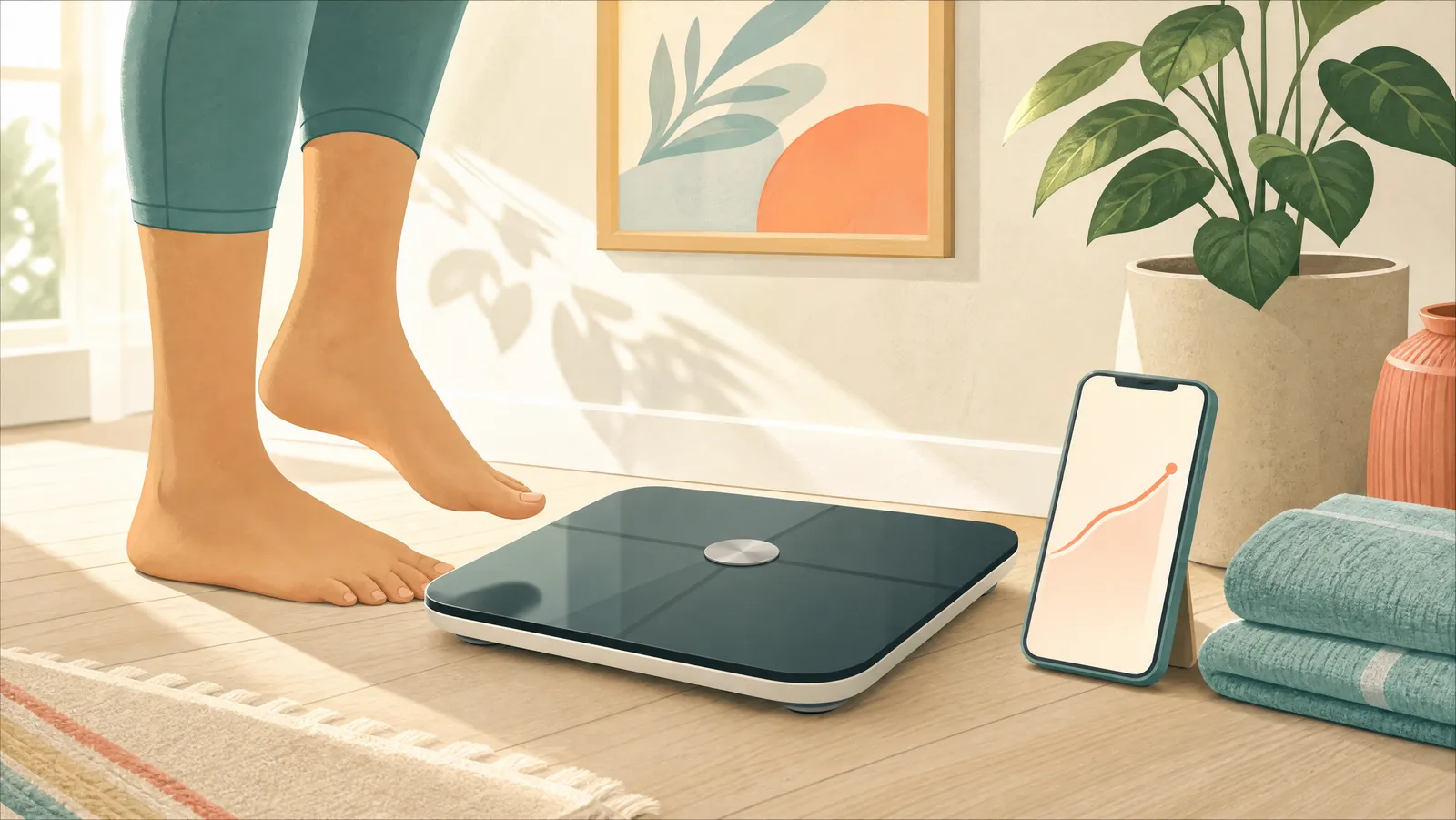
After comparing today's leading body-composition scales, our pick for the best smart scale is the RENPHO 7-in-1 Display Smart Scale — around $40 as of July 2026, with a 500 lb capacity and every key reading shown on the scale itself, no phone required. Four more picks below cover everything from a sub-$20 budget scale to a premium 8-electrode analyzer. Better Life Span is reader-supported; if you buy through links on this page we may earn a small commission, at no cost to you.
A scale is usually the first — and most used — of all home health monitoring devices, and the smart versions have become genuinely useful: they recognize each family member automatically, log every weigh-in to an app, and estimate body composition alongside weight. In this guide we explain what those body-fat numbers can and cannot tell you, flag one safety issue that matters for anyone with an implanted heart device, and walk through the five scales we recommend at different budgets.
Body-composition scales: useful, within honest limits
Almost every smart scale on this list estimates body composition using bioelectrical impedance analysis (BIA). The scale passes a tiny, imperceptible electrical signal through your body via metal or ITO-coated contact points under your feet (plus a hand-held handle on 8-electrode models). Because lean tissue and water conduct electricity better than fat does, the scale can convert the resistance it measures into estimates of body fat, muscle mass, and body water.
Those estimates come with real caveats. According to a 2024 study in Frontiers in Nutrition, multi-frequency BIA delivered highly repeatable — though only moderately accurate — body-composition estimates under tightly controlled conditions: consistent hydration, meal timing, recent-exercise status, and time of day. Its authors cautioned that those results may not carry over to everyday, free-living use, and changing any of those conditions makes the numbers drift. BodySpec, a DEXA body-scan provider, notes that consumer BIA readings shift with hydration, food intake, and even skin temperature, and that fat-mass estimates can be off by 5 to 10 pounds compared with a DEXA scan.
Our advice: treat body-fat percentage as a long-term trend line, not a daily truth. The number a smart scale measures directly — your weight — is far more dependable, and the app's weekly and monthly charts are where the real value lives. If the body-fat trend drifts down over months while your strength holds steady, that is meaningful. A Tuesday-to-Wednesday jump is almost certainly water.
A safety note before you step on
BIA works by sending a small electrical current through your body, and that current is the reason for one firm rule: body-composition scales are not recommended for people with pacemakers, implanted defibrillators, or other implanted electronic medical devices, and manufacturers also advise against BIA mode during pregnancy. A 2023 safety evaluation published in Heart Rhythm found, in simulations and benchtop testing, that bioimpedance signals from smart scales, watches, and rings could exceed the interference thresholds set for cardiac implantable electronic devices, and its authors called for clinical studies in people who have these implants. GE prints this warning directly in its product materials, and the caution applies to every BIA scale in this guide.
There is one useful exception story. Our budget pick, the Etekcity, includes a Zero-Current Mode that weighs you without sending the BIA signal at all — you give up the body-composition estimates but keep the smart weight tracking, app history, and multi-user profiles. If you have a pacemaker or another implanted device, that mode (or any ordinary non-BIA scale) is the appropriate choice, and it is worth confirming with your cardiologist.
Smart scale features that matter after 50
Spec sheets for these scales list dozens of metrics, but after comparing the category we think a handful of practical features matter far more than metric counts:
- A display you can actually read. Bending over to squint at a dim LCD gets old fast. Our top pick shows seven readings on a bright display at your feet; the GE and premium RENPHO go further with color screens on a retractable handle you read at eye level, standing fully upright.
- Capacity and platform size. Standard scales often stop at 300 or 400 lb on a small glass square. A 500 lb capacity and an 11.8-inch or wider non-slip platform mean more stability and confidence for every body — something we weight heavily for older users concerned about balance.
- App simplicity and syncing. The app is where your trend lives, so it should show a clear graph without a subscription. Every pick here syncs with Apple Health or Google Fit, and most add Fitbit, Samsung Health, and MyFitnessPal. If you already wear a watch or band — see our best fitness trackers for seniors — choose a scale that feeds the same app so your steps and weight land in one place.
- Multi-user support. All five picks recognize individual profiles (most support unlimited users), so a couple can share one scale and keep separate histories.
- FSA/HSA eligibility. Four of our five picks can be purchased with FSA/HSA funds, which effectively discounts the price if you have such an account.
Wi-Fi versus Bluetooth is the other real fork in the road. Bluetooth scales need your phone nearby (or a later sync) to upload readings; a Wi-Fi scale uploads by itself the moment you step off. If remembering to open an app is the kind of friction that kills a habit, Wi-Fi is worth the premium.
Our selection criteria
We compared current smart scales on five practical dimensions: price and value across a realistic spread of budgets, display readability for aging eyes, capacity and platform stability, app quality and ecosystem syncing, and safety options such as a current-free weighing mode. We favored established brands with mature apps over no-name scales with inflated metric counts, and we required every pick to support multiple users without a paid subscription for basic trends.
The five best smart scales of 2026
Our Pick: RENPHO 7-in-1 Display Smart Scale
Most smart scales make you open an app to see anything beyond weight. The RENPHO 7-in-1's defining feature is that weight, BMI, body fat, muscle mass, water percentage, bone mass, and metabolic age all appear on the scale's own display — the phone becomes optional, which is exactly what many people over 50 want. Add a 500 lb capacity on a roomy 11.8-inch platform, 0.2 lb precision, unlimited user profiles, and Apple Health and Google Fit syncing, and at around $40 as of July 2026 it is the easiest scale here to recommend. The trade-off: its four foot electrodes cannot match the detail of the 8-electrode handle models below.
Best Budget: Etekcity Smart Body Weight Scale
At just under $20 as of July 2026, the Etekcity covers the fundamentals: precise weight readings in increments as small as 0.05 lb, a free app with 13 metrics and progress graphs, and broad syncing from Apple Health to MyFitnessPal. Its quiet superpower is the Zero-Current Mode discussed above — the rare budget scale with a weighing option that sends no BIA current, making it our default recommendation for anyone with an implanted device. You do give up on-scale metric readouts; beyond weight, everything lives in the app.
Best Wi-Fi Scale: Etekcity Wi-Fi Smart Scale with TFT Display
The Wi-Fi Etekcity, around $64 as of July 2026, removes the last bit of friction from daily weighing: readings upload to the cloud automatically, no phone in the bathroom required. A color TFT display shows up to 9 of its 14 metrics right on the scale, an ITO coating guides your foot placement for consistency, and you can even ask Alexa for your last reading. It costs about three times the basic Etekcity, and you will still need the app once for setup — but afterward the habit runs itself.
Best Full-Body Metrics: GE 8-Electrode Smart Scale with Handle Display
Foot-only scales send current up one leg and down the other, so they largely infer your upper body. The GE's hand-held handle adds four more electrodes, letting it measure arms, legs, and trunk separately across more than 50 metrics, including visceral fat and skeletal muscle. The 5.3-inch color display on the handle means you read results at eye level — no bending — and readings take 10 to 15 seconds on an extra-wide 400 lb platform. At around $90 as of July 2026 it is the best value in full-body analysis, though the implanted-device restriction applies and most users will only ever consult a fraction of those metrics.
Premium Pick: RENPHO MorphoScan Nova 8-Electrode Smart Scale
The MorphoScan Nova is what a smart scale looks like with every constraint removed: dual-frequency 8-electrode analysis with per-limb muscle and fat breakdowns, a 4.3-inch handle display you page through with physical buttons, voice guidance through each measurement, USB-C charging that lasts up to 150 days, and a printable body report you can bring to a trainer or clinician. At around $187 as of July 2026 it costs more than three of our other picks combined — worth it only if you will genuinely use the segmental data, for example to track limb-by-limb muscle during structured strength training.
A weigh-in routine that produces a real trend
Whichever scale you choose, the routine matters more than the hardware. Body weight normally swings noticeably from day to day; the Cleveland Clinic points to sodium, carbohydrate intake, hormones, and hydration as common causes of fluctuations that have nothing to do with body fat. A single reading is weather. The trend is climate.
To make your numbers comparable:
- Weigh in at the same time each day — first thing in the morning, after using the bathroom and before eating or drinking, is the easiest anchor.
- Keep conditions consistent: same scale, hard level floor, bare feet, minimal clothing.
- Judge the weekly average, not the daily reading. Every app here charts this for you; a 7-day trend smooths out water swings that can otherwise rattle your motivation.
- Give body-composition numbers months, not days. Muscle and fat change slowly; hydration changes hourly.
Deciding which health numbers to track after 50 is its own topic, but weight trend sits near the top of the list precisely because it is cheap, fast, and reliable when measured this way. One boundary worth stating plainly: a scale tracks trends — it does not diagnose; discuss unexplained weight change, in either direction, with your clinician.
Muscle mass matters more after 50
There is a specific reason we favor scales that estimate muscle mass, not just fat. According to NIH News in Health, adults naturally lose roughly 3 to 5 percent of their muscle mass per decade starting around age 30, a decline that can progress to sarcopenia — muscle loss severe enough to affect strength and daily function. This is why two people can hold the same scale weight for a decade while their bodies change underneath: fat quietly replacing muscle looks like "stable weight" on a dumb scale.
A smart scale's muscle-mass trend is an estimate, but it is a useful nudge. If it drifts downward for months, that is a prompt to act, and the response is well established: the National Institute on Aging reports that strength training helps older adults rebuild and keep muscle, supporting mobility, everyday tasks like climbing stairs, and continued independence. You do not need a gym membership — a basic set of resistance bands and two or three short sessions a week is a legitimate starting point. Pair the habit with the scale and you can actually watch the investment hold its ground.
FAQ
Are smart scale body-fat readings accurate?
They are estimates, not measurements. Research comparing BIA with DEXA scans finds consumer readings can be off by several percentage points, and hydration, meals, and time of day all move the numbers. Weigh under consistent conditions and follow the trend over weeks; ignore any single day's body-fat figure.
Can I use a smart scale with a pacemaker?
Not in body-composition mode. BIA scales pass a small current through the body; manufacturers advise people with pacemakers, defibrillators, or other implanted electronic devices to avoid bioimpedance features, and a 2023 Heart Rhythm safety evaluation found those signals could exceed the interference thresholds set for such implants. A scale with a current-free option, like the Etekcity's Zero-Current Mode, still gives you smart weight tracking — confirm your choice with your cardiologist.
Should I weigh myself every day or once a week?
Either works if you are consistent; what matters is judging the weekly average rather than reacting to daily readings. Normal water shifts move weight day to day, which is why every scale app in this guide charts a smoothed trend. If daily numbers stress you, weigh weekly under identical morning conditions.
Do smart scales work on carpet?
BIA scales are designed for a hard, level surface; carpet compresses unevenly and throws off both weight and impedance readings. If you only have carpeted floors, place the scale on a rigid board or weigh in on tile or hardwood elsewhere in the house.
The bottom line
For most people, the RENPHO 7-in-1 Display Smart Scale is the best smart scale to buy in 2026: readings on the scale itself, a high-capacity platform, and a mature app at around $40 as of July 2026. Pick the budget Etekcity if you mainly want a dependable weight trend (or need its current-free mode), the Wi-Fi Etekcity if automatic syncing will keep you consistent, and the GE or RENPHO MorphoScan Nova if segmental muscle data will genuinely inform your training. A scale is one instrument in a larger toolkit — a blood pressure monitor is the natural companion purchase — and our full guide to home health monitoring devices shows how the pieces fit together. Step on tomorrow morning, and let the trend do the talking.

RENPHO Smart Scale for Body Weight, Body Fat, BMI, 7-in-1 Display, 500Ibs
The RENPHO 7-in-1 shows weight, BMI, body fat, muscle mass, water percentage, bone mass, and metabolic age right on its LED display, so you never need a phone to see results. The 11.8 x 11.8 inch platform supports up to 500 lb and reads in 0.2 lb increments using four high-sensitivity electrodes and four precision sensors. The Renpho Health app tracks 13 body metrics, syncs with Apple Health and Google Fit, works with Apple Watch, and supports unlimited users; the scale is FSA/HSA eligible.

Etekcity Smart Scale for Body Weight, Body Fat and BMI, FSA Eligible
This Etekcity scale pairs high-precision sensors that read in increments as small as 0.05 lb with the free VeSync app, which tracks 13 body-composition metrics with goal setting and progress graphs. A Zero-Current Mode weighs you without sending the BIA current through your body, and a baby mode tracks a baby's or pet's weight, reading items as light as 100 g. It syncs with Apple Health, Samsung Health, Google Fit, Fitbit, and MyFitnessPal, supports unlimited users, and is FSA/HSA eligible.

Etekcity Smart Scale for Body Weight and Fat, BMI, FSA Eligible, Black
Wi-Fi connectivity means readings sync to the cloud automatically — no phone in the bathroom required. The color TFT display shows up to 9 body metrics right on the scale, out of 14 measured, including weight, BMI, body fat, and heart rate. An ITO coating guides foot placement for consistent readings, and the VeSync app syncs with Apple Health, Google Fit, Fitbit, MyFitnessPal, and Samsung Health, with Alexa voice queries. It is FSA/HSA eligible.

GE Smart Scale for Body Fat with BMI Muscle Mass, 5.3-inch Handle Display
The GE scale uses 8-electrode segmental BIA — foot sensors plus a hand-held handle — to measure more than 50 metrics, including visceral fat, skeletal muscle, muscle mass, and body water. The 5.3-inch color display sits on the retractable handle, so you read weight, BMI, and body fat at eye level instead of bending down. Readings arrive in 10 to 15 seconds, the extra-wide 11.8-inch non-slip platform handles up to 400 lb, and the Fit Profile app adds trend charts, weekly reports, and unlimited user profiles with syncing to Apple Health, Google Fit, Fitbit, Samsung Health, and Health Connect.

RENPHO Smart Scale for Body Weight, TFT Handle Display, Rechargeable
RENPHO's flagship uses dual-frequency, 8-electrode segmental BIA to analyze more than 50 body metrics, including per-limb muscle and fat analysis. A 4.3-inch TFT handle display pages through 9 screens of results with physical scroll buttons, and a voice broadcast guides each step of the measurement. It recharges over USB-C for up to 150 days per charge, offers a large 14.08 x 12.2 inch ITO-glass platform with a 400 lb capacity, produces a printable body report from the RENPHO Health app, syncs with Apple Health, Google Fit, and MyFitnessPal, and is FSA/HSA eligible.
Keep reading
Smart Rings vs. Smartwatches for Health Tracking: Which Is Right for You?
Smart ring vs smartwatch: rings win on comfort, sleep tracking, and battery life; watches win on real-time data, GPS, and safety. Here is how to choose.
Which Health Numbers Are Worth Tracking at Home After 50?
The health metrics to track at home after 50 — blood pressure, resting heart rate, weight trend, waist-to-height ratio — and which numbers to skip.
Are Home Health Devices Covered by Medicare, FSA, or HSA?
Are home health monitoring devices covered by Medicare? Usually not. But FSA and HSA dollars cover far more. Here is what each program actually pays for.