The Best OTC Hearing Aids with Bluetooth in 2026
The best OTC hearing aids with Bluetooth in 2026: which ones truly stream calls and music, which use Bluetooth only for a phone app, and how to tell.

Affiliate disclosure: This article contains affiliate links. As an Amazon Associate we earn from qualifying purchases, at no extra cost to you. Learn more.
◆ The verdict
5 reviewed- 1Best Overall for StreamingVivtone Bluetooth Hearing Aids with APP Control for Precise Fitting, Phone Call & Music Streaming, Rechargeable OTC Hearing Aids for Seniors Adults Men Women, Xpure 2.0Check price ▸
- 2Best for Hands-Free CallsJabra Enhance Select 700 Clinic-Quality Hearing Aids + Audiology SupportCheck price ▸
- 3Best App ExperienceELEHEAR-Beyond Pro Bluetooth Hearing Aids for Seniors, 30% Clearer SpeechCheck price ▸
- 4Best Under $350Techmi FacePro OTC Hearing Aids with Bluetooth for Seniors and AdultsCheck price ▸
- 5Best Budget App ControlMETIKO-Elclear 64-Channel Hearing Aids with AI Noise Cancellation, Bluetooth APP-Control, Rechargeable OTC Hearing Aid Ultralight Invisible for Seniors Adults, SilverCheck price ▸
Two hearing aids can both say Bluetooth on the box and do completely different things. One streams phone calls and music into your ears the way earbuds do. The other uses Bluetooth only so an app can change the volume and the listening mode; no audio ever crosses that link. If you want calls in your ears, only the first kind will do it, and most listings do not make the difference obvious.
That is why this article exists. Among the best OTC hearing aids with Bluetooth we reviewed, only two carry an explicit manufacturer claim to stream calls and music: the Vivtone Xpure 2.0 at $396.09 and the Jabra Enhance Select 700 at $1,995.00, both as of August 2026. The other three use Bluetooth for app control, and one says so outright on its own listing. All five appear in our best OTC hearing aids roundup; here we sort them by what the wireless link carries.
One expectation first. Streaming is a convenience feature, not a hearing feature. It does not raise the ceiling on what over-the-counter hardware can do — a question we take apart in our piece on whether OTC hearing aids actually work. Prices here move a lot, so treat every figure as an August 2026 snapshot.
The two kinds of Bluetooth on a hearing aid listing
Nothing obliges a seller to say which kind they are selling, so learn to read for it.
- Streaming Bluetooth — audio travels from your phone into the aids. Calls, music, podcasts and video sound arrive in your ears with no separate accessory. This is what most people picture, and what they believe they are paying for.
- App-only Bluetooth — the link carries settings, not sound. Your phone becomes a remote control for volume, programs and tone, and sometimes a self-administered hearing check. What you hear still comes entirely from the aid's own microphones. Take a call and your phone speaker handles it, exactly as before.
The tells are in the verbs. Listings that stream say "make and receive phone calls" or "stream music". Listings that do not say "app control" or, in one case here, "device management" — a phrase doing quiet work, since managing a device is not the same as listening through it.
There is now a third layer. The Bluetooth SIG's LE Audio specification adds formal support for hearing aids, introduces the LC3 codec — which the SIG says beats the older SBC codec even at half the bit rate, freeing power for battery life — and brings Auracast, the broadcast feature positioned as the eventual successor to hearing loops in theatres and airports. None of that arrives on a device just because the box says Bluetooth.
OTC is a regulated category with hard limits
Under 21 CFR 800.30, over-the-counter hearing aids are for people 18 and older with perceived mild to moderate hearing impairment. The rule caps output at 111 dB SPL, or 117 dB SPL with input-controlled compression engaged, and requires the most inward part of the device to sit at least 10 mm from the eardrum. Those are engineering limits with a clinical purpose, and Bluetooth does not change them.
The FDA is explicit that anyone who suspects more severe or profound loss should see a licensed hearing health professional, and that under-18s need a prescription device. Add the situations no self-fit should handle: hearing that dropped suddenly, loss that hits one ear far harder than the other, ear pain, drainage, ringing in one ear only, or dizziness. Those belong to a physician first. Plenty of people do sit inside the boundary — the NIDCD reports that 22% of adults aged 65 to 74, and 55% of those 75 and older, have disabling hearing loss.
Our picks at a glance
We ranked these by what the Bluetooth link actually does; full details are in the cards on this page. Audio genuinely reaches your ears on two of them: the Vivtone Xpure 2.0 at $396.09 and the Jabra Enhance Select 700 at $1,995.00. On the ELEHEAR Beyond Pro at $599.00, the Techmi FacePro at $319.99 and the METIKO Elclear at $290.84, the app talks and the audio does not. All five prices are as of August 2026.
Vivtone Xpure 2.0 is the cheapest honest streaming pick
Vivtone states that the Xpure 2.0 lets you make and receive phone calls and stream music and audio, and that it works with iOS 11 or Android 6.0 and newer. That is an unusually direct claim in a category full of hedged ones, and it is why this device leads the list rather than the $1,995.00 pick.
Vivtone also states the app runs a hearing check and sets gain from your result, so the first fit is anchored to your ears rather than a factory default. Modes and volume change from the app or from the button on the aid — which matters, because a device that only works with your phone in your hand is one you will fight with in a restaurant.
What we would tell a relative is to read Vivtone's own battery numbers first: up to 24 hours of runtime, but 3 to 5 hours of streaming. Those are the manufacturer's figures, not ours, and they describe two very different days.
Jabra Enhance Select 700 is the one built for calls
This is the only pick with a hands-free calling gesture. Jabra Enhance states that Tapcontrol lets you double-tap your ear or the aid to answer a call on iOS and Android, that the aids stream music, calls and media from compatible Apple or Android devices, and that they support LE Audio and Auracast. Nothing else here claims any of it.
The rest of the proposition is not hardware. Jabra Enhance sells it with audiology support included, positioning it as clinic technology and support at roughly half the price of an in-person clinic. That is Jabra's framing, not our measurement, and it deserves weighing against a local quote — the trade-offs are the subject of our piece on OTC hearing aids compared with prescription hearing aids.
Two cautions. It costs more than the other four picks put together, and price drift here is real: our own pillar guide listed it at $1,695.00 two weeks earlier. And Auracast only helps in venues that have installed it, which today means almost none that most readers visit.
ELEHEAR Beyond Pro has the best app, not the best link
If your priority is control rather than streaming, this is the most capable app in the group. ELEHEAR states that VocClear 2.0 delivers 30% clearer speech, with high-frequency detail up to 8,500 Hz and 8 ms latency. Those are ELEHEAR's own marketing figures with no independent test behind them, so treat the 30% as a claim, not a result.
The app carries one-tap actions, voice adjustments, 20 ambient soundscapes and, per ELEHEAR, real-time AI translation across 20 languages. ELEHEAR also states that remote support from its hearing-care specialists is available in the app — the feature we would actually value, because a self-fit gone sideways is far easier to rescue with a person on the other end.
Here is the limitation. ELEHEAR's listing describes app control and a Music mode but never states that the aids receive calls or stream audio from your phone, and we will not assert a feature the manufacturer has not claimed. ELEHEAR does not describe those soundscapes as audio streamed from your phone — for what actually helps, see our guide to OTC hearing aids for tinnitus, and note that no OTC hearing aid is authorised to treat tinnitus.
Techmi FacePro is the value pick with a control-only link
At $319.99 as of August 2026 this is the cheapest device here with genuine app-side mode switching. Techmi states that a DSP chip cuts background noise such as traffic or restaurant chatter, that four modes — Quiet, Speech, Classic and Music — are selected from the phone, and that the aids run up to 25 hours on a charge, the longest single-charge figure anyone here quotes.
It ships with seven pairs of domes, which matters more than most specs: a dome that does not seal is the commonest reason a self-fit sounds thin.
But Techmi describes the Bluetooth connection as being for device management, and device management is app control. There is no streaming claim here, and we will not manufacture one.
METIKO Elclear proves the point
This is the cleanest illustration of the whole problem, and it is to METIKO's credit that the company is upfront about it. The product name carries the phrase Bluetooth APP-Control; the feature text then states that the connection is not available for receiving calls or playing audio. It could not be plainer.
Taken as an app-controlled hearing aid it is a lot of adjustment for $290.84 as of August 2026: METIKO states a 64-channel compression chip, an AI noise-reduction chip the company says improves signal-to-noise ratio by up to 13.3 dB, and app control over volume, program and ambient settings.
Now imagine reading that listing quickly, seeing Bluetooth in the title, and buying it to take calls at the kitchen table. That mistake requires no carelessness. It only requires a product title and a feature bullet to say different things.
Streaming costs you battery, and the makers say so
The most useful number on a streaming listing is not the headline runtime. It is the streaming runtime, quoted separately.
- Vivtone Xpure 2.0 — up to 24 hours of hearing-aid runtime, or 3 to 5 hours of Bluetooth streaming, from a 2.5-hour charge, per Vivtone.
- ELEHEAR Beyond Pro — up to 20 hours per charge, 6 hours from a 15-minute top-up, four more charges in the case, per ELEHEAR.
- Techmi FacePro — up to 25 hours on a single charge, per Techmi.
- METIKO Elclear — 20 hours of continuous use, up to 100 hours total with the case, per METIKO.
- Jabra Enhance Select 700 — no runtime figure appears in the data we sourced, so we will not publish one.
Set Vivtone's two figures side by side and the arithmetic is stark: heavy streaming can cost roughly four-fifths of the day's runtime. That is not a criticism — it is physics, and Vivtone deserves credit for publishing both numbers when competitors publish only the flattering one. LE Audio is meant to narrow that gap, since the Bluetooth SIG's position is that LC3 matches or beats SBC at half the bit rate, and only the Jabra pick claims it here.
iPhone and Android are not the same story
Apple's Made for iPhone protocol has been the stable path for years. Android is messier. HearingTracker dates Google's Audio Streaming for Hearing Aids to 2019, and Android's own ASHA specification is blunt about the limit: there is no audio backlink from the aids to the phone, so during a call the phone's microphones are used for voice input. Streaming works; true hands-free calling does not. Bluetooth LE Audio on newer Android phones is designed to close that gap, but many older and mid-range handsets do not support it at all.
- Check your phone, not just the hearing aid. Vivtone states the Xpure 2.0 supports iOS 11 or Android 6.0 and newer, but app support is not hands-free call support.
- Hands-free means the aid's microphone carries your voice. Look for an explicit hands-free claim. Jabra Enhance makes one for Tapcontrol; nobody else here does.
- LE Audio and Auracast are phone-side and venue-side features too. A hearing aid that supports them cannot use them with a phone that does not, and the Bluetooth SIG's picture of Auracast — one broadcaster feeding unlimited receivers in airports and theatres — only helps where a venue has switched it on, which in 2026 is very few of the places most readers go.
A five-minute check before you buy
Run a listing through this before you click.
- Search the page for the words call and stream. If "make and receive phone calls" or "stream music" is not there in the maker's own words, assume the function is absent. They are separate claims; some devices make only one.
- Treat app control and device management as red flags. Both describe the phone controlling the aid, not audio going the other way.
- Look for a separate streaming battery figure. A maker who quotes one is admitting streaming is a real drain, which is a good sign about the whole listing.
- Read the regulatory wording. "FDA-registered" is a filed form: the FDA states that registration and listing does not denote approval, clearance or authorisation, and that implying otherwise is misbranding. Only self-fitting OTC hearing aids, under 21 CFR 874.3325, need 510(k) clearance.
- Find the return window before the checkout button. Two to three weeks of adjustment is normal, per Techmi's own guidance, so anything shorter than a month is not much of a trial.
Three situations where Bluetooth is not worth paying for
Streaming is useful for some people and irrelevant to others. Be honest about which you are.
- You do not carry a smartphone. No app, no streaming, no reason to pay for either. A well-fitted device with controls on the body beats a connected one you cannot configure.
- Your problem is conversation, not media. If the difficulty is following family across a dinner table, what helps is directional microphones, dome fit and a program suited to noise. Streaming does nothing for the sound in the room.
- Small controls are already a struggle. If arthritis or vision makes a phone screen hard work, a device needing an app for every adjustment will sit in a drawer.
One more thing, because marketing in this category drifts toward it: hearing aids are not a dementia treatment. The ACHIEVE trial, published in The Lancet in 2023, randomised 977 adults aged 70 to 84 with untreated hearing loss to a hearing intervention or health education and followed them for three years. In the full cohort it found no reduction in cognitive decline. A prespecified higher-risk subgroup from the ARIC cohort did show roughly 48% slower decline — worth taking seriously, but a subgroup result from a trial whose primary outcome was null. Nobody should buy on the strength of it.
Our take
If you want calls and music in your ears from the OTC shelf, the Vivtone Xpure 2.0 at $396.09 as of August 2026 is the sensible starting point: the cheapest device here with an explicit manufacturer claim for both. If hands-free calling is the point, the Jabra Enhance Select 700 at $1,995.00 as of August 2026 is the only pick claiming Tapcontrol, LE Audio and Auracast, with audiology support in the price.
If what you want is a hearing aid you can fine-tune from your phone, the streaming question stops mattering and the ELEHEAR Beyond Pro, Techmi FacePro and METIKO Elclear all become reasonable. Just buy them knowing what their Bluetooth does, and check the price and return window first.
The wireless link is the last thing to decide, not the first. Fit, output and honest expectations come first, and those are the subject of our complete OTC hearing aid guide. And if your hearing changed suddenly, affects one ear far more than the other, or comes with pain, drainage or dizziness, close the shopping tab and see a clinician.
Frequently asked questions
Do all OTC hearing aids with Bluetooth stream phone calls?
No. Many use Bluetooth only so a phone app can adjust the device, with no audio crossing the link. In this lineup only the Vivtone Xpure 2.0 and Jabra Enhance Select 700 carry explicit streaming claims, and METIKO's listing for the Elclear says its connection cannot receive calls or play audio.
Can OTC hearing aids stream music from an Android phone?
Some can, but Android is less predictable than iPhone. Android's ASHA specification states there is no audio backlink from the aids to the phone, so on a call the phone's own microphones carry your voice; full hands-free calling generally needs a newer Android phone with Bluetooth LE Audio. Check both the aid's claim and your phone.
Is Bluetooth worth the extra cost on a hearing aid?
It depends on what you want it for. Streaming does not improve amplification, so if your difficulty is conversation in noisy rooms, fit and listening programs matter far more. If you take a lot of calls or watch a lot of video, streaming can be worth real money.
Does FDA-registered mean the FDA cleared the device?
No. The FDA states that registration and listing does not denote approval, clearance or authorisation of a facility or its devices, and that suggesting otherwise is misbranding. Under the 2022 rule, only self-fitting OTC hearing aids, classified under 21 CFR 874.3325, require 510(k) clearance; preset and remote-controlled models are exempt.

Vivtone Bluetooth Hearing Aids with APP Control for Precise Fitting, Phone Call & Music Streaming, Rechargeable OTC Hearing Aids for Seniors Adults Men Women, Xpure 2.0
The Xpure 2.0 is a rechargeable receiver-in-canal pair, a design Vivtone says minimises distortion and feedback. Vivtone states that the aids let you make and receive phone calls and stream music and audio over Bluetooth, and that they work with iOS 11 or Android 6.0 and newer. Setup runs through an in-app hearing check that sets gain from your result, and you can switch scene modes, volume and frequency from either the app or the button on the device. On power, Vivtone states a 2.5-hour full charge, up to 24 hours of hearing-aid runtime, 3 to 5 hours of Bluetooth streaming, and about a week of power held in the charging case. Vivtone states it ships with a manual and quick guide and offers phone support with a real person.

Jabra Enhance Select 700 Clinic-Quality Hearing Aids + Audiology Support
Jabra Enhance states the Select 700 streams music, calls and media from compatible Apple or Android devices, and that it supports Bluetooth LE Audio and Auracast. Tapcontrol lets you answer a call hands-free by double-tapping your ear or the hearing aid on iOS and Android. Jabra Enhance describes the hardware as the world's smallest rechargeable receiver-in-ear design and pairs it with SoundScape processing and an Auto Focus feature the company says adapts to the listening environment in real time. It is sold with audiology support included, which Jabra Enhance positions as clinic technology and support at roughly half the price of an in-person clinic.
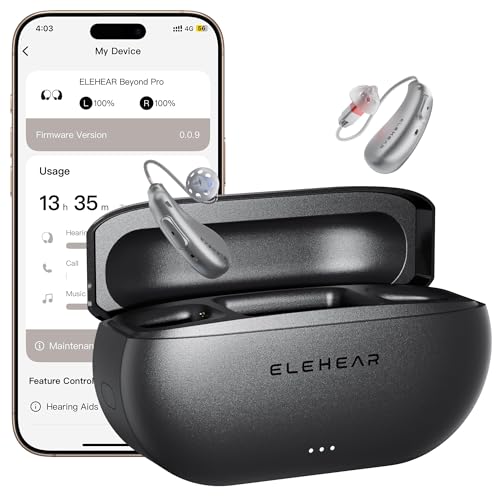
ELEHEAR-Beyond Pro Bluetooth Hearing Aids for Seniors, 30% Clearer Speech
The Beyond Pro is a receiver-in-canal pair that powers on and off automatically as you take it out of the case or put it back, and ships with several dome sizes. ELEHEAR states that its VocClear 2.0 processing delivers 30% clearer speech, with high-frequency detail up to 8,500 Hz and 8 ms latency. The iOS and Android app carries one-tap actions, voice adjustments, 20 ambient soundscapes and, per ELEHEAR, real-time AI translation across 20 languages. ELEHEAR states that a 15-minute charge gives up to 6 hours of use, a full charge up to 20 hours, and the case holds four more full charges. ELEHEAR also states that remote support from its hearing-care specialists is available through the app.

Techmi FacePro OTC Hearing Aids with Bluetooth for Seniors and Adults
The FacePro is an in-ear device with medical-grade silicone domes that Techmi states is designed for adults with mild to moderate hearing loss. Techmi states that a DSP chip reduces background noise such as traffic or restaurant chatter while enhancing speech clarity, and that four modes, Quiet, Speech, Classic and Music, are switched from the phone. Techmi describes the Bluetooth connection as being for device management. On power, Techmi states up to 25 hours of runtime on a single charge, with a portable case for top-ups. The box includes 7 pairs of domes, a charging dock and case, a USB-C cable, a power adapter, a cleaning brush and a wax-guard kit, and Techmi states that a 2 to 3 week adjustment period is normal.

METIKO-Elclear 64-Channel Hearing Aids with AI Noise Cancellation, Bluetooth APP-Control, Rechargeable OTC Hearing Aid Ultralight Invisible for Seniors Adults, Silver
The Elclear is a receiver-in-canal pair supplied with several dome sizes, which METIKO describes as operable one-handed. METIKO states a 64-channel wide dynamic range compression chip with 8 ms audio processing, and an AI noise-reduction chip the company says improves the signal-to-noise ratio by up to 13.3 dB. A free app adjusts volume, program, sampling rate and ambient settings for each program. METIKO's own listing states that the Bluetooth connection is not available for receiving calls or playing audio. METIKO states a 2-hour full charge, 20 hours of continuous use, and up to 100 hours of total battery life with the USB-C charging case.
Keep reading
Are OTC Hearing Aids FSA, HSA, or Medicare Eligible?
Are OTC hearing aids FSA eligible? Yes, and HSA too. Original Medicare is a flat no, Medicare Advantage usually helps. Here is how to pay for them in 2026.
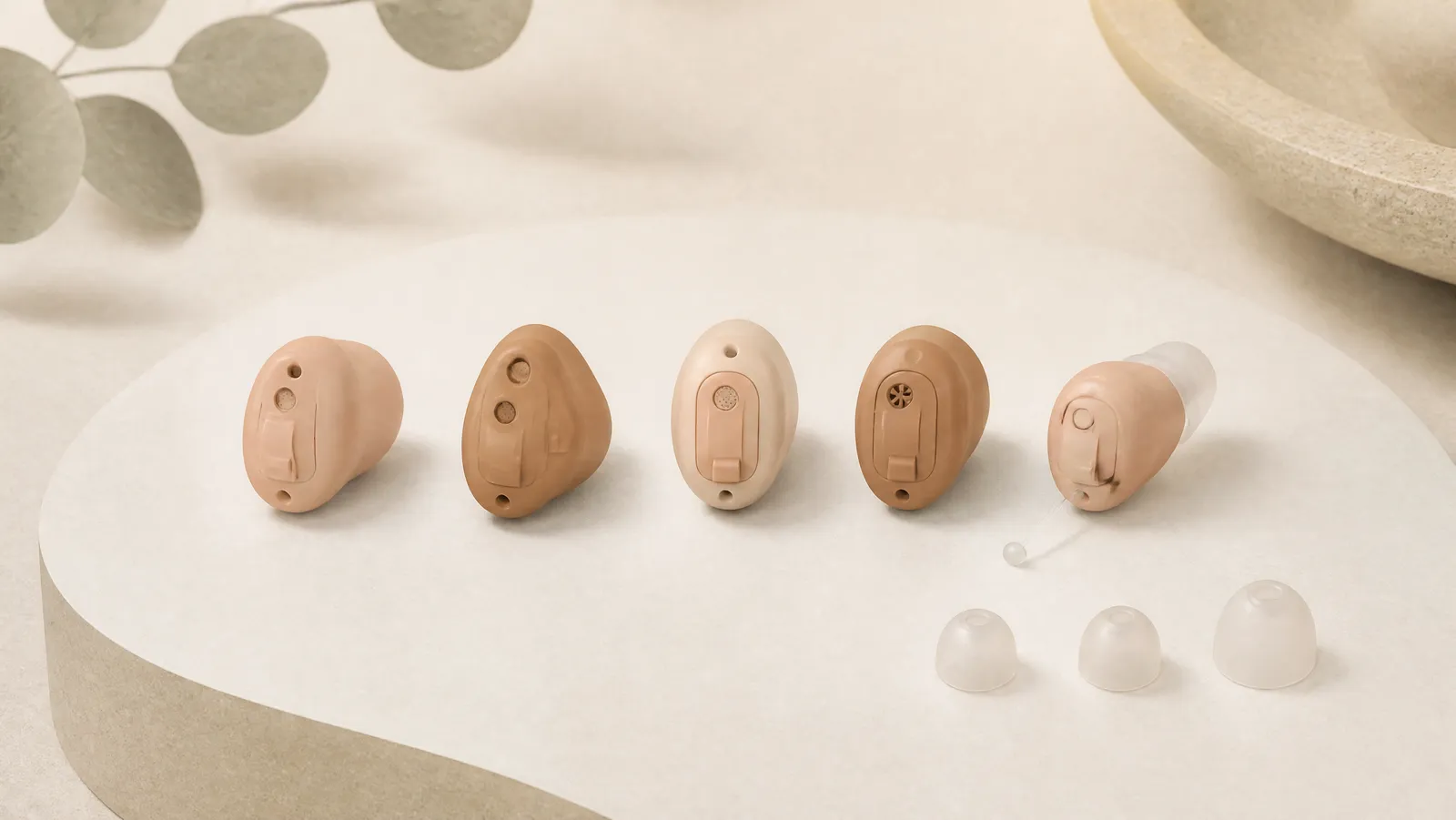
The Most Discreet OTC Hearing Aids of 2026
Invisible OTC hearing aids do not really exist, but some are genuinely discreet. Five in-canal picks for 2026, and what going smaller actually costs you.
OTC Hearing Aids and Severe Hearing Loss: Where the Limit Is
OTC hearing aids for severe hearing loss are outside the FDA category, which covers perceived mild to moderate loss. Here is where the line sits, and why.