Do Blue Light Glasses Work? What the Trials Actually Found
Do blue light glasses work? A 2023 Cochrane review of 17 trials found no benefit for eye strain. What the evidence shows for sleep and retinal protection, and what actually helps.

Affiliate disclosure: This article contains affiliate links. As an Amazon Associate we earn from qualifying purchases, at no extra cost to you. Learn more.
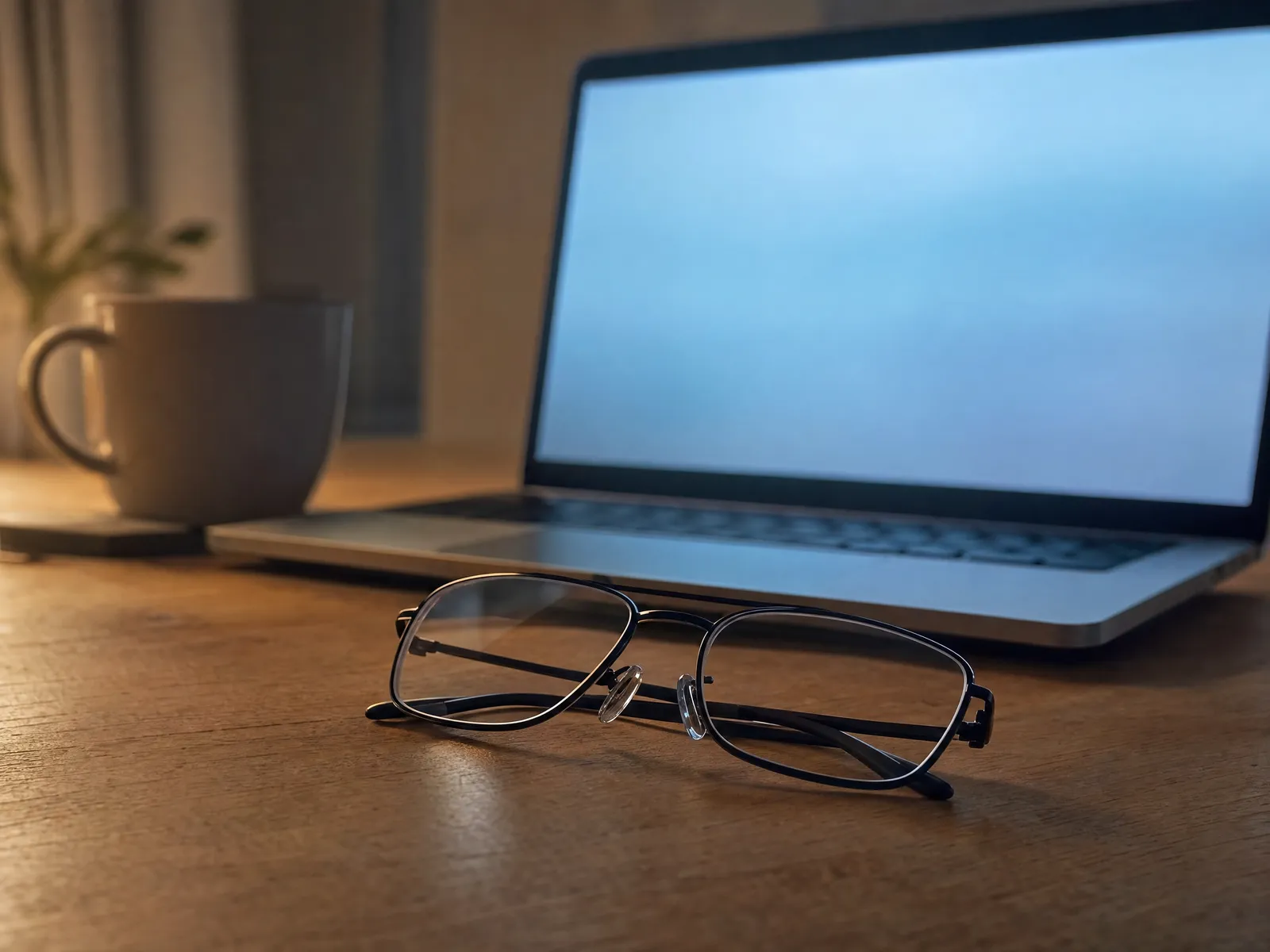
Do blue light glasses work? For eye strain, the best available evidence says no. For sleep, the underlying biology is real but the glasses are a weak lever. For protecting your retina from screens, the premise behind the claim does not hold up. They are cheap, no serious harms have turned up in the trials, and that is much of why they sell.
The trouble is that "do blue light glasses work" is not one question. It is three questions bundled into one product, and each one has a different answer. Bundling them is how a lens with no measurable effect on eye strain ends up being sold on the strength of research about melatonin.
We have not run a lens trial and we do not examine anyone's eyes. What we did was read the systematic reviews and the position statements from the organisations that do, then sort out which of the three claims survives. For the wider picture of what changes with age, start with our guide to eye health after 50.
Three claims wearing one name
Take any blue light glasses listing apart and you will find three separate promises stacked on top of each other:
- They reduce digital eye strain. The reason most people buy them.
- They protect your retina from screen light. The scariest claim, and the one resting on the shakiest premise.
- They help you sleep. The one built on real circadian science, attached to the wrong product.
Claim 1: blue light glasses reduce eye strain
Verdict: the trials do not support it.
The most useful single source here is a Cochrane systematic review published on 18 August 2023 by Singh and colleagues, "Blue-light filtering spectacle lenses for visual performance, sleep, and macular health in adults." Cochrane reviews pool the randomised trials on a question and grade how much confidence the result deserves.
That review covered 17 randomised controlled trials from six countries, with 619 participants in total. The trials followed people for anywhere from less than one day to five weeks. On eye strain, the authors concluded there may be no short-term advantages to using blue-light filtering lenses to reduce visual fatigue with computer use, compared with ordinary non-filtering lenses, a finding they graded as low-certainty evidence. On visual acuity they found probably little or no effect, which they graded as moderate-certainty evidence. Most of the remaining outcomes were graded low to very low certainty, largely because the included trials were small and brief.
The American Academy of Ophthalmology arrives at the same place from a different direction. Its patient guidance states plainly that the Academy does not recommend blue light-blocking glasses, citing the lack of scientific evidence that blue light is damaging to the eyes, and notes that several studies suggest blue light-blocking glasses do not improve symptoms of digital eye strain.
One honest caveat about what that means. "No evidence of benefit" and "proof of no benefit" are different findings, and the Cochrane review delivered the first, not the second. The trials were short and small, and the authors explicitly called for higher-quality randomised trials to define the effects more clearly. What you can say with confidence is this: after 17 trials, nobody has been able to show the benefit. That is a long way from a product that works.
So why do your eyes hurt at the computer?
Because something real is happening. It just is not the colour of the light.
The first culprit is your blink rate. A 2022 review of digital eye strain in the journal Ophthalmology and Therapy, by Kaur and colleagues, cites studies in which blink rate during computer use fell from 18.4 to 3.6 blinks a minute in one, and from 22 to 7 in another. Blink that little and the tear film stops being resurfaced, the eye surface dries, and you get the burning, grittiness and blurred patches that people describe as strain. The American Academy of Ophthalmology makes the same point: long hours staring at digital screens leads to decreased blinking, and those effects are caused by how people use their screens, not by anything coming from the screens.
If that description fits, you are not dealing with a light-filtering problem. You are dealing with a tear-film problem, and the fixes are completely different. We went through them in detail in our guide to dry eye after 50.
The second culprit is focusing effort. The same Ophthalmology and Therapy review notes that people with uncorrected or under-corrected refractive errors are even more susceptible to digital eye strain, because screen work already places extra demand on the balance between focusing and eye alignment. After 50, that matters more than it used to. Presbyopia, the age-related stiffening of the lens that makes near work harder, is near-universal by about 60, and Mayo Clinic lists eyestrain and headache after close work among its symptoms. A monitor sitting at arm's length is squarely in the range where a stiffening lens struggles. We covered what shifts and when in our piece on vision changes after 50.
What to change instead of buying a tint
None of this needs a filter. It needs a few boring adjustments.
- Fix the magnification first. If screen text is hard to read, the answer is almost always the right power at the right working distance, not a tint over the wrong prescription. A monitor sits farther away than a book, so the strength that works for paperbacks may be wrong at the desk. Our roundup of the best reading glasses walks through matching power to distance.
- Move the screen. The Ophthalmology and Therapy review describes a typical recommended setup as roughly 20 inches from the eyes, with the viewing area 15 to 20 degrees below eye level.
- Kill the glare. The same review lists screen glare and reflections, and poor letter-to-background contrast, among the contributing factors. Turning a desk 90 degrees away from a window is free.
- Take breaks, with realistic expectations. The American Academy of Ophthalmology recommends the 20-20-20 rule: every 20 minutes, shift your eyes to look at an object at least 20 feet away for at least 20 seconds. Be aware that the specific numbers are more convention than finding. The rule was coined by optometrist Jeffrey Anshel in the late 1990s, and a 2023 paper in Optometry and Vision Science by Johnson and Rosenfield, titled "20-20-20 Rule: Are These Numbers Justified?", questioned how much peer-reviewed evidence sits behind those particular intervals. Breaks are still sensible. Just do not expect a precise dose-response.
Claim 2: blue light glasses protect your retina
Verdict: the premise does not hold up.
This is the claim that sells on fear, and it is the one where the official position is most direct. The American Academy of Ophthalmology states that there is no scientific evidence that the light coming from computer screens is damaging to the eyes, and that the amount of light coming from a computer has never been demonstrated to cause any eye disease.
It also points out the detail that deflates the whole argument: the largest source of blue light is sunlight. A screen is a dim object compared with a bright sky. If the dose from a monitor were dangerous, a walk to the mailbox would be a bigger problem than a workday.
There is laboratory work showing blue light can damage photoreceptor and retinal pigment cells in cell cultures and animal models, summarised in a 2016 review in the journal Molecular Vision, and that research is real. But those experiments use isolated cells and animal eyes under intensities and conditions that do not mimic a person looking at a laptop, and research has not shown that screen blue light damages human retinas or causes age-related macular degeneration. Treat any product page that cites petri-dish phototoxicity as evidence about your eyes as a marketing document, not a scientific one.
Claim 3: blue light glasses help you sleep
Verdict: the biology is real, the glasses are the weakest way to use it.
Start with what is solid. The American Academy of Ophthalmology confirms that blue light does affect the body's circadian rhythm, the natural wake and sleep cycle, and that too much blue light late at night from a phone, tablet or computer can make it harder to get to sleep. Harvard Health describes an experiment comparing 6.5 hours of blue light exposure with green light of comparable brightness: the blue light suppressed melatonin for about twice as long, and shifted circadian rhythms by twice as much, 3 hours versus 1.5.
Now the awkward part. Strong evidence that evening light shifts your clock is not evidence that a pair of glasses fixes it. The Cochrane review found the sleep results indeterminate, with mixed outcomes across dissimilar study populations: of the trials reporting it, three showed improvement with filtering lenses and three showed no difference. A 2025 meta-analysis in Frontiers in Neurology pooled three randomised crossover trials with 49 participants between them and found no statistically significant effect of blue-blocking glasses on how long people took to fall asleep, total sleep time, sleep efficiency or time awake after falling asleep. The authors noted that the Cochrane review had already judged the evidence on these glasses inconclusive and of low certainty, and called for larger, well-powered trials with standardised protocols.
There is also a product mismatch nobody mentions at checkout. The amber or orange lens that researchers use for evening circadian work is a different object from the near-clear lens sold for daytime screen use. Harvard Health suggests blue-blocking glasses for shift workers and people who use a lot of devices at night, and notes that cheap orange-tinted sunglasses do block blue light but block other colours too, which makes them unsuitable indoors at night.
And the cheaper lever is the one the Academy actually recommends: limit screen time in the two to three hours before bed, and use the nighttime display settings already built into your devices. If sleep is the goal, the room matters more than the eyewear, which is why we put the detail in how to build a sleep environment and the behavioural side in our guide to sleep hygiene habits.
What the coating actually is
Here is the physical reality that explains the trial results.
A lens that looks clear cannot be removing much visible light, because that is what "clear" means. A 2017 study in PLoS ONE by Leung, Li and Kee measured five commercially available blue-light filtering spectacle lenses and found blue-light transmittance between 74.9 and 90.3 percent. In other words, the lenses blocked roughly 10 to 25 percent of blue light. The same study calculated that the lenses theoretically reduced retinal phototoxicity by 10.6 to 23.6 percent, and reduced melatonin suppression efficiency by 5.8 to 15.0 percent.
Those are not nothing. They are also not the kind of numbers that change how your eyes feel at 4pm, which is exactly what the trials found.
When a listing advertises a dramatic blocking percentage, check the wavelength it applies to. A figure measured across a narrow band at the violet end of the spectrum is not the same as filtering blue light generally, and a lens with no visible tint cannot be doing both. Any percentage on a product page is a manufacturer's claim about its own lens, and should be read as one.
Who might still want a pair
We are not going to tell you to be angry about a 15-dollar purchase.
Blue light glasses appear to be close to harmless. The Cochrane review did log adverse events, including headache in 8 percent of participants in one study, increased depressive symptoms in 17 percent in another, and lowered mood in 5 percent in a third, but it noted that similar effects were reported with the non-filtering lenses used for comparison. That is roughly what you would expect from wearing unfamiliar glasses, not from the filter.
So a few people genuinely do fine with them:
- You like the way they look, or a frame on your face is the cue that reminds you to sit up and take a break.
- You want an amber lens for evening use specifically, understanding it is a circadian tool rather than an eye-strain tool.
- You were getting glasses anyway and the filter costs nothing extra.
What we would not do is pay a premium for the coating, buy them instead of an eye exam, or treat them as retinal protection. If a shop quotes a meaningful upcharge for a blue-light filter on a prescription lens, that money buys more peace of mind in a better monitor position or an updated near prescription.
The bottom line
For eye strain, the answer is no: 17 randomised trials pooled by Cochrane in 2023 could not show a benefit, and the American Academy of Ophthalmology does not recommend the glasses. For retinal protection, the claim fails at the premise, because there is no scientific evidence that screen light damages the eye and sunlight delivers far more blue light than any monitor. For sleep, evening light genuinely matters, but the trials on these specific glasses are small and mixed, and cutting evening screen time is the stronger move.
If your eyes hurt at the computer, the likely causes are a collapsed blink rate and a focusing system working at the wrong distance. Those have real fixes, and none of them are blue.
Before you change anything
This article is general information, not medical advice. Mary Burson is a health writer, not a physician and not an eye care professional, and nothing here is a diagnosis. Persistent eye discomfort at the screen is worth an eye exam, because the common causes include a prescription that no longer matches your eyes and a dry eye problem that needs treating on its own terms. Talk with an eye doctor or physician about your own situation.
Some symptoms are not a screen-habits question at all. Sudden vision loss, eye pain, a burst of new floaters or flashes of light, or a shadow or curtain moving across your field of vision all need to be seen urgently rather than self-treated. Those are emergency-room and same-day-appointment symptoms, not wait-and-see ones.
Where this fits
Blue light glasses are a small question dressed up as a large one. The larger question, the one worth your attention after 50, is whether your prescription is current, whether your tear film is holding up, and whether you are getting the dilated exams that catch the conditions that actually threaten sight. For how all of that fits together, see Better Life Span's guide to eye health after 50.
Keep reading
Early Signs of Cataracts and What the Timeline Actually Looks Like
The early signs of cataracts, what cataract vision looks like, and the real timeline from the first clouding to surgery, sourced to the NEI, AAO and AOA.
The Best Reading Glasses for Presbyopia in 2026
The best reading glasses for presbyopia in 2026. Why several cheap pairs beat one costly pair, how to pick your strength, and our five picks.
Dry Eye After 50: Why It Happens and What Actually Helps
Dry eye after 50 has two very different causes, and most people treat the wrong one. What the NEI and AAO evidence says actually helps, and what does not.