How to Lose Belly Fat After 50
How to lose belly fat after 50, by the evidence. Why visceral fat is the most exercise-responsive fat you have, what to measure, and what to skip.

Affiliate disclosure: This article contains affiliate links. As an Amazon Associate we earn from qualifying purchases, at no extra cost to you. Learn more.
You cannot choose where fat comes off. That is the honest answer to how to lose belly fat after 50, and it is better news than it sounds. Visceral fat — the deep fat packed around your organs — happens to be the most exercise-responsive fat depot you have, which is why the middle often starts changing before the scale does.
That reorganizes the plan. Crunches are not the lever, and a stalled scale is not proof that nothing is happening. For the broader program, see what actually works for weight loss after 50. This piece is narrower: which fat moved, how to tell, and what the randomized evidence supports doing. We are a research desk, not a clinic, and we did not examine anyone. Where the evidence is small or mixed, we say so in the same sentence.
Two kinds of belly fat, and only one of them is the real problem
Subcutaneous fat sits under the skin. It is the layer you can pinch. Visceral fat sits deeper, wrapped around the liver, pancreas and intestines, and it is the depot tied to cardiometabolic risk. The two are also measured differently: as Speaker and Fleshner note in their 2012 review in BMC Physiology, accurately measuring visceral fat in humans requires a CT or MRI scan. Everything else is a proxy or an estimate.
What changes in midlife is less the total than the distribution. A four-year longitudinal study of initially premenopausal women, published by Lovejoy and colleagues in the International Journal of Obesity in 2008, used DXA for total fat and CT for abdominal fat. All of the women gained subcutaneous abdominal fat. Only those who became postmenopausal showed a significant increase in visceral fat, alongside a significant drop in serum estradiol.
The scale is a poor witness to this. In the SWAN body-composition analysis published in JCI Insight in 2019, the rate of fat gain roughly doubled at the start of the menopause transition, from about 0.25 kg a year beforehand to about 0.45 kg a year during it, and lean mass began declining about two years before the final menstrual period. Over the roughly three-and-a-half-year transition, the average participant's proportion of fat rose 3.6 percent and her proportion of lean mass fell 1.9 percent — while body weight did not accelerate at all. The composition changed and the scale did not, which is why so many women are told their weight gain is not real. We cover that shift under menopause weight gain.
How to know what you are actually dealing with
You cannot see the depot you care about, so you use proxies and you call them proxies.
- Waist circumference — the National Heart, Lung, and Blood Institute puts an unhealthy waist at greater than 40 inches for men and greater than 35 inches for women, and links those figures to higher risk of heart disease, type 2 diabetes and high blood pressure. Its evidence review notes those cutpoints date to the 1998 clinical guidelines.
- Waist-to-height ratio — the UK's National Institute for Health and Care Excellence, in guideline NG246, sets bands of 0.4 to 0.49 for healthy central adiposity, 0.5 to 0.59 for increased central adiposity and increased health risk, and 0.6 or above for high central adiposity. NICE applies the bands to adults of both sexes and all ethnicities with a BMI under 35, including people with high muscle mass, and gives clinicians one line to use: keep your waist to less than half your height. Run your numbers with our waist-to-height ratio calculator.
- What a scale cannot do — consumer bioimpedance devices, including every model in our roundup of smart scales, estimate body fat percentage from electrical resistance. An estimate of total body fat is not a measurement of visceral fat, and no household device measures the deep depot — where a scale reports a "visceral fat" figure, that number is also an impedance-derived estimate.
Spot reduction, written honestly
The weight of randomized evidence goes against spot reduction. A meta-analysis of randomized trials found aerobic exercise significantly reduced visceral fat compared with control, while resistance training alone did not produce a significant reduction; head to head, the effect favored aerobic training but did not reach statistical significance. The STRRIDE AT/RT trial pointed the same way: a substantial amount of resistance training alone did not reduce body mass or fat mass, while recommended amounts of aerobic training were significantly better at reducing both.
Then there is the dissenting trial, and we are not going to hide it. A 2023 randomized controlled trial by Brobakken and colleagues in Physiological Reports matched two exercise groups for energy expenditure and found the abdominal-endurance group lost more trunk fat — about 697 grams, roughly 3 percent — than the treadmill-only control, which showed no change. It studied 16 men, and in what we could find it has not been replicated.
One small trial on one side, the bulk of the randomized literature on the other. The trials that found any local effect used endurance and circuit work, not strength work. Crunches are not the lever. And the honest framing is better news than spot reduction would be, because visceral fat sometimes falls without significant weight loss — which suggests dose and intensity matter more than which muscle you work.
Step one: moderate-to-vigorous aerobic work, at a real dose
This is the best-supported lever for the depot in question, and the one most readers under-dose. The Physical Activity Guidelines for Americans set the adult target at 150 to 300 minutes a week of moderate-intensity aerobic activity, or 75 to 150 minutes of vigorous activity, or an equivalent mix, preferably spread through the week. Additional benefits accrue beyond the 300-minute equivalent, and for older adults the guidance adds multicomponent activity including balance training.
Moderate-to-high-intensity aerobic training appears to have the highest potential to reduce visceral adipose tissue, so intensity does work duration alone will not. And because visceral fat can fall without much weight change, you may be making the change you came for during a month the scale calls a failure. That is an argument for the tape measure, not for quitting.
Step two: resistance training, for a different reason entirely
Strength work belongs in this plan. It does not belong in it for your waistline, and we would rather say so plainly than sell you a six-week ab program.
In the randomized evidence above, resistance training alone did not significantly reduce visceral fat — though a larger network meta-analysis of 84 randomized trials, published by Chen and colleagues in Obesity Reviews in 2024, did find a benefit for resistance training while ranking it the least effective of the exercise types it compared. Read it as weight of evidence rather than a closed question. What strength work does more reliably is protect the tissue midlife quietly takes. A later SWAN analysis linked body-composition change during the menopause transition to fractures afterwards: each standard-deviation increment of lean mass loss and of fat mass gain was associated with 63 percent and 28 percent greater fracture hazard.
The federal guidance asks for muscle-strengthening activity of moderate or greater intensity, working all major muscle groups, on 2 or more days a week. Two sessions. That is the whole ask, and the half most people over 50 skip. If a gym is not realistic, resistance bands are a reasonable place to start.
Step three: protein, inside a range you agree on with your clinician
Be careful with the protein numbers online: several are presented as federal policy and are not.
The recommended dietary allowance for protein is 0.8 g per kg of body weight per day for adults of all ages, derived from nitrogen-balance studies. The higher figures you have seen are expert-group consensus, not the RDA. The PROT-AGE Study Group, in the Journal of the American Medical Directors Association in 2013, recommends at least 1.0 to 1.2 g/kg a day for people over 65 to maintain and regain lean mass and function, and 1.2 g/kg or more for those who exercise and are otherwise active. The ESPEN Expert Group, in Clinical Nutrition in 2014, recommends at least 1.0 to 1.2 g/kg/day for healthy older people.
As an illustration of the arithmetic rather than a target for you: for someone weighing 70 kg, about 154 pounds, 1.0 g/kg works out to roughly 70 grams a day. Few people are near the upper figures — a UK study of older adults found fewer than 15 percent met the ESPEN 1.2 g/kg/day recommendation.
One exception has to be stated outright. If you have reduced kidney function, these targets do not apply to you: protein intake in chronic kidney disease is individualized by stage, and that is a conversation for your clinician. For how to hit a reasonable intake with food, see how much protein you need after 50.
Step four: sleep, because short sleep shows up on a CT scan
This is the step most readers want to skip. In a randomized crossover trial led by Covassin and colleagues at Mayo Clinic, published in the Journal of the American College of Cardiology in 2022, 12 healthy, non-obese inpatients with unlimited food access were randomized to 14 days of restricted sleep — a four-hour opportunity — or control sleep at nine hours. Mayo's summary reports that insufficient sleep produced a 9 percent increase in total abdominal fat area and an 11 percent increase in abdominal visceral fat versus control sleep. Participants ate more than 300 extra calories a day, energy expenditure did not change, and body weight rose only about a pound.
Read that last clause again. The visceral change was detectable only by CT; the scale barely moved. The trial was small and the participants young, aged 19 to 39, so we would not transfer the number onto a 60-year-old. As a direction of effect it is hard to ignore. If sleep is your weak link, start with how to sleep better.
Step five: the liquid calories, in order of evidence
Sugar-sweetened drinks have the cleanest observational signal. In an analysis of the Framingham Heart Study Third Generation cohort published in Circulation in January 2016, Ma, Fox and colleagues compared CT scans taken about six years apart in roughly a thousand adults with a mean age of 45. Daily consumers' visceral fat volume rose by 852 cubic centimeters, against 658 in nonconsumers; in Healio's report of the study, that came to about a 27 percent greater increase after adjustment. Diet soda showed no such association, and sugary drinks were not linked to changes in body weight or subcutaneous fat. It is observational, but note which depot moved and which measure did not.
Alcohol is more mixed than the headlines suggest. An Oxford Biobank analysis from Fredrik Karpe's group used DXA in 5,761 adults and found the heaviest-drinking group had more than 10 percent higher visceral fat than lighter drinkers, after adjusting for age, smoking, physical activity and overall body fat; Oxford's summary notes waist circumference did not reliably capture the difference. A CT-based study of 998 Japanese men in the Journal of Epidemiology in 2019 found higher weekly intake associated with greater visceral fat area even after adjusting for BMI, with no significant association with subcutaneous fat. A longitudinal UK Biobank analysis found little association overall. Research suggests heavier intake tracks with the deep depot; the effect size is unsettled.
Stress: what we can say, and what we will not
We are not making stress a numbered step, because the human evidence does not support one. Speaker and Fleshner's BMC Physiology review reports that dysregulation of the HPA axis is positively correlated with visceral obesity, citing Björntorp and Rosmond's clinical work and epidemiological findings linking higher waist-to-hip ratios to job stress and stress-related mood disorders. But much of the direct support is rodent and primate work, and correlation in humans is not a trial. Managing chronic stress is defensible on its own merits; we found no trial evidence that a stress-reduction program reduces visceral fat, and we will not imply we did.
What to skip, and we mean skip
- Waist trainers. They compress tissue, they do not remove it. Cleveland Clinic hepatologist Jamile Wakim-Fleming told the clinic's health site that a waist trainer can make the waist look smaller and may cause temporary loss by suppressing appetite, "but this is not a permanent thing," and that compressing the ribs means "you're not getting enough oxygen with each breath." The clinic also lists worsened reflux, skin irritation and organ strain, and advises exercise and diet.
- Belly-fat "burner" supplements. This category has a federal enforcement history. In Operation Big Fat Lie in 2004, the Federal Trade Commission sued six weight-loss marketers, including one selling a chitosan supplement advertised as producing up to four pounds of loss a week without diet or exercise. A later action against the marketers of Relacore targeted claims that it reduced stress-related abdominal fat.
- Detox teas and anything sold as a flush. We found no trial evidence that a tea changes visceral fat.
- Vinegar, for this purpose. We went through the trial literature on apple cider vinegar for weight loss separately. Nothing in it replaces the aerobic dose.
- Targeted ab devices, and any plan built on crunches. Working a muscle does not reliably strip the fat above it.
A realistic timeline, without a promised rate
We will not tell you how many inches come off per month: nobody can say that honestly, and the depot you target can move while your weight does not. What to watch instead:
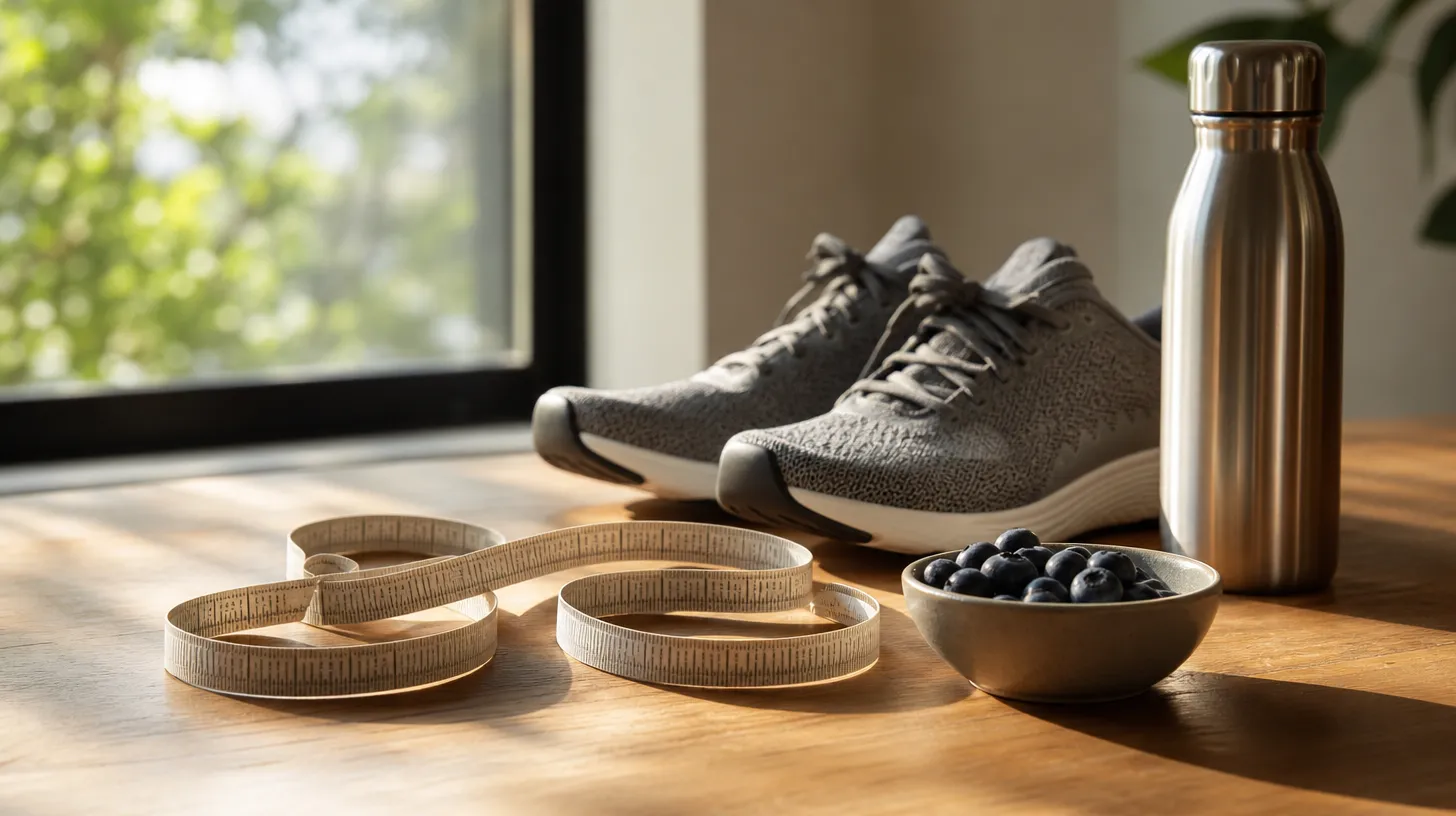
- The tape, monthly. Same spot, same time of day, same tension, judged against the NICE bands above rather than against last Tuesday.
- How clothes fit. Crude, but it integrates weeks the way a daily weigh-in cannot.
- The multi-month trend. The sleep trial above produced a measurable visceral change alongside about a pound of weight gain. The reverse is just as possible, which is why a flat scale is weak evidence of a flat month.
- The reason it stalled, if it has. If progress stopped rather than never started, that is a different problem with a different fix, and we took it apart in why the weight stopped coming off.
What actually matters, in order
If you do three things, do these.
- Put in the aerobic dose, with some of it hard. 150 to 300 minutes a week of moderate activity or the vigorous equivalent, per the Physical Activity Guidelines, with enough intensity that moderate-to-high-intensity work is genuinely represented — that is where the visceral-fat signal is strongest.
- Defend lean mass while you do it. Two strength sessions a week across all major muscle groups, plus protein inside whatever range your clinician agrees fits you. Not for your waist: for the tissue SWAN watched disappear and the fractures that followed.
- Fix sleep, then the drinks. A four-hour sleep opportunity added abdominal visceral fat in two weeks in the Mayo trial, and daily sugary drinks tracked with 27 percent more visceral fat gain over six years in Framingham.
Nothing above is a flat-belly protocol, and nothing promises a rate. It is a plan whose steps are each attached to a trial, pointed at the fat depot that actually matters. For how this fits with everything else that changes after 50, start with our complete weight and metabolism guide.
Keep reading

Why You Can't Lose Weight After 50 (And What Changes It)
Why can't I lose weight after 50? The largest study of human energy use says it is rarely a broken metabolism. Here is what changed, and what still works.
Does Your Metabolism Really Slow Down After 50?
Does metabolism slow down with age? Not when you think. The largest measurement study found adjusted energy burn is flat from 20 to 60, then declines slowly.
How Much Protein Do You Actually Need After 50?
How much protein do you need after 50? The RDA is 0.8 g per kg for all adults. Two expert groups say 1.0 to 1.2 for over-65s. Why both are right.