Medications That Increase Fall Risk After 50 (and How to Review Yours)
The drug classes most consistently linked to fall risk after 50, what the 2023 Beers Criteria actually says, and how to get a real medication review.

Affiliate disclosure: This article contains affiliate links. As an Amazon Associate we earn from qualifying purchases, at no extra cost to you. Learn more.
The medications that increase fall risk cluster into two groups: the ones acting on your brain and the ones acting on your blood pressure. Sedatives, antipsychotics, some antidepressants, opioids, anticholinergics, blood-pressure drugs and glucose-lowering drugs are the repeat names. The single most useful move is a scheduled medication review with whoever prescribed them.
Do not stop or cut anything on your own. Stopping some of these drugs abruptly is more dangerous than taking them. When the FDA updated the boxed warning for the whole benzodiazepine class on 23 September 2020, it stated that stopping them abruptly or reducing the dosage too quickly can cause withdrawal reactions, including seizures, and that those reactions can be life-threatening. Antidepressants and several heart drugs have their own version of that problem.
So this is a map for a conversation, not a licence to edit your own list. A medication review is one of the five or six things that make up real fall prevention for seniors, and it is the one most often skipped. We are a research desk, not a clinic.
The Six Mechanisms That Turn a Prescription Into a Fall
What matters is not the list of names but how a drug reaches the floor. The CDC's STEADI fact sheet on medications linked to falls names the pathways directly: some medications can cause dizziness, sedation, confusion, blurred vision, or orthostatic hypotension.
- Sedation and slowed reaction time. Everyone stumbles. Recovering takes a fraction of a second of intact attention and reflex.
- Orthostatic hypotension. Blood pressure drops when you stand. The conventional definition, per a 2023 Irish Longitudinal Study on Ageing analysis in Age and Ageing, is a fall of at least 20 mmHg systolic or 10 mmHg diastolic within three minutes of standing.
- Dizziness and unsteadiness. Some drugs act on the inner ear and the brain's balance pathways, the subject of our coming piece on dizziness and vertigo after 50.
- Anticholinergic effects. Confusion, blurred vision and dry mouth sound trivial one at a time. Stacked, they change how well you read the edge of a step.
- Low blood sugar. Shaking, sweating and confusion during a hypoglycaemic episode are a fall mechanism.
- Night-time urgency. A drug that sends you to the bathroom twice a night puts you on an unlit floor while half asleep.
The Beers Criteria: A Clinician's List, Not a Ban List
Most of the detail below traces to one document: the 2023 American Geriatrics Society Beers Criteria for Potentially Inappropriate Medication Use in Older Adults, published online in the Journal of the American Geriatrics Society on 4 May 2023 and in the July 2023 print issue. AGS calls it the seventh overall update and the fourth since the society became the criteria's steward. There is no newer edition; third-party pages dated 2026 are page reviews, not a new list.
AGS describes it as an explicit list of potentially inappropriate medications "typically best avoided by older adults in most circumstances," written for clinicians. The panel states the criteria "are not to be used in a punitive manner" and should be applied "in a manner that supports, rather than replaces, shared clinical decision-making." Finding your drug on it is not a verdict. AGS also published a companion list of alternative treatments on 23 July 2025, so prescribers have somewhere to go next.
Benzodiazepines and Z-Drugs: The Clearest Signal
This is where the evidence is least ambiguous. The 2023 Beers Criteria states that "in general, all benzodiazepines increase the risk of cognitive impairment, delirium, falls, fractures, and motor vehicle crashes in older adults," a criterion it rates as moderate quality of evidence with a strong recommendation to avoid. In the separate criterion for older adults with a history of falls or fractures, AGS rates the quality of evidence for benzodiazepines as high. It also corrects a common assumption: shorter-acting benzodiazepines are not safer than long-acting ones.
The newer sleep drugs are not an escape hatch. AGS says the Z-drug hypnotics eszopiclone, zaleplon and zolpidem have adverse events similar to benzodiazepines, including delirium, falls and fractures, with "minimal improvement in sleep latency and duration." A prescriber might taper slowly, treat the insomnia differently, or cut other sedating drugs if this one has to stay. The FDA is explicit that no standard tapering schedule suits every patient.
Antipsychotics: The Narrowest Window
AGS flags antipsychotics for older adults with a history of falls or fractures because they "may cause ataxia, impaired psychomotor function, syncope, or additional falls." For people with dementia the criteria go further, citing increased risk of stroke, a greater rate of cognitive decline and higher mortality, and advising against use for behavioural problems unless documented non-drug options have failed. AGS adds that when these drugs are used, "periodic deprescribing attempts should be considered."
Antidepressants and the Mixed SNRI Picture
Here the honest answer is messier than most summaries admit. The 2023 Beers Criteria says that for antidepressants, "evidence for risk of falls and fractures is mixed; newer evidence suggests that SNRIs may increase falls risk." SNRIs include duloxetine and venlafaxine. The update separately flags antidepressants with strong anticholinergic properties, including the older tricyclics.
Mixed means mixed, and depression itself is associated with falls: a 2013 meta-analysis in the Journal of the American Geriatrics Society found depressive symptoms consistently associated with falls in older people. Untreated depression is not the safe option. A prescriber might switch classes, lower the dose, or leave it alone. Abrupt stopping is the move to avoid: a 2018 review in the American Journal of Psychiatry notes that FDA prescribing labels caution about new-onset symptoms on discontinuation of antidepressants and recommend gradual tapering.
Opioids and Muscle Relaxants
Opioids were added in the 2023 update to the drugs to avoid in older adults at risk of delirium, with AGS citing emerging data linking opioid administration to delirium. They also appear on the falls-and-fractures list and in the CDC's psychoactive group.
Skeletal muscle relaxants were new to the Beers combination criterion in 2023, over "concern for adverse effects when used in combination with other CNS-active drugs." If you take a muscle relaxant plus a sleeping pill plus gabapentin, you are the reason that change was made. A prescriber might reassess the pain target, shift the timing, or substitute a non-drug approach.
Anticholinergics: The Load Nobody Counts
This is the most under-recognised item here, because the burden is cumulative and no single pill looks dangerous. The 2023 Beers Criteria states that "cumulative exposure to anticholinergic drugs is associated with an increased risk of falls, delirium, and dementia, even in younger adults," and tells clinicians to "consider total anticholinergic burden during regular medication reviews." On combinations it is blunter: "use of more than one medication with anticholinergic properties increases the risk of cognitive decline, delirium, and falls or fractures."
AGS added anticholinergics to the medications to avoid in older adults with a history of falls or fractures in the 2023 update. These drugs turn up where you would not look: bladder antimuscarinics, some antidepressants, first-generation antihistamines, muscle relaxants. The total is what matters, not the individual entry.
Blood Pressure and Heart Medications
The CDC's STEADI fact sheet lists "medications affecting blood pressure" among the classes to review in everyone 65 and older. The mechanism is usually orthostatic: the drug works, you stand up, and the pressure at your head drops for a few seconds. The 2023 Age and Ageing analysis notes that orthostatic hypotension "is often related to culprit medications, such as anti-hypertensives."
What is not settled is whether treating blood pressure causes falls on balance. Treatment prevents strokes, and a stroke is a worse outcome than a near-fall. This is a dose, drug and timing question for a prescriber, not a reason to skip a tablet.
What you can bring is data. Learn to measure your blood pressure at home, take a seated reading followed by a standing one, and note both with the time of day. Ask for a sitting-and-standing check in the office too, and see what health numbers to track after 50 for how often to log it.
Diabetes Medications That Can Cause Lows
Low blood sugar is a direct fall mechanism, and the data are reasonably strong. In the ARIC cohort analysis published in Diabetes Care in 2020, covering 1,162 participants with diagnosed diabetes, severe hypoglycaemia was associated with a more than twofold higher adjusted risk of falls (hazard ratio 2.23, 95% CI 1.61 to 3.07).
The 2023 Beers Criteria advises against sulfonylureas as first- or second-line monotherapy or add-on therapy in older adults unless there are substantial barriers to safer and more effective agents, citing higher risks of cardiovascular events, all-cause mortality and hypoglycaemia than alternative agents. It also advises against sliding-scale insulin regimens, which it says carry a higher risk of hypoglycaemia without improving hyperglycaemia management. A prescriber might relax an overly tight glucose target, switch agents, or change the regimen. Skipping a diabetes medication unilaterally creates its own emergency.
Diuretics and the Night-Time Bathroom Trip
Diuretics sit on fall-risk lists for two reasons: volume depletion that worsens the standing blood-pressure drop, and urgency at the wrong hour. The 2023 Beers Criteria flags one specific pairing, warning that loop diuretics combined with non-selective peripheral alpha-1 blockers increase the risk of urinary incontinence in older women, and advising against the combination unless both drugs are warranted.
The evidence tying nocturia itself to falls is weaker than the mechanism feels, so we would not oversell it. The ask is cheap anyway: whether a diuretic could be taken earlier in the day, and better light on the route to the bathroom either way.
Cumulative Risk: Three or More CNS-Active Drugs
This is the most useful single fact here. No individual pill in a typical list looks alarming. The stack does.
The 2023 Beers Criteria includes a drug-drug interaction criterion advising clinicians to avoid concurrent use of three or more CNS-active drugs, written as "≥3" in the criteria, and to minimise the number of them, citing increased risk of falls and of fracture. The evidence level for that criterion was raised to high in 2023. The categories that count toward the three:
- Antiepileptics, including the gabapentinoids gabapentin and pregabalin
- Antidepressants
- Antipsychotics
- Benzodiazepines
- Z-drug hypnotics (eszopiclone, zaleplon, zolpidem)
- Opioids
- Skeletal muscle relaxants, added in 2023
Count yours. Four of those categories in one pill organiser is common, and it is the pattern the criterion was written about. AGS adds that if one of the drugs must be used, clinicians should "consider reducing the use of other CNS-active medications that increase the risk of falls and fractures." The fix is often subtraction elsewhere, not removal of the drug you most need.
In a cross-sectional analysis of 424 adults aged 65 and older arriving at an academic emergency department after a fall, reported in Innovation in Aging in 2022, 45.8% were taking at least one fall-risk-increasing drug and 25.5% were taking two or more. That is prevalence in a sample of people who had already fallen, not evidence the drugs caused those falls.
The Over-the-Counter Aisle Counts Too
The CDC's STEADI fact sheet tells clinicians to review prescription drugs, over-the-counter medications and herbal supplements, and names antihistamines among the classes that can cause dizziness, sedation, confusion, blurred vision or orthostatic hypotension. That instruction exists because patients do not think of the sleep aisle as medication.
Diphenhydramine is the headline. Per MedlinePlus it is sold both on its own and combined with pain relievers, which is why it turns up in many over-the-counter night-time sleep aids and in the common pain relievers labelled "PM", and it doubles as an allergy antihistamine. AGS describes it as highly anticholinergic, with reduced clearance in advanced age and tolerance developing when used as a hypnotic, and lists confusion among its effects. The criteria do allow that diphenhydramine "in situations such as acute treatment of severe allergic reactions may be appropriate."
If you reach for one nightly, the question is what else could do the job. Our round-up of natural sleep aids is honest about how thin the evidence is for most of them, which is the point: the alternative is usually a sleep-habit conversation, not another product. Supplements belong on the list too, and we cover the common interactions in supplement safety after 50.
Getting a Real Medication Review
The CDC's 2017 STEADI guidance to clinicians is three verbs: stop medications when possible, switch to safer alternatives, reduce to the lowest effective dose. Your job is to make the review happen and arrive with the right material.
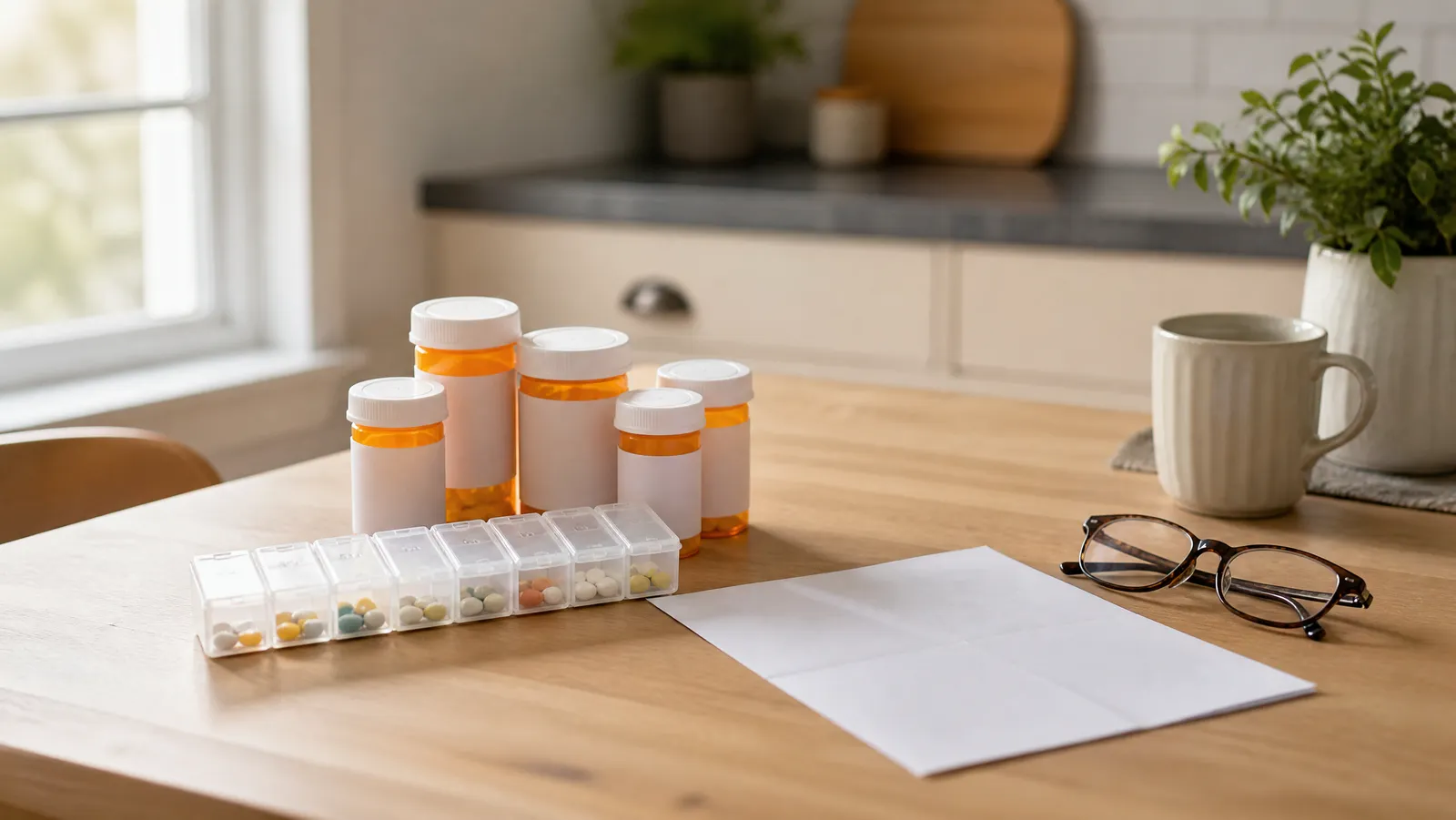
- Bring every bottle to one appointment. Not a list typed from memory. The actual containers, including over-the-counter products, eye drops, patches, inhalers and supplements. Reviews fail on the items nobody declared.
- Ask the specific question. "Which of these could be contributing to my dizziness or unsteadiness?" beats "are my medications safe?" It gives the prescriber a symptom to work backwards from.
- Ask for a sitting-and-standing blood pressure check, and bring your home readings.
- Ask about timing. Whether anything can move away from bedtime, or toward it, is often the lowest-risk change available and costs nothing.
- Use a pharmacist. Medicare.gov states that plans with Medicare drug coverage must offer Medication Therapy Management services to people who meet certain requirements, and that the service can include a comprehensive review of your medications and the reasons you take them, plus a written summary. Per Medicare.gov, "if you qualify, you can get these services at no cost to you." Your plan decides eligibility, so ask it.
- Bring a number, not just a feeling. A timed chair-stand gives the appointment an objective anchor. Our guide shows how to test your balance at home in about fifteen minutes.
The Honest Limits of the Deprescribing Evidence
Most articles on this topic imply that stopping fall-risk drugs is a proven way to prevent falls. The trial evidence does not support that, and you should know it before walking in with the wrong expectation.
In a systematic review and meta-analysis published in BMJ Open in February 2021, Justin Lee and colleagues pooled five randomised controlled trials covering 1,305 adults aged 65 and older followed for 6 to 12 months. Withdrawing fall-risk-increasing drugs as a sole strategy produced a rate ratio for falls of 0.98 (95% CI 0.63 to 1.51) and a relative risk of experiencing a fall of 1.04 (95% CI 0.86 to 1.26). Neither shows a benefit. The authors graded that evidence as very low certainty and noted that no trial measured fractures, hospitalisations, or the harms of deprescribing itself.
There is a plausible reason the trials look like this. The people who most need sedatives, opioids and blood-pressure drugs are also the frailest, and the conditions those drugs treat carry their own fall risk. Removing a drug does not remove the disease.
So the honest framing is narrow: these classes are consistently associated with falls, a review is low-risk and worth doing anyway for side effects and cost, and the claim that stopping them reduces your falls is not established. The review's own authors note that other reasons to deprescribe remain valid.
The intervention with the clearest evidence is not pharmacological at all. In its 2024 recommendation statement the US Preventive Services Task Force recommends exercise interventions to prevent falls in adults 65 and older at increased risk, a B grade based on moderate certainty of a moderate net benefit. That is why we would book the review and start the balance exercises for seniors in the same week rather than wait for one to finish.
Red Flags That Mean a Same-Day Call
Some events are not "mention it at the next appointment" material. Contact a clinician the same day if any of these happen:
- Fainting or passing out, with or without a fall.
- A fall you cannot remember. Not remembering the fall itself points at something other than a trip.
- New confusion, slurred speech or sudden drowsiness, especially after a dose change.
- Any fall with a head impact while taking an anticoagulant or antiplatelet drug. Bleeding inside the skull can declare itself hours later. That is an emergency assessment, not a wait-and-see.
- New, repeated light-headedness on standing, or any episode where you had to grab something to stay upright.
Our Take
Nobody is going to run this review for you. The appointment where somebody lays out every bottle you own and asks what each one is still for is the most under-used hour in preventing falls after 50, and it rarely happens unless the patient asks.
Count your CNS-active drugs against the AGS list of seven categories. Add up the anticholinergic load, including the sleep aid you do not think of as a drug. Keep expectations calibrated: the review is worth doing, and the evidence that stopping these drugs cuts falls is weaker than the internet suggests. Then do the unglamorous thing that does have evidence behind it. Train your balance and your legs, fix the lighting on the route to the bathroom, and talk to your doctor before changing anything on this page.
Should You Stop a Medication Because It Appears in the Beers Criteria?
No. The AGS panel states that the criteria are not to be used in a punitive manner and should support rather than replace shared clinical decision-making. The list is written for clinicians, flags medications that are potentially inappropriate rather than banned, and includes documented exceptions. Bring it to a prescriber as a question.
Are Over-the-Counter Sleep Aids Safer Than Prescription Sleeping Pills?
Not automatically. Most over-the-counter night-time sleep aids and "PM" pain relievers contain diphenhydramine, which AGS describes as highly anticholinergic with reduced clearance in older age, and the 2023 Beers Criteria links cumulative anticholinergic exposure to falls, delirium and dementia. "No prescription needed" describes regulation, not risk.
What Should You Bring to a Medication Review?
Every container, including over-the-counter drugs, supplements, eye drops and patches; a note of who prescribed what and why; home blood-pressure readings taken sitting and standing; the dates of any falls or near-falls in the past year; and one specific question about which drug could be causing your unsteadiness.
Keep reading
Best Medical Alert Systems With Fall Detection in 2026
The best medical alert systems with fall detection in 2026: how the sensors work, who answers the call, what Medicare covers, and five honest picks.

Fall Prevention for Seniors: The Complete Guide for Adults Over 50
A practical fall prevention guide for seniors: how to test your own risk, the exercise that works, the medication trap, and a room-by-room home audit.
How to Test Your Balance at Home: 4 Fall-Risk Self-Checks After 50
How to test your balance at home: four tests clinicians use, the published cut-off number for each, and the results that mean see a doctor.