Balance Exercises for Seniors: A Progressive Fall-Prevention Program
Balance exercises for seniors, level by level: the Cochrane numbers, the dose trials actually used, and the safety setup before exercise one.

Affiliate disclosure: This article contains affiliate links. As an Amazon Associate we earn from qualifying purchases, at no extra cost to you. Learn more.
Balance and functional training is the fall-prevention intervention with high-certainty evidence behind it, and the dose that produced that evidence is substantial and ongoing, not a two-week fix. Balance exercises for seniors are not gentle stretching. They are deliberate practice at being slightly unsteady on purpose, safely, within arm's reach of a kitchen counter.
According to the CDC, more than 14 million adults aged 65 and older, about one in four, report falling each year, and roughly 37% of those who fell reported an injury needing medical treatment or limiting their activity for at least a day. Of everything in the fall prevention for seniors toolkit, this is the piece with the most weight behind it.
What follows is the progression, grouped by how much you are holding on. We are a research desk, not a clinic: a physical therapist is the right person to set your starting level.
Balance Training Is the Lever, Not Exercise in General
The number everyone quotes is 23%. It is usually attached to the wrong thing.
In the 2019 Cochrane review by Sherrington and colleagues (Cochrane Database of Systematic Reviews, CD012424), which pooled 108 randomised trials and 23,407 participants, exercise of any type reduced the rate of falls by 23% in community-dwelling older adults: rate ratio 0.77, 95% confidence interval 0.71 to 0.83, from 59 studies and 12,981 participants, rated high-certainty evidence.
Split by exercise type, the same review reports a clear hierarchy:
- Balance and functional training: 24% fewer falls. Rate ratio 0.76 (95% CI 0.70 to 0.81), 39 studies, 7,920 participants, high-certainty. Cochrane's summary also reports 13% fewer people experiencing one or more falls for this type (risk ratio 0.87, 95% CI 0.82 to 0.91).
- Multiple exercise types, mainly balance and functional work plus resistance: 34% fewer falls. Rate ratio 0.66 (95% CI 0.50 to 0.88), 11 studies, 1,374 participants, rated moderate-certainty: it probably reduces falls.
- Tai chi: 19% fewer falls. Rate ratio 0.81 (95% CI 0.67 to 0.99), 7 studies, 2,655 participants, and Cochrane rated the rate-of-falls evidence here low-certainty. Promising, not settled.
- Resistance exercise alone: no clear answer for falls. Cochrane judged the evidence insufficient to determine an effect for resistance-only programmes, and the same for dance and walking.
One point of precision: these are reductions in the rate of falls, how often falls happen, not in your chance of ever falling, which moved less in most of those analyses.
The US Preventive Services Task Force agrees. Its 2024 recommendation statement on falls prevention recommends exercise interventions for community-dwelling adults 65 and older at increased risk of falls, a B recommendation, concluding with moderate certainty of a moderate net benefit.
The Dose Is Larger Than Most Articles Admit
This is where most articles go quiet.
An updated Sherrington meta-analysis published in the British Journal of Sports Medicine in 2017, summarised in the World Physiotherapy congress proceedings, found larger effects when programmes gave a high challenge to balance and totalled more than three hours of exercise a week. That summary also states plainly that ongoing participation is necessary or the benefits will be lost. Balance is a skill with a short memory.
The Task Force's 2024 evidence review noted that trial sessions were most commonly scheduled two to three times per week.
The best-documented at-home template is the Otago Exercise Programme, developed by the New Zealand Falls Prevention Research Group at the University of Otago. According to the National Council on Aging, it consists of 17 strength and balance exercises plus a walking programme performed three times a week, with a physical therapist assessing and prescribing the initial exercises: roughly four therapist visits over eight weeks, then self-management for four to ten months. NCOA reports that studies show participants experience a 35% to 40% reduction in falls, with a 35% reduction in high-risk older adults, and describes it as most effective for frail older adults.
The individual prescription is part of the intervention, not an optional extra. The University of North Carolina's Center for Aging and Health, which runs Otago training for US therapists, describes the programme as tailored to each individual and delivered by a physical therapist over a 52-week course, with the exercises becoming progressively more challenging. In the published US implementation studies, including a 2017 report in Physical Therapy, the therapist selects the appropriate exercises from the 17 rather than prescribing all of them.
On cost, Medicare says Part B covers medically necessary outpatient physical therapy, with you paying 20% of the Medicare-approved amount after the Part B deductible and no annual dollar limit. Advantage plans differ.
Set Up the Room Before the First Exercise
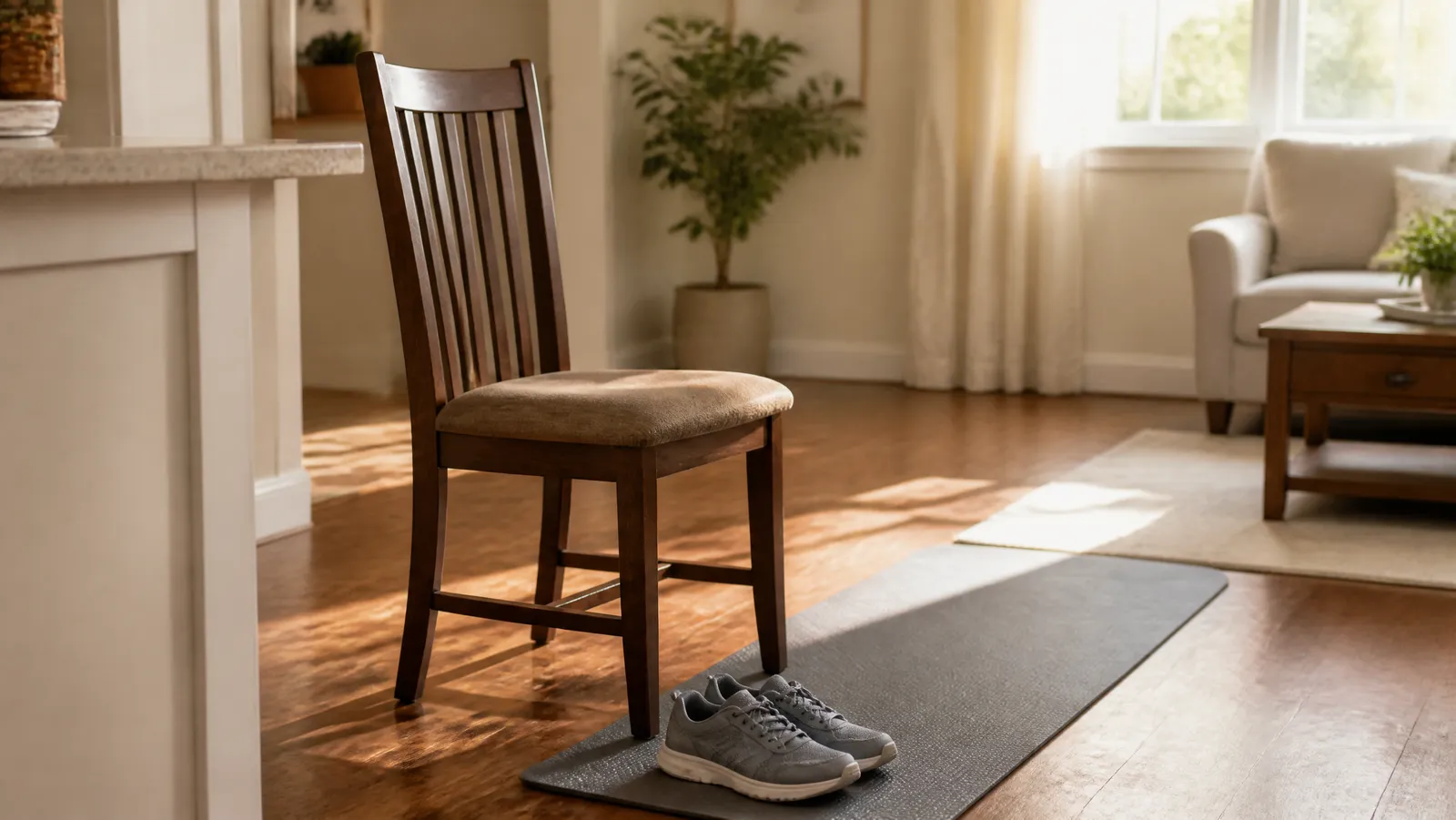
Non-negotiables, and they take two minutes:
- A counter or sturdy chair back within reach. Not a wheeled chair, not a side table. Something that will not move under your weight.
- Shoes with non-slip soles, or bare feet on a non-slip floor. Never socks. Socks on hard floors remove the one thing you are training. Federal guidance on MyHealthfinder, adapted from National Institute on Aging material, goes further for everyday walking around the house: non-slip soles rather than bare feet, socks or smooth-soled slippers.
- Nothing on the floor. No rug edges, no cords, no pets in the room.
- Someone nearby for the first few sessions if you already feel unsteady, especially for hands-off work.
- A clear count of seconds. The CDC's 4-stage balance test asks for 10-second holds and notes that an older adult who cannot hold a tandem stand for at least 10 seconds is at increased risk of falling, which makes 10 seconds a sensible unit.
Some situations mean calling a doctor first rather than starting: a recent fall that caused an injury, new or worsening dizziness, chest pain or unusual breathlessness on exertion, or new neurological symptoms such as numbness, weakness, double vision or trouble speaking. Those are reasons to be examined, not to practise harder. The same goes if you have started or changed a drug on the list of medications that increase fall risk: the wobble may not be a balance problem at all.
Level 1: Exercises You Do While Holding On
Both hands on the counter is not cheating. It is the starting dose.
Narrow Stance
Feet about two inches apart, hands on the counter, tall posture, eyes straight ahead rather than down. Harder: one hand off, then both. Easier: widen back to hip width. Handhold: both hands in light contact until you can hold it without swaying.
Feet Together
Feet fully together, side by side and touching. The first position of the CDC's 4-stage balance test, where 10 seconds is the benchmark. Harder: hands off, then a slow head turn. Easier: back to narrow stance. Handhold: fingertips once the hold feels quiet.
Heel Raises and Toe Raises
Holding the counter, rise onto the balls of your feet, pause, lower slowly. Then rock back onto your heels, lifting your toes. Calf raises and toe raises are both in the Otago strength set listed by the University of North Carolina. Harder: slow the lowering. Easier: less range. Handhold: one hand on throughout, because the heel-raised position has the smallest base of support here.
Sit-to-Stand
Sit on a firm chair, feet flat, stand without pushing off with your hands, then lower under control. This is the movement behind the CDC's 30-second chair stand test, which counts full stands in 30 seconds with arms crossed against age-and-sex-banded norms. Harder: a lower seat, or a slower descent. Easier: push off the armrests. Handhold: arms crossed is the goal, hands on thighs the bridge.
Level 2: Fingertips Only
Level 2 narrows your base of support. The handhold becomes a safety net rather than a support. Slow head turns, left and right then up and down, make any hold here harder by removing some of the visual reference your balance was leaning on. Stop and sit if head movement makes you dizzy, and tell your doctor about that dizziness.
Semi-Tandem Stance
The instep of one foot against the big toe of the other, so the feet are offset rather than in line. The second position of the CDC's 4-stage test. Harder: full tandem. Easier: feet together. Handhold: one hand hovering, not gripping.
Tandem Stance
One foot directly in front of the other, heel to toe, in a line. The CDC flags being unable to hold this for 10 seconds as a marker of increased fall risk, which makes it the most informative position in the set. Harder: eyes closed two or three seconds, hand near the counter. Easier: back to semi-tandem. Handhold: fingertips at first, hovering after.
Heel-to-Toe Walking
Walk forward along a counter, the heel of each step against the toes of the other foot. Heel-toe walking, backwards heel-toe walking and heel-toe standing all appear in the Otago balance exercises listed by the University of North Carolina. Harder: go slower, which is harder rather than easier. Easier: allow an inch between heel and toe. Handhold: trail one hand along the counter.
Level 3: Hands Off and Moving
Level 3 is only sensible once Level 2 holds feel genuinely quiet. The counter stays within reach regardless.
Single-Leg Stand
Stand near the counter, lift one foot clear of the floor, hold. One-leg stand is part of the Otago balance set per the University of North Carolina. Harder: knee higher, head turned, or a firm cushion underfoot. Easier: rest the lifted toe lightly on the floor. Handhold: two fingers, and switch sides, because most people have a notably weaker one.
Step-Ups
Face a low step or the bottom stair, step up with one foot, bring the other up, then step down under control, leading with the same foot before switching. Harder: a slower descent. Easier: tap up and down without transferring full weight. Handhold: a hand on the rail, always. Never a wobbling stool.
The Strength Half of the Programme
Resistance work alone showed no clear effect on falls in Cochrane's analysis. That is not a reason to drop it: the 34% figure came from programmes combining balance work with resistance, the best number in the table.
- Load the legs twice a week. Resistance bands are one of the cheapest ways to add load to knee extension, knee flexion and hip abduction at home, the strength movements the Otago set is built around.
- Keep the joints moving. Our daily mobility routine is a reasonable base to layer balance work onto.
- Eat enough protein for the strength work to stick. See how much protein you need after 50.
- Leave room between hard sessions. Recovering between sessions matters more at 70 than it did at 40.
Signs the Programme Is Working
Balance gains are hard to feel and easy to measure. Write the numbers down on day one, then re-check every four to six weeks with the self-checks in our guide to how to test your balance at home.
- A longer tandem hold. Five seconds to a comfortable 10 or more is the clearest single signal, given the CDC's 10-second marker.
- More stands in 30 seconds, arms crossed, on the chair stand test.
- Less reliance on the counter at a given level, which is progression even when nothing else changes.
A caution worth repeating: the chair stand, the Timed Up and Go, the 4-stage balance test and gait speed are screening tools, not diagnoses, and their norms are banded by age and sex. A below-average score is a prompt to talk to a clinician, not a verdict.
Tai Chi and Group Classes Earn Their Place
The honest version: Cochrane rated the tai chi rate-of-falls evidence low-certainty, at a 19% reduction. A weaker base than balance and functional training, and we will not dress it up.
The strongest single trial beats the pooled picture. In a 2018 randomised trial of 670 community-dwelling adults aged 70 and older at high risk of falling, published in JAMA Internal Medicine, Fuzhong Li and colleagues delivered twice-weekly 60-minute sessions for 24 weeks and found a therapeutically tailored tai ji quan programme cut falls by 31% against a multimodal exercise programme (incidence rate ratio 0.69, 95% CI 0.52 to 0.94) and by 58% against stretching. The lead author disclosed that a licensing fee for the programme is paid to his own company, worth knowing when reading the result.
The practical argument is adherence. A class you attend twice a week for six months beats a perfect home programme abandoned in March, and the dose research is explicit that stopping costs you the benefit. Many senior centres and area agencies on aging run evidence-based falls classes, often free. Ask locally before buying anything.
Three Fall-Prevention Ideas to Skip
- Vitamin D for fall prevention. The Task Force's 2018 statement recommended against vitamin D supplementation to prevent falls in community-dwelling adults 65 and older, a grade D recommendation, and its December 2024 draft again proposed recommending against vitamin D for preventing falls in community-dwelling postmenopausal women and men 60 and older, concluding with moderate certainty of no net benefit. Vitamin D has other uses, and a diagnosed deficiency is a separate conversation with your doctor. It is not a balance intervention.
- Resistance training alone, if falls are the goal. Excellent for muscle. Not the fall lever, per Cochrane's insufficient-evidence rating for resistance-only programmes.
- Vibration plates and gadget-first approaches. The evidence is thin and mixed rather than flatly negative: a 2012 Maturitas review found whole-body vibration may improve basic balance and mobility, particularly in frailer older adults, while calling for better trials, and in a 2025 commentary, authors of the Cochrane falls reviews urged caution about applying vibration findings given wide confidence intervals and possible adverse events. Nothing there justifies buying a platform instead of practising. Wobble boards and balance trainers sit in similar territory, and we will take those apart separately.
Our Take
Starting from scratch at 70, we would spend two weeks at Level 1 at the kitchen counter, book a physical therapy evaluation for an individually prescribed starting level, and look for a local evidence-based class for the adherence it buys. We would record a tandem hold and a chair stand count on day one, then treat the programme as permanent: the dose research says the benefit goes when the practice goes.
The rest of the picture, from footwear to home hazards to the medication review most people never get, is in our complete fall prevention guide.
How Often Should You Practise Balance Exercises?
More often than most people expect. The 2017 British Journal of Sports Medicine meta-analysis by Sherrington and colleagues found larger effects above three hours a week, and the Otago programme is performed three times a week per the National Council on Aging. Ask a physical therapist to set your frequency rather than copy a trial protocol.
Can Balance Improve After 70?
Research suggests yes. Li and colleagues' 2018 JAMA Internal Medicine trial enrolled community-dwelling adults aged 70 and older already at high risk of falling, and still found 31% fewer falls in the tai ji quan group than in an active comparator group over six months.
Do You Need a Physical Therapist to Start?
Not to practise a narrow stance at your own counter. But the Otago exercises are individually prescribed by a therapist per the National Council on Aging, and the University of North Carolina notes therapists select a subset of the 17. If you have fallen, feel unsteady, or are unsure which level is yours, ask your doctor whether a physical therapy evaluation is appropriate and covered under your plan.
Keep reading
Bathroom Safety for Seniors: Where Falls Happen and How to Stop Them
Bathroom safety for seniors in priority order: CDC data on where falls happen, what to change first, and six equipment picks from seating to lighting.
The Best Grab Bars for Seniors in 2026: Picks for Bath and Bedside
The best grab bars for seniors in 2026: six picks for tub, shower, toilet and bedside, plus load ratings, mounting heights and the suction-cup caveat.
Fall Prevention for Seniors: The Complete Guide for Adults Over 50
A practical fall prevention guide for seniors: how to test your own risk, the exercise that works, the medication trap, and a room-by-room home audit.