Bathroom Safety for Seniors: Where Falls Happen and How to Stop Them
Bathroom safety for seniors in priority order: CDC data on where falls happen, what to change first, and six equipment picks from seating to lighting.

Affiliate disclosure: This article contains affiliate links. As an Amazon Associate we earn from qualifying purchases, at no extra cost to you. Learn more.
◆ The verdict
6 reviewed- 1Our PickDrive Medical Premium Shower Chair with Back and Padded Arms, White | Shower Chair with Back and Padded Arms, Adjustable Height Seating for Safety and Comfort, Supports 350 PoundsCheck price ▸
- 2Best Higher Weight CapacityPELEGON Shower Chair for Elderly and Disabled (450lb) with Padded Armrests and Back, Adjustable Height Shower Seat, Heavy Duty Shower Chairs for Inside Shower, Handicap - BlueCheck price ▸
- 3Best for Getting Over a Tub WallMedline Transfer Bench for Bathtubs and Showers, 400 lb Capacity, Gray | Adjustable Height, Heavy-Duty Shower Bench for Safe Transfers, Comfortable Backrest, Slip-Resistant Feet, Tool-Free AssemblyCheck price ▸
- 4Best Raised Toilet SeatMedline 5" Elongated Raised Locking Toilet Seat, 400 lb Capacity | Toilet Riser with Removable Padded Arms, Fits Most Elongated Toilets, No Lid, Medical Seat For Adults and ElderlyCheck price ▸
- 5Best Non-Slip MatRubbermaid Commercial Products Safti-Grip Bath Mat, Large, White | 28 x 16 Inch, Suction-Backed, Non-Slip, Textured Surface, for Commercial/Residential Use for Shower Stall/Bathtub/BathroomCheck price ▸
- 6Best Handheld Shower HeadBESAQUO 9 Functions High Pressure Handheld Shower Head with Power Wash | Pause Mode for Water Saving, Power Wash for Tub&Tile, Easy Clean Nozzles, 6ft Hose,Bracket/ Premium ChromeCheck price ▸
Most bathroom falls happen at two moments: getting in or out of the tub or shower, and getting up off the toilet. Fix them in that order. Grab bars where you push off and pull up, then somewhere to sit, then traction underfoot, then toilet height, then a handheld shower, then light you can switch on before you step in.
We earn an affiliate commission on purchases made through the Amazon links on this page, and it does not change what we recommend.
Bathroom safety for seniors is a sequencing problem more than a shopping problem: that order follows the injury data, and each change makes the next one usable. A shower chair is useless without a handheld shower head, and a mat fixes nothing if the real problem is a tub wall you cannot step over. If you are working on the whole house, start with how to prevent falls at home.
Bathroom Falls Cluster in Two Places
The best national picture is old, and we will say so: the figures come from the CDC's Morbidity and Mortality Weekly Report of June 10, 2011, based on 2008 emergency-department surveillance. We found nothing newer at national scale.
Per that CDC report, an estimated 234,094 nonfatal bathroom injuries among people aged 15 and older were treated in US emergency departments in 2008, a rate of 96.4 per 100,000. Note the age floor: everyone 15 and up, not an older-adult number.
- 81.1% were fall-related, per the CDC.
- The tub or shower had the highest injury rate, 65.8 per 100,000.
- The toilet was next, 22.5 per 100,000.
- Risk climbs steeply with age — 58.8 per 100,000 at ages 15-24, and 515.3 per 100,000 at ages 85 and older.
The age pattern inside the bathroom should change your shopping list. In the CDC's data, the share of bathroom injuries happening in or around the tub or shower was highest at ages 15-24 (84.5%) and lowest at 85 and older (38.9%). The tub dominates overall, but the older the person, the more of the burden sits at the toilet — which is why a raised toilet seat belongs on the main list.
One number to ignore: claims that over 80% of falls among older adults happen in the bathroom. The CDC's 81.1% is the share of bathroom injuries that were falls, and in the same report bathroom injuries were about 2.5% of all unintentional injuries among people aged 65 and older.
Home Changes Work, But Mostly for People Already at Risk
The 2023 Cochrane review of environmental interventions for preventing falls (Clemson and colleagues, CD013258) found home fall-hazard reduction probably cut the overall rate of falls by about 26% (rate ratio 0.74, 12 studies, 5,293 participants, moderate-certainty evidence). Split by who was treated:
- People selected for higher fall risk — a fall in the past year, recent hospitalisation, or needing help with daily activities — saw about a 38% reduction in fall rate (rate ratio 0.62, 9 studies, 1,513 participants), rated high-certainty.
- People not selected for fall risk saw no reduction at all (rate ratio 1.05, 6 studies, 3,780 participants), also high-certainty.
So: if the person has already fallen, is unsteady, or came home from hospital recently, this is one of the better-evidenced few hundred dollars available to you. If you are a fit 58-year-old buying for "someday", the evidence promises nothing. Buy for comfort, not insurance.
Keep the comparison honest. The strongest fall-prevention evidence is exercise, not equipment: the 2019 Cochrane review (Sherrington and colleagues, CD012424) found balance and functional exercise cut the rate of falls by 24% (rate ratio 0.76, 39 studies, 7,920 participants, high-certainty). If you do not know where you stand, test your balance at home first.
We are a research desk, not a clinic. For anyone frail or already falling, the strongest assessment available is an occupational therapist in the actual bathroom, watching a real transfer. MedlinePlus advises the same route: if you are not sure what changes your bathroom needs, ask your health care provider for a referral to an occupational or physical therapist, who can visit your bathroom and make safety recommendations.
The Priority Order We Would Follow
- Grab bars where you push off and pull up. MedlinePlus, the NIH's consumer health library, advises two bars in the bath — one for getting in and out of the tub, one to help you stand from sitting — fixed vertically or horizontally rather than diagonally, and warns against towel racks because "they can't support your weight." See our best grab bars for seniors for load ratings and anchoring.
- Somewhere to sit — a chair inside the stall, or a bench that straddles the tub wall.
- Traction underfoot, inside the tub and outside it.
- Toilet height, because height is what makes standing up possible.
- A handheld shower head, so sitting down to wash actually works.
- Light you can turn on before you step in, including the route from the bed at 3 a.m.
One rule runs through all of it: suction cups are not weight-bearing. A suction-backed mat is traction; a suction-mounted handhold is a balance cue at best. Only a bar screwed into framing or solid blocking is built to take weight.
Shower Chair, Transfer Bench, or Stool
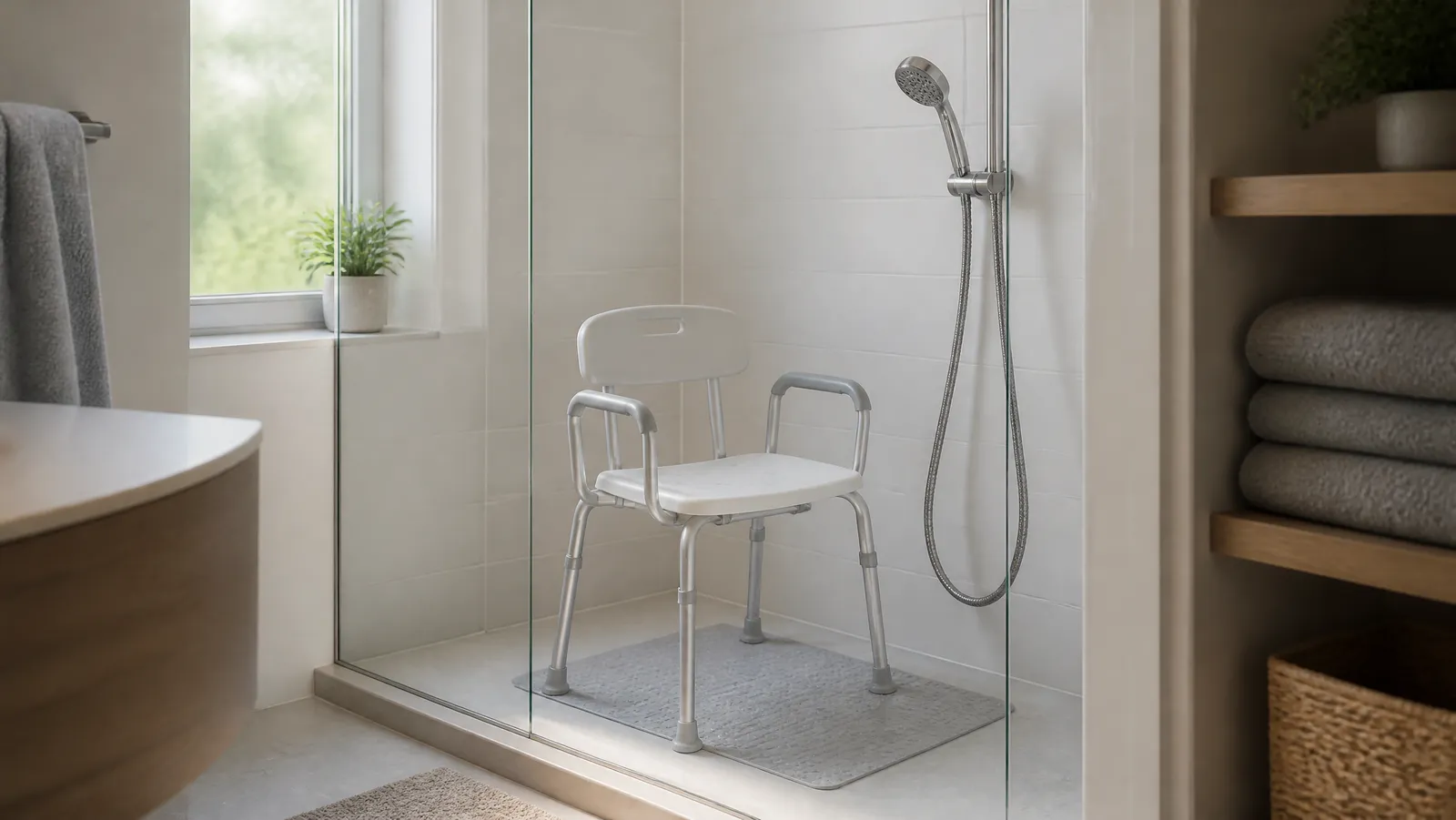
- A shower chair goes inside the stall or tub. Memorial Sloan Kettering's patient education describes them as being for people who "cannot stand for a long time" — right if the user can step in safely but cannot stay standing.
- A transfer bench straddles the tub wall. Per Memorial Sloan Kettering it is for people who have trouble lifting their legs over the tub: place it so "a little more than half of it is in the tub," two legs inside and two outside, so "you do not have to step over the side of the tub."
- A backless stool is for a rest, not for instability. Nothing to lean on, nothing to push up from.
Never use a shower chair to get over a tub wall. That is the bench's job.
Fit is where these purchases go wrong:
- Measure first. Memorial Sloan Kettering: "Not all shower chairs fit in smaller showers or tubs. Make sure to measure your bathtub or shower before buying a shower chair." Measure at the narrowest point.
- A transfer bench and a glass shower door do not mix — per Memorial Sloan Kettering you cannot use one with glass doors; the fix is a curtain.
- Match seat height to leg length — feet flat on the floor, knees level with or slightly below the hips. One-inch adjustment increments beat two-inch ones.
- Weight capacities are maker specifications, not independently verified ratings: Drive Medical states 350 lb for its chair, PELEGON 450 lb, Medline 400 lb for the bench. Leave margin.
- Rubber feet, drainage holes, and a suction check before every use. Memorial Sloan Kettering's instruction for suction legs: "make sure they stick to the shower floor before you use the chair."
If rising from a low seat is already hard elsewhere in the house, that is a strength question too: see mobility and aging.
Toilet Height Is the Whole Point
- A raised toilet seat clamps or bolts onto the bowl and adds roughly two to six inches depending on the model. Height is the active ingredient: the higher the seat, the less work the knees and hips do.
- A toilet safety frame stands on its own legs around the toilet and gives you arms to push from. It suits someone whose problem is the push rather than the distance.
- Toilet safety rails bolt to the seat hinge, adding arms but no height. Useful, but arms alone may not solve "I cannot get up."
MedlinePlus advises adding an elevated toilet seat to raise seat height, and separately that you need two grab bars, one of them to help you stand from a sitting position. The CDC's Check for Safety checklist is more specific on placement: grab bars next to and inside the tub, and next to the toilet. One shortens the movement; the other gives you something solid to pull on.
Elongated versus round is the measurement people skip, and the top reason raised seats get returned. Per Lowe's buying guide, measure from the center of the seat mounting bolt holes to the front rim: roughly 16.5 inches indicates a round bowl, roughly 18.5 inches an elongated one.
Measure the existing seat height too. Our own judgement, not a sourced rule: five inches onto an already tall comfort-height toilet can leave a shorter person's feet barely touching the floor, trading one problem for another.
Floor Traction Inside and Outside the Tub
Inside the tub or shower. The CDC's Check for Safety home fall prevention checklist asks whether the tub or shower floor is slippery and answers: "Put a non-slip rubber mat or self-stick strips on the floor of the tub or shower." MedlinePlus recommends non-slip suction mats or rubber silicone decals in the bottom of the tub. Adhesive treads may be the better choice on a textured or heavily grouted floor, where suction has nothing smooth to grip.
Outside the tub. MedlinePlus recommends a non-skid bath mat outside the tub for firm footing. A cotton mat that slides on tile is itself a hazard, at the moment you step out wet and off balance. The CDC checklist's guidance on loose floor coverings applies: remove the rug, or use double-sided tape or a non-slip backing.
Mats also need washing. Suction holds against a smooth, clean surface, and soap film between the cups and the enamel is how a mat that held fine for a month quietly lets go. A mat is traction, never a handhold.
Shower Fittings and Water Temperature
A seated shower only works if the water comes to you, which is what a handheld head on a long hose is for. Memorial Sloan Kettering notes a second benefit: it can lower fall risk, because you can get into a dry tub or shower and turn the water on once seated. It also notes insurance plans do not usually cover handheld shower heads.
Scald risk matters here, because a seated person cannot jump back from a hot burst. MedlinePlus advises setting the water heater to no more than 120°F (49°C) to prevent burns. The Consumer Product Safety Commission's tap water scald publication shows why: most adults will suffer third-degree burns from a two-second exposure to 150°F water, and burns also occur after about six seconds at 140°F. The CPSC also notes that the majority of tap water scald injuries and deaths involve the elderly and children under five. Shields and colleagues, writing in the Journal of Burn Care & Research in 2013, add that thinner skin burns more quickly, so older adults are at increased risk, and that older adults scalded by tap water have higher death rates, longer hospitalisations and more severe outcomes than younger adults.
Lighting and the Night Route to the Bathroom
Not every bathroom fall happens mid-shower. A familiar one is the trip to the toilet at 3 a.m., in the dark, in a hurry.
The CDC's Check for Safety checklist asks whether the path from your bed to the bathroom is dark and recommends a nightlight so you can see where you are walking, noting that some come on by themselves after dark. It also asks whether the light near the bed is hard to reach, and recommends placing a lamp close to it. In shopping terms: a reachable lamp at the bed, motion-sensor lights along the route, and a switch you can reach before stepping onto a hard wet floor.
Part of why this matters more with age is plumbing. A 2020 meta-analysis in the Journal of Urology by Pesonen and colleagues found nocturia associated with a pooled risk ratio of 1.20 for falls (95% CI 1.05 to 1.37, four studies), graded moderate-quality for the association — but rated the evidence for nocturia as a cause of falls and fractures very low quality. More night trips travel with more falls; the causal arrow is not established.
Frequent night trips are a conversation with a doctor rather than a hardware problem, and medication is part of it — diuretics being the common example, covered in medications that increase fall risk. Age-related changes in night vision and glare recovery play in too: see vision changes after 50. And because the bathroom is where a fall is most likely to leave someone alone on a hard floor behind a closed door, it is the strongest argument for a wearable alarm: see best medical alert systems with fall detection.
Our Picks
We did not install or sit in these. What follows is editorial judgement from manufacturer specifications and the evidence above.
Drive Medical Premium Shower Chair
For someone who can get into a shower or tub safely but cannot stand for a full wash. Drive Medical gives the Premium Shower Chair a contoured backrest, padded armrests, tool-free height adjustment in one-inch increments, rubber feet, drainage holes, and removable arms and back for a tight stall. Drawback: Drive Medical rates it to 350 lb, the lowest of the seating picks here.
PELEGON Shower Chair (450 lb)
The same job with more margin. PELEGON rates it to 450 lb, credits a crossbar design for the stability, and shapes the armrests to assist standing up, with height adjustable from 17 to 21 inches. Drawbacks: the 18-inch seat needs a stall to match, and it is the pricier of the two chairs.
Medline Tub Transfer Bench
The pick for the hardest movement in a tub bathroom: two legs sit outside on slip-resistant feet and two inside on suction-cup feet, so you sit down dry and slide across. Medline states a 400 lb capacity, push-button height adjustment from 17.6 to 21.9 inches, and a reversible backrest that fits either side. Drawback: it is big — Medline lists 28.7 inches overall width and 18.4 inches depth — so it needs real floor space and stays in the bathroom.
Medline 5" Raised Locking Toilet Seat
Five inches of height is the change most likely to make standing up possible without a second person, and it needs no assembly: a front clamping mechanism locks it onto the bowl, and the padded arms come off. Medline states a 400 lb capacity. The drawback is this category's main return reason: it fits elongated bowls, not round ones, and it has no lid.
Rubbermaid Safti-Grip Bath Mat
A plain suction-backed textured mat that Rubbermaid rates for commercial as well as residential bathrooms, about as close to a durability signal as this category gets. It is traction and nothing else. Drawbacks: at 28 by 16 inches it will not cover a long tub floor, and suction needs a smooth, clean surface, so it suits a textured tub poorly and lets go over soap film.
BESAQUO Handheld Shower Head
The fitting that turns a shower chair into an actual shower. BESAQUO specifies a 6 ft stainless hose for reach from a seated position, an adjustable brass ball-joint bracket, and a standard 1/2-inch universal thread, so it replaces an existing head by hand with no adapter. The drawback, worded precisely: per BESAQUO, the pause mode "reduces flow to a gentle trickle rather than a full water cutoff," so it is not an off switch.
Cost, Renting, and What We Would Skip
Expect to pay for most of this yourself. Consumer sources covering Medicare and bath equipment consistently describe shower chairs, transfer benches, grab bars and raised toilet seats as comfort or convenience items that Original Medicare generally does not cover. We will flag the sourcing honestly: we could not find an official CMS or medicare.gov page stating that exclusion item by item, and one consumer source suggested a grab bar or commode might be covered where a doctor deems it medically necessary. Check rather than assume.
A bedside commode is a different category: medicare.gov states Part B covers commode chairs as durable medical equipment when a provider orders one for use in your home from a Medicare-enrolled supplier, with 20% of the Medicare-approved amount payable by you after the Part B deductible. Some Medicare Advantage plans may pay for bath safety items through an over-the-counter allowance; allowances vary, so check your own summary of benefits. We cover the wider picture in what Medicare, FSA and HSA actually cover, and we do not claim FSA or HSA eligibility product by product.
Two calls worth making first: some Area Agencies on Aging and non-profit loan closets may lend used bath equipment free, and some dealers rent benches and commodes by the month, which suits a short recovery after surgery better than buying. As of November 2026, a chair, a bench, a raised seat, a mat and a handheld head came to under $200 together at the prices we saw.
What we would not buy at any price:
- Suction-mounted grab bars as anything but a balance cue. They are not fall arrest, however the listing is written.
- Towel racks used as handholds — MedlinePlus warns they cannot support your weight.
- Backless stools for someone unsteady, and fabric bath rugs with no rubber backing.
- A third product instead of an assessment. If two have not helped, get an occupational therapist into the room.
- Anything sold on a "non-slip" label alone. The voluntary slip-resistance standard for bathing facilities, ASTM F462, was withdrawn in 2016, and the CPSC states that its purpose now is to work with ASTM to re-establish F462 or develop a new voluntary standard. So a "non-slip" claim on a listing is not certified against a current standard, and this equipment is not FDA-regulated as a class either, so there is no approval to look for.
How Do I Tell Whether My Toilet Is Round or Elongated?
Measure from the center of the seat mounting bolt holes to the front rim of the bowl. Per Lowe's buying guide, about 16.5 inches indicates a round bowl and about 18.5 inches an elongated one. Compact elongated bowls measure close to round but still need an elongated seat, and dimensions vary by manufacturer, so measure rather than assume.
The Bottom Line
The bathroom concentrates risk because it combines water, hard surfaces and two movements that are hard when you are unsteady: getting over a tub wall, and getting up off a low seat. The CDC's 2008 data puts the highest injury rate at the tub or shower and the next highest at the toilet, with the toilet's share rising with age. That is the order we would spend in. And Cochrane's 2023 review found a 38% reduction in fall rate only where home hazard work targeted people at higher risk, so be honest about which group you are in and treat this as a companion to balance and functional exercise, not a substitute.
Do the free things this afternoon: check the water heater setting, put a nightlight on the route from the bed, wash the mat. Then work down the list. Better Life Span's fall prevention guide covers the rest of the house, and a home safety checklist for aging in place and a piece on non-slip shoes for seniors are coming shortly. If anyone has already fallen, start with a doctor and an occupational therapist, not a shopping cart.

Drive Medical Premium Shower Chair with Back and Padded Arms, White | Shower Chair with Back and Padded Arms, Adjustable Height Seating for Safety and Comfort, Supports 350 Pounds
A seated shower chair with a contoured backrest and padded armrests, tool-free height adjustment in 1-inch increments, and removable arms and backrest. The frame is aluminium and weighs 10 lb, with rubber feet for grip and drainage holes to limit water pooling. Drive Medical states it supports 350 pounds.

PELEGON Shower Chair for Elderly and Disabled (450lb) with Padded Armrests and Back, Adjustable Height Shower Seat, Heavy Duty Shower Chairs for Inside Shower, Handicap - Blue
A padded-back shower chair with ergonomic armrests shaped to help with sitting down and standing up, height adjustable from 17 to 21 inches on an 18-inch-wide seat. PELEGON states a crossbar design for added stability, non-slip feet, tool-free assembly, and a capacity of up to 450 lb.

Medline Transfer Bench for Bathtubs and Showers, 400 lb Capacity, Gray | Adjustable Height, Heavy-Duty Shower Bench for Safe Transfers, Comfortable Backrest, Slip-Resistant Feet, Tool-Free Assembly
A bench that straddles a tub wall so the user sits down outside the tub and slides in. Medline states a rust-resistant aluminium frame, 400 lb capacity, push-button seat height adjustment from 17.6 to 21.9 inches, a reversible backrest that fits either side, slip-resistant feet outside the tub and wide suction-cup feet inside it. Overall width is 28.7 inches and overall depth 18.4 inches.

Medline 5" Elongated Raised Locking Toilet Seat, 400 lb Capacity | Toilet Riser with Removable Padded Arms, Fits Most Elongated Toilets, No Lid, Medical Seat For Adults and Elderly
A riser that adds 5 inches of toilet seat height with no assembly required, held on by a front clamping mechanism with a quick-release clamp, plus removable padded armrests. Medline states a 400 lb capacity and dimensions of 15.5 inches wide, 5 inches tall and 16.7 inches long, and lists it as fitting most elongated bowls.

Rubbermaid Commercial Products Safti-Grip Bath Mat, Large, White | 28 x 16 Inch, Suction-Backed, Non-Slip, Textured Surface, for Commercial/Residential Use for Shower Stall/Bathtub/Bathroom
A suction-backed bath mat measuring 28 by 16 inches with a textured surface that Rubbermaid says reduces slipping. It is rated by the maker for commercial as well as residential bathrooms.

BESAQUO 9 Functions High Pressure Handheld Shower Head with Power Wash | Pause Mode for Water Saving, Power Wash for Tub&Tile, Easy Clean Nozzles, 6ft Hose,Bracket/ Premium Chrome
A handheld shower head on a 6 ft stainless steel hose that BESAQUO says gives extra reach for showering from a seated position. It fits a standard 1/2-inch universal thread with no adapter needed, mounts on an adjustable-angle bracket with a brass ball joint, and offers 9 spray settings including a pause mode.
Keep reading
Balance Exercises for Seniors: A Progressive Fall-Prevention Program
Balance exercises for seniors, level by level: the Cochrane numbers, the dose trials actually used, and the safety setup before exercise one.
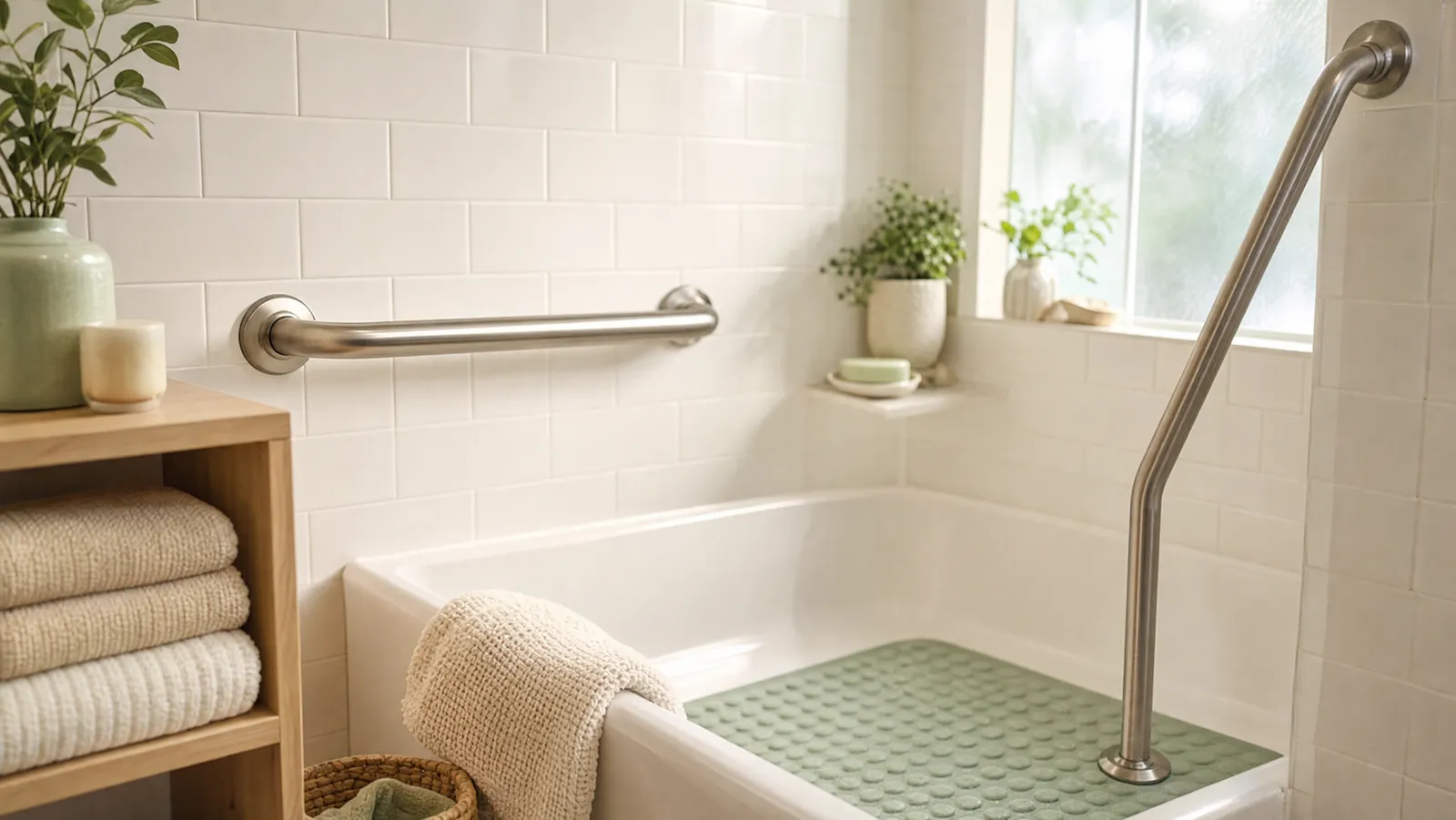
The Best Grab Bars for Seniors in 2026: Picks for Bath and Bedside
The best grab bars for seniors in 2026: six picks for tub, shower, toilet and bedside, plus load ratings, mounting heights and the suction-cup caveat.
Fall Prevention for Seniors: The Complete Guide for Adults Over 50
A practical fall prevention guide for seniors: how to test your own risk, the exercise that works, the medication trap, and a room-by-room home audit.